Get Full Government Meeting Transcripts, Videos, & Alerts Forever!
Get email alerts on the Homelessness topic
No spam. Unsubscribe anytime.
Fall River council adopts resolution to probe shelter operations after recent death; public urges winter capacity, tiny-house options
Summary
Councilors voted Tuesday to have the finance committee meet with the administration to examine shelter operations and funding after a recent death of an unhoused resident prompted public outcry.
Councilors voted Tuesday to have the finance committee meet with the administration to examine shelter operations and funding after a recent death of an unhoused resident prompted weeks of public outcry.
The resolution calls for discussion of “ongoing issues related to the First Step In providing safe shelter services in the winter,” including funding, admission barriers and bed counts. The full council adopted the measure after public comment and several rounds of debate.
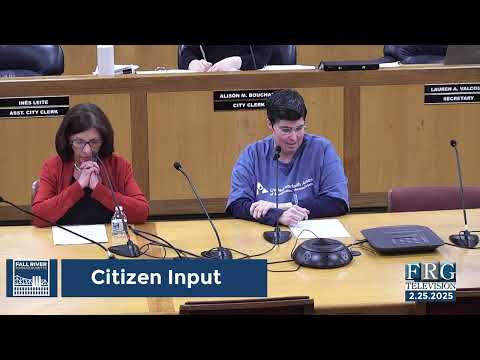
The move follows more than two hours of testimony during the meeting’s citizen input period from veterans, volunteers and service providers describing gaps in shelter capacity and barriers that keep people from entering shelters. “The HERO Act will help many veterans, but we also need more shelter beds,” said Vietnam veteran Thomas Cabral, who addressed the council during public comment. “This resolution to implement tax relief is not just policy. It’s about honoring those who served,” Cabral added while urging support for veterans and related services.
Multiple speakers urged the city to increase year-round shelter capacity. Janice Heppe, a board member with UIA, said the group supports a minimum of 50 year-round shelter beds and lowering access barriers such as removal of a local ID requirement. “Housing insecurity is the number-one issue in our cities,” Heppe said. Community organizer Tracy Albornas told the council that shelter access and moving people into affordable housing are both necessary to reduce street homelessness.
Several commenters described local interim responses. Richard Branko, who said he has lived outside, thanked volunteers and cited an extensive outreach effort that helped limit deaths over the winter; he also criticized perceived wasteful spending and urged the city to prioritize shelter dollars. Volunteer and outreach leaders described a “FAST team” (a multiagency outreach team) and ongoing collaborations with churches and nonprofits that run warming sites and meals.
Council members acknowledged the breadth of services the city and nonprofit partners provide while also stressing the need for a clearer account of contract obligations and shelter performance. One councilor advised the administration to report the city’s contractual obligations with Stepping Stone, including any funding commitments, and noted that the city spends roughly $3.9 million annually on homelessness work through grants and the Community Development Agency.
Counsel and staff who briefed the committee said the city maintains multiple shelter options and emergency motel placements, and noted that the Tamayo Center and other community sites have been used as warming centers. Several councilors argued the city should also explore alternatives such as tiny homes, motel-based programs and more targeted wraparound services — ideas raised repeatedly by public commenters.
The resolution directs the finance committee to meet with the city administrator, corporation counsel, director of financial services, the chair of the board of assessors and the veterans’ service officer to examine the operational, contractual and funding issues affecting First Step In/Stepping Stone.
Supporters said the meeting should be used to collect service agreements, clarify admission standards (for example whether pregnancy or sobriety rules apply), and explore whether the city can expand the use of municipal facilities as temporary warming centers when shelters are at capacity. The council also discussed possible outside audits if contract or finance irregularities are identified during the follow-up.
The resolution passed on a voice vote in full council; no roll-call breakdown of the final adoption was entered in the minutes.
What’s next: the finance committee will schedule a convening with the listed administration officials; the resolution asks for documentation of service agreements, current bed counts, admission criteria and a description of warming/cooling center activation during extreme weather.