Get Full Government Meeting Transcripts, Videos, & Alerts Forever!
Get email alerts on the Annexation Impact Fees topic
No spam. Unsubscribe anytime.
Committee pauses debate on annexation, impact-fee changes in House Bill 3165
Summary
The Medical, Military, Public and Municipal Affairs subcommittee adjourned debate on House Bill 3165 after hearing multiple witnesses and questions from members.
The Medical, Military, Public and Municipal Affairs subcommittee adjourned debate on House Bill 3165 after hearing more than a dozen witnesses and members’ questions, then approved a motion to postpone further consideration.
House Bill 3165, as summarized for the committee, would extend the required impact-fee refund period from three years to seven years for fees that have not been expended; require a county to report monthly to a bordering municipality about residential development within a one-mile radius; require a municipality increasing its territory to notify the county where the property to be annexed is located before the first reading; permit certain notices to be published on a government entity’s website; and make corrections to statutory definitions and drafting errors, according to committee staff.
Why it matters: supporters said the bill aims to improve communication between counties and municipalities and make impact fees more usable for counties handling rapid growth. Opponents said parts of the bill would create new burdens, weaken existing checks on local government decision-making, or conflict with public-notice requirements.
Bill author Representative Wooten described the proposal as a transparency measure, saying it is intended to "help restore at least some trust and transparency back to our constituents and the people in our community" by ensuring counties and municipalities notify one another about near-border development and annexation plans.
Local municipal officials and associations urged changes or removal of portions of the bill. Shannon Laverin, the city manager for the City of Greenville, told the committee the city supported removing sections 1 and 2 of the bill and asked the subcommittee to revisit Section 5 because it would shift responsibility for capital improvement plans: "...we would appreciate the opportunity to revisit section 5," Laverin said, arguing capital improvement plans are budgetary matters that should remain under elected officials’ control.
Representatives of municipal and county associations gave differing reactions. Erica Wright of the Municipal Association of South Carolina stressed that annexations are public processes under existing state law and said municipalities already notify several state agencies; she said adding the county governing body to the statutory notice list would provide more transparency. Leslie Simpson of the South Carolina Association of Counties said the proposal is "a start" but will not solve longstanding annexation conflicts such as municipal "donut holes," and cautioned that reporting requirements could be burdensome for small counties with limited staff.
Developers and builder groups urged the committee to preserve technical study requirements and cautioned about extending the refund timeline without safeguards. Alex James of the Home Builders Association of South Carolina said the association supported restoring study requirements and warned that extending the refund window could cause residents to perceive that new development is not paying its fair share if improvements are delayed.
Members of grassroots and county groups argued for stronger annexation reform and supported the longer refund period. Therese Alisore of Developed Lexington County Responsibly said, "Expanding the time to 7 years is a good common sense step that we need," and urged clearer definitions of contiguity to prevent what she described as line-of-sight annexations.
Representative Jones offered an amendment—discussed but not adopted at the time of adjournment—asking that a municipality seeking to annex county land commission an affordability-impact study to assess zoning changes, displacement risks and protections required before annexation. Jones said the proposal was intended to disclose how city zoning could affect costs for current residents; other legislators asked who would conduct and pay for such a study.
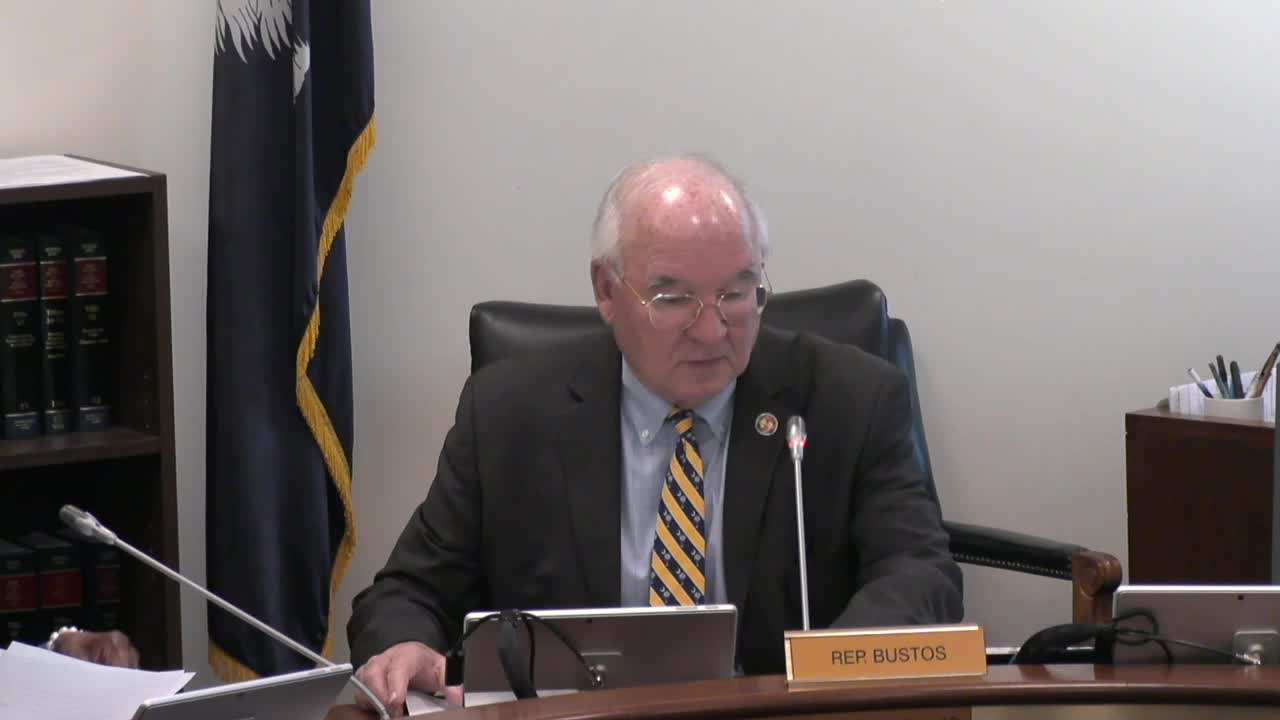
The subcommittee approved a motion to adjourn debate on House Bill 3165. Subcommittee Chairman Joe Bustos made the motion; a second was recorded but the transcript does not name the seconder. The roll call recorded: Bustos (yes), Representative Edgerton (yes), Representative Jones (yes), Representative Magnuson (aye), Representative Sanders (yes) and Representative Davis (aye). The motion passed and the item was deferred for further discussion.
The committee heard a mix of technical, fiscal and procedural concerns: city officials urged protections for existing public-notice procedures and elected oversight of capital budgeting; counties warned about staffing burdens for expanded reporting; builder representatives described the cumulative costs of infrastructure and tap fees; and community advocates sought stronger annexation safeguards.
Members signaled they will continue work on annexation and impact-fee language and possible technical amendments. The committee did not take final action on the substantive provisions of House Bill 3165 and left multiple points—timing triggers for the seven-year period, who conducts affordability studies, and precise notice mechanics—unresolved.
Ending: The subcommittee said it will revisit the bill at a later date; no further timeline was set in the hearing record.