Get Full Government Meeting Transcripts, Videos, & Alerts Forever!
Get email alerts on the National Guard Emergency Management topic
No spam. Unsubscribe anytime.
Military Department outlines armory revitalization, PPE stockpile plan and storm-recovery needs
Summary
Major General Van McCarty and state emergency management director Kim Stinson briefed the subcommittee on National Guard deployments, armory revitalization funding, PPE stockpile transition and state cost-share requirements for recent disasters, and requested recurring and one-time funding for several priorities.
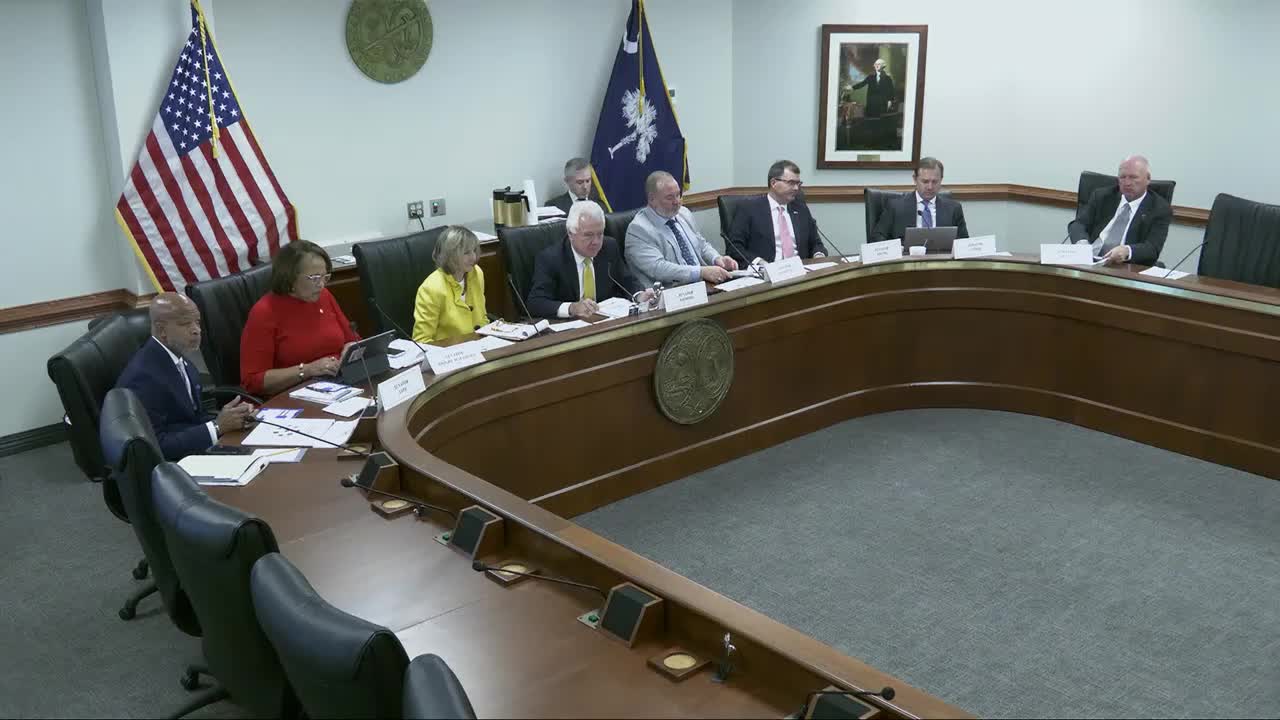
Major General Van McCarty, representing the South Carolina Military Department, told the Senate Finance Committee constitutional subcommittee that the state's military department and National Guard currently have about 430 soldiers and airmen deployed—roughly 40 of them overseas—and outlined budget priorities that include armory revitalization, personnel support for the state guard, and several emergency management projects.
Why it matters: The military department’s budget supports the guard’s readiness to respond to overseas deployments and state emergencies, maintains armories and training facilities, and funds emergency-preparedness stockpiles. Funding decisions affect response capacity for hurricanes, winter storms and other disasters and carry statewide fiscal implications for disaster cost shares.
Top requests and context: Major General Van McCarty identified a set of budget items aligned with the governor’s request:
• Armory revitalization: $2.8 million in recurring state dollars to supplement $3.2 million currently recurring; state funds are matched with federal dollars to complete two design/engineering projects and two construction projects per year.
• State Guard partnerships and personnel: $56,000 recurring to support SC LEAP (South Carolina Law Enforcement Assistance Program) participation (the guard pays costs though the FTE belongs to SLED); $50,000 recurring for Microsoft 365 licenses for the State Guard; $56,000 recurring for salary increases at the South Carolina Military Museum; and a $185,000 non‑recurring request to buy 4.8 acres adjacent to the Graniteville armory from the South Carolina Forestry Commission for localized training and buffer space.
• PPE stockpile and warehouse transition (presented by Kim Stinson, director of the state emergency management division): a two‑year extension of the current commercially managed PPE storage/maintenance contract (estimated $4.2 million) while the department retrofits its Winnsboro warehouse; funding to purchase replacement PPE (the department estimated a target 60‑day stockpile in five categories for about $1.7 million); and $2.7 million to renovate 20,000 square feet of the Winnsboro warehouse to support climate‑controlled storage.
• Storm-Act federal match: funding to provide the state’s 10 percent share ($1.1 million) that unlocks an additional $9 million in federal Storm Act funds for two projects (a structural retrofit of a Charleston fire station and a Garden City streetscape project in Horry County).
Disaster cost-share exposure: Kim Stinson summarized an estimated state non‑federal share for 2024 legacy and recent disasters at roughly $222 million, including a $2.9 million legacy deficit and the state share for 2024 events. Those estimates, Stinson said, will change as damage assessments are finalized.
Operational notes and concerns: The military department said it has used emergency deployments for hurricanes, winter storms and the National Capital Region (inauguration support). The department acknowledged an unspent lapse of about $566,000 from prior appropriations tied to administrative delays in hiring new members of the state guard; leadership said they have a corrective plan and realigned some funds.
Committee questions touched on PPE lifecycle (industry standard ~5 years for masks), the location of leased versus owned PPE storage (Prosperity leased facility vs. Winnsboro owned facility) and options to phase PPE purchases. Members also asked about armory maintenance in rural counties, IT/connectivity challenges at armories, and continuity of youth programs (the job challenge program will close and be absorbed regionally, officials said).
Ending: Officials asked the subcommittee to support the identified recurring and non‑recurring items and the enabling provisos needed to execute them; no appropriation votes were taken at the hearing.