Get Full Government Meeting Transcripts, Videos, & Alerts Forever!
Get email alerts on the Conservation topic
No spam. Unsubscribe anytime.
Conservation Bank asks Legislature for $5.5M recurring, $23M one‑time to protect farms, parks and working lands
Summary
Chairman Mike McShane and Director Riley West told the Senate Finance Committee the Conservation Bank issued 64 grants in 2024 protecting more than 30,000 acres and is requesting $5.5 million recurring plus $20 million one‑time and an additional $3 million one‑time for working agricultural lands.
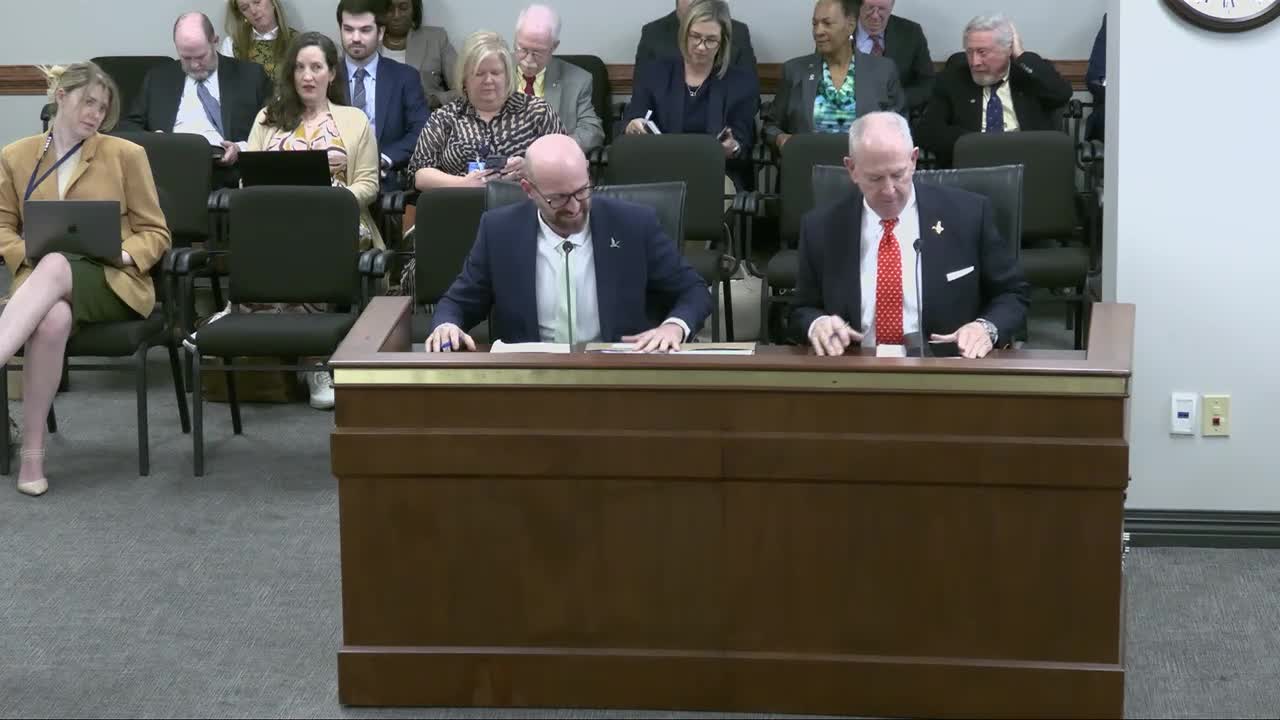
Mike McShane, chairman of the South Carolina Conservation Bank board, and Riley West, the bank’s director, told the Senate Finance Committee the bank needs increased recurring and one‑time funding to continue protecting land statewide as population growth increases development pressure.
McShane asked for $5.5 million in recurring funding, a $20 million nonrecurring allocation and an additional $3 million nonrecurring appropriation targeted to the bank’s working agricultural lands program; together the nonrecurring requests total $23 million.
Why it matters: West said the bank issued 64 grants in 2024 that protected more than 30,000 acres and put the agency’s historical total above 400,000 acres — roughly 2% of South Carolina’s land mass — arguing the funding helps preserve farmland, wildlife corridors and public access near population centers.
Key details
- 2024 activity: Director Riley West said the bank issued 64 grants in 2024 protecting over 30,000 acres and that the program has protected over 400,000 acres in its history.
- Project highlights: McShane and West cited specific recent projects: Gregory Neck (about 44,409 acres near I‑95 between Beaufort and Savannah and more than a dozen miles of coastal tidal rivers), Witherspoon Island (about 3,708 acres and three miles of the Great Pee Dee River near Florence), Saluda Bluffs (about 1,000 acres and two miles of the South Saluda River near scenic Highway 11) and a 2,248‑acre Santee Corridor expansion added to Weti Wildlife Management Area.
- Costs and leverage: McShane said fee‑simple acquisitions averaged roughly $3,400 per acre; private‑lands easements averaged about $300 per acre. He said the bank has used about $146 million in taxpayer funds to leverage nearly $650 million in real‑estate value.
- Working lands: The bank’s working agricultural lands program has already committed most of its initial funds to five farms across the state; the board asked for $3 million additional nonrecurring to expand that program.
- Provisos and authorities requested: The bank asked to renew a $4 million annual grant to the Department of Natural Resources (DNR) — including a $3 million state match to draw federal Pittman‑Robertson or similar excise tax funds — and to retain a $1 million wetlands management allocation (formerly tied to the North American Wetlands Conservation Act match). The bank also requested carry‑forward authority for operating dollars and $25 million in budget authority for reimbursements tied to large federal grants.
Quotes and approach
"We work with willing voluntary landowners to negotiate using compensation to result in conservation without regulation," Mike McShane said, describing the bank's emphasis on easements and voluntary transactions.
Riley West framed the request against population growth: "South Carolina welcomed 90,000 people to our state last year," he said, and added that population growth increases pressures on rural and historic landscapes the bank aims to conserve.
Committee response
Senators praised the bank's leverage and asked whether additional working‑lands funding could be absorbed; McShane said the bank could leverage additional state dollars and that timing is important because rising land values increase program costs.
Ending
The Conservation Bank concluded by formally submitting its recurring and nonrecurring funding requests and a set of provisos for committee consideration, including renewal of the DNR grant, wetlands management funding, carry‑forward authority and reimbursement budget authority.