Get Full Government Meeting Transcripts, Videos, & Alerts Forever!
Get email alerts on the Broadband Energy Regulation topic
No spam. Unsubscribe anytime.
Office of Regulatory Staff warns federal funding uncertainty could affect broadband and energy programs
Summary
Acting director Andrew Bateman told the Senate Finance subcommittee ORS does not seek increased budget authority but highlighted broadband progress funded by ARPA and BEAD/BEED allocations, the Energy Office's rebate funding and potential impact from a Jan. 20 executive order and related litigation.
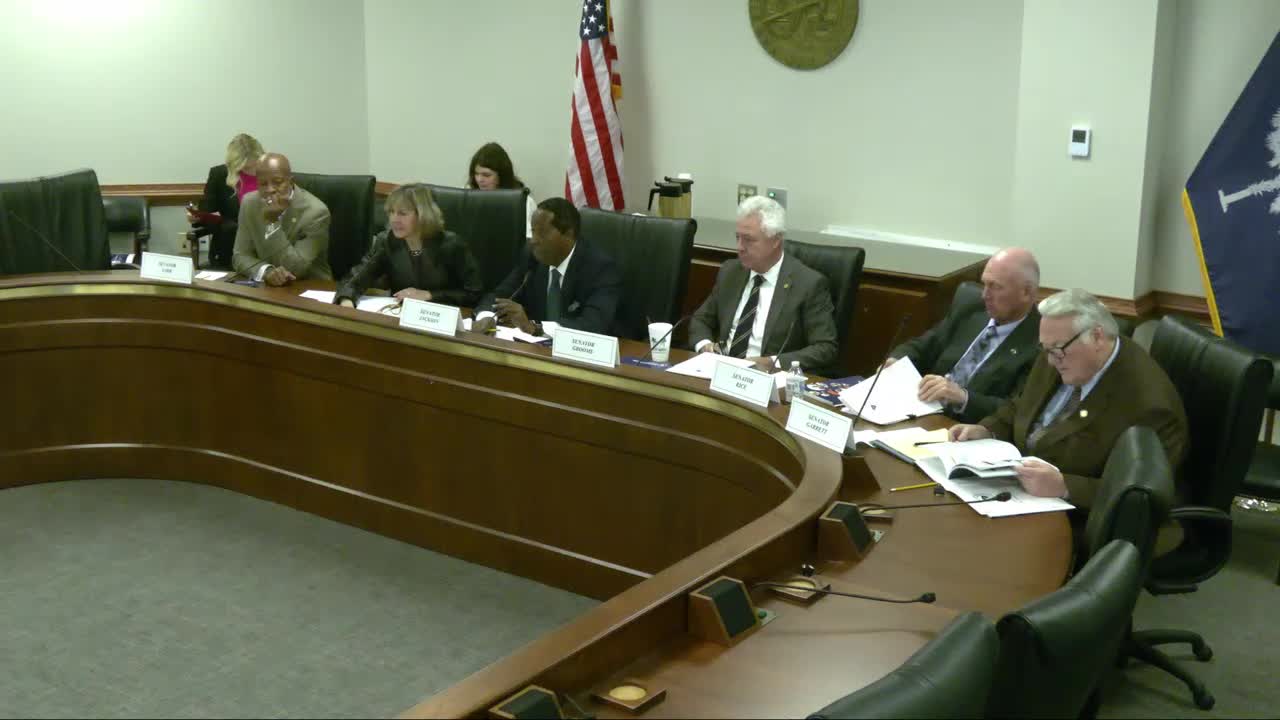
Acting Executive Director Andrew Bateman told the Transportation and Regulatory Subcommittee the Office of Regulatory Staff is not seeking additional budget authority or FTEs for fiscal year 2026 but outlined major broadband and energy programs the agency administers and federal funding risks.
Bateman said ORS oversees both regulatory work that produced about $14 million in customer savings this fiscal year through matters before the Public Service Commission and a set of nonregulatory programs transferred into ORS in recent years, including the State Energy Office, the Broadband Office and the Digital Opportunity Department.
On broadband, Bateman said American Rescue Plan Act (ARPA) matching grants previously allocated to internet service providers amounted to about $400 million and that federal BEAD (Broadband Equity, Access and Deployment) funds allocated to the state total about $546 million. He said combined work already reduced the state's unserved or underserved broadband serviceable location (BSL) count to roughly 112,000 newly served locations and projected a remaining 30,000–32,000 BSLs once currently funded projects are completed.
"There will be 30 to 32,000 broadband serviceable locations which are still potentially unserved or underserved once these ARPA funds are done," Bateman said, adding that BEAD deployment funding is intended to bring that number toward zero and that nondeployment BEAD dollars can be used for workforce development and cybersecurity.
Bateman also described other federal funding the Energy Office is administering, including an approximately $137 million homes rebate program and Department of Energy and Infrastructure investments tied to IIJA/IRA funding streams. He said a January 20 executive order and subsequent court actions had created uncertainty about some federal awards and that portions of nearly $700 million in programs (ARPA/BEAD/capacity grants and energy rebates) could be at risk depending on the outcome of federal processes.
Bateman said some program dollars have not yet been obligated to ISPs and that the state's BEAD plan would not be submitted until September 2025 under the timeline he described. He also described ORS-managed programs that are already operating: an equipment distribution program that approved nearly 500 applications and installed equipment for about 80 clients and emergency support functions that aided restoration after Hurricane Ian (referred to by Bateman as Hurricane Helene in testimony).
Bateman listed regulatory and policy developments ORS is tracking, including EPA and FERC rulemakings that could shift generation mix and transmission planning requirements. He emphasized ORS's goal to preserve customer protections while administering federal broadband and energy programs in a changing legal environment.
ORS told the committee there is no current request for new provisos beyond those in effect and that the agency plans a move of its offices that will use some carryforward funds for moving expenses. Committee members asked staff about the scale of federal funding at stake and confirmed the state is not financially obligated for BEAD funds that have been allocated but not yet awarded to ISPs.
ORS asked that existing provisos remain in place and offered more detailed program materials to the committee for review.