Get Full Government Meeting Transcripts, Videos, & Alerts Forever!
Get email alerts on the Government Efficiency Commission topic
No spam. Unsubscribe anytime.
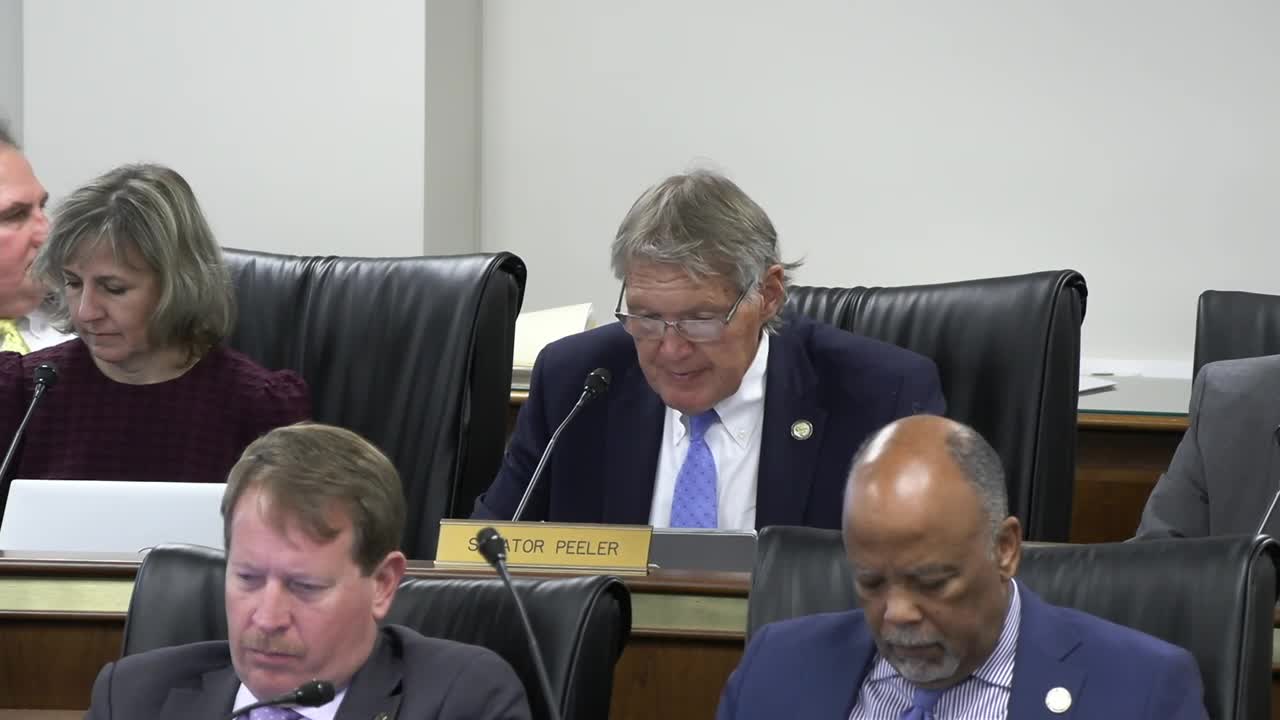
Senate panel adopts amendment and advances joint resolution to create Government Efficiency Commission
Summary
The Senate Finance Committee advanced a joint resolution to create a Delivery of Government Efficiency Commission and adopted a subcommittee amendment clarifying membership restrictions, conflict-of-interest rules and reporting pathways to budget and oversight committees.
The Senate Finance Committee voted to report favorably on a joint resolution to create a Delivery of Government Efficiency Commission (DGE Commission), adopting a subcommittee amendment that narrows commission rules and clarifies reporting authority.
The amendment, presented by staff and described by the subcommittee chair, renamed the commission to the Delivery of Government Efficiency Commission and clarified several points: appointees may not be current members of the General Assembly or have a conflict of interest; conflict of interest is defined in the amendment as a reasonable foreseeability that an appointee could derive a direct financial benefit or loss from the commission's work; membership shall not constitute dual office holding. The amendment also enumerated how the commission's findings may be used: the chairs of Senate Finance and House Ways and Means may request presentations to budget subcommittees, and the commission may report findings to standing legislative oversight committees for additional investigation.
Several senators questioned the commission's authority to access agency information and whether it would have subpoena power or other investigatory authority. The sponsor and staff said the commission would be an advisory body that could review appropriations, codes and regulations and identify redundancies; it would not exercise sovereign authority, could not fire employees or directly change agency staffing, and would make recommendations to existing legislative committees. Staff stated the commission would review information that "all of us have access to" and would not be granted access to confidential personal data beyond what legislators already can obtain.
Senators also debated whether the commission should have statutory direction to require agencies to produce documents and whether the commission appointments should have geographic or other representation rules. The subcommittee adopted the amendment and moved the favorable report; the transcript records the vote with several senators recorded as voting "no" (identified in the transcript as Senator Williamsburg, Senator Colloton, and Senator from Greenville), while the motion carried.
The amendment as adopted includes a sunset date for the commission in October 2026; senators said the short term would allow experience to guide whether further investigatory authority or structural changes are appropriate. Several senators urged enhancing existing oversight mechanisms (Legislative Audit Council, inspector general, and legislative oversight committees) instead of creating a new body; others said a short-term commission could produce useful recommendations at low cost.