Get Full Government Meeting Transcripts, Videos, & Alerts Forever!
Get email alerts on the Housing Affordability topic
No spam. Unsubscribe anytime.
SC Housing outlines homeownership, rental and tax-credit activity; requests budget increases
Summary
The South Carolina State Housing Authority presented its 2024 activity and budget drivers, citing $394 million in single‑family loans purchased in 2024, expansion of down‑payment assistance and requests tied to rental subsidy increases and low‑income housing tax credit administration.
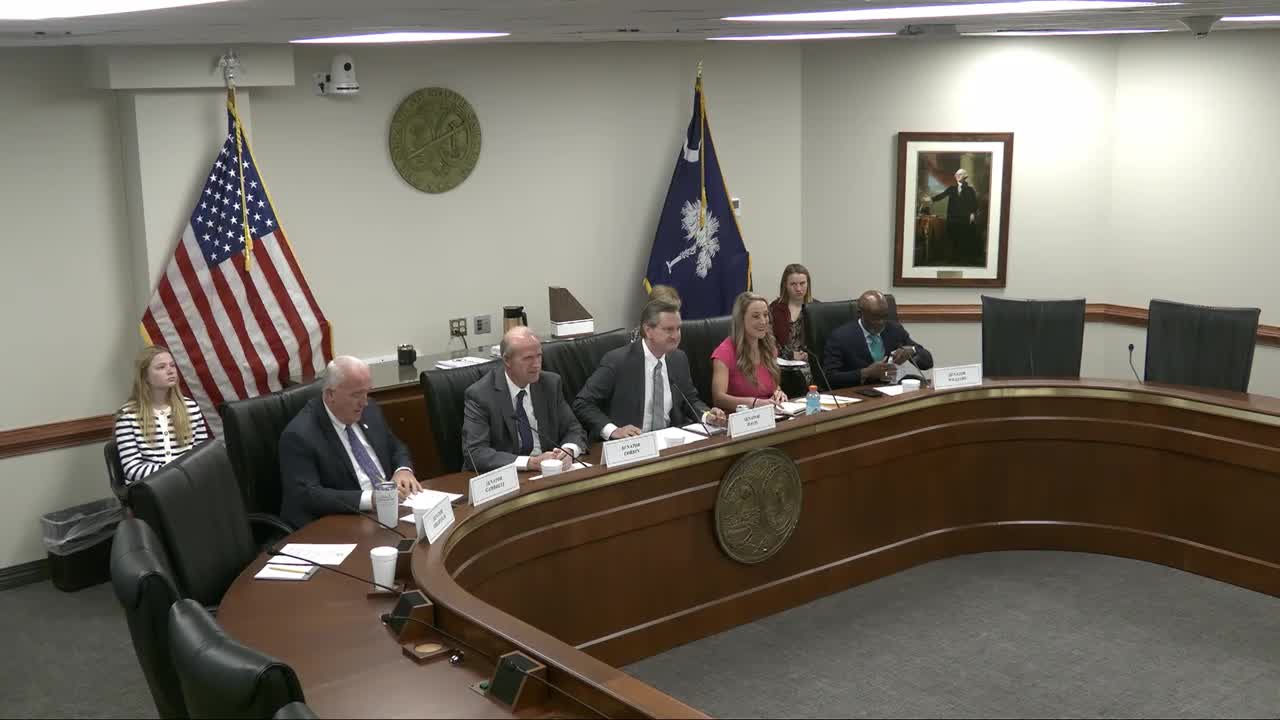
Richard Hutto, executive director of the South Carolina State Housing Authority, told the Economic Development Subcommittee on Oct. 12 that the agency purchased $394,000,000 in single‑family loans in 2024 and issued more than $300,000,000 in tax‑exempt bonds to support its flagship homeownership program.
Hutto said the authority’s loan rates are about 50 basis points below market and that recent transactions produced an “overspread” the agency can use to be more aggressive on rates and down‑payment assistance. “We actually purchased $394,000,000 in single family loans in 2024,” Hutto said.
The agency described four major program areas: the homeownership program (tax‑exempt bond supported and conventional products), rental assistance (project‑based and tenant‑based Section 8), low‑income housing tax credit allocations, and the state housing trust fund. Agency staff said they expect to expand a HERO program targeting first responders, teachers and veterans and to offer more down‑payment assistance in fiscal 2025.
Nut graf: The authority’s presentation explained why the agency is seeking budgetary flexibility: federal fair‑market rent increases are driving much of the proposed subsidy pass‑through, while administration of tax credits and trust‑fund block grants affects staffing and operating costs.
The authority said rental assistance is the largest single subsidy driver in its FY25 request: the agency runs project‑based and tenant‑based Section 8 programs supporting 266 properties statewide and roughly 2,500 tenant‑based homes in seven counties, with more than $200,000,000 in subsidy flow. Hutto told the committee the authority’s FY25 budget request includes an $18,800,000 increase, of which $16.8 million is for increased subsidy pass‑through tied to higher fair‑market rents.
On tax credits, the agency reported it allocated $26,000,000 in state 9% tax credits to 14 properties (949 units) and $8,000,000 in state credit in the 4% tax‑exempt bond program to seven projects (766 units); it also used $125,000,000 in bond ceiling for these deals.
Hutto said the agency has made “significant changes” to the state housing trust fund, including streamlining the application process, block‑granting $11,300,000 to the Office of Resilience for households affected by extreme weather and a $9,200,000 block grant to local government for disaster relief.
During questioning, Senator Corbin asked what share of the single‑family bond purchases served rural areas; Hutto said it would be “less than 30%” and offered to provide the committee with detailed figures. Hutto described tiered county incentives intended to relax first‑time‑buyer restrictions in less populated counties to encourage lending outside major metros.
Hutto also reviewed internal reforms adopted since his June 2023 appointment: tighter reporting controls, real‑time project profit‑and‑loss analysis, and quantitative risk analysis. He noted the authority does not receive a general state appropriation and operates with a business model that requires financial self‑management.
Ending: Committee members thanked Hutto and indicated follow‑up requests for rural breakdowns and additional details on program incentives.