Get Full Government Meeting Transcripts, Videos, & Alerts Forever!
Get email alerts on the Transportation Adaptive Signals topic
No spam. Unsubscribe anytime.
Mill Valley council approves study and pilot for adaptive traffic signals
Summary
City council approved a professional services agreement to study and pilot adaptive signal timing along key corridors after staff said the system would provide real‑time monitoring and operational control; staff flagged Caltrans coordination and uncertain near‑term travel‑time gains.
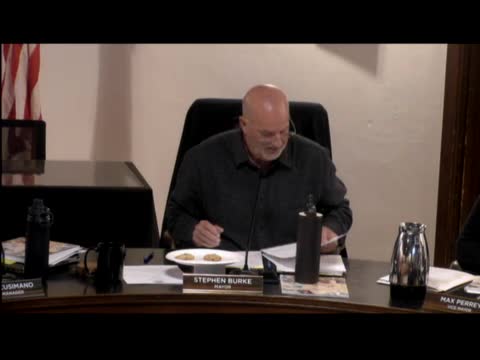
The Mill Valley City Council approved a resolution to authorize the city manager to execute a professional services agreement for the design and implementation phases of an adaptive signal timing project, a move staff said will add real‑time monitoring and remote control to several signalized intersections.
City Manager Todd Cusimano told the council the agreement covers software and maintenance services and that the consultant’s scope includes a feasibility assessment, a refined scope of work and metrics for anticipated operating improvements. Cusimano said the company selected is the same firm that produced the city’s traffic report card and that the work is intended to give staff real‑time visibility when signals fail or when unusual traffic patterns appear.
The project cost figures discussed in the meeting vary in the staff presentation and in staff remarks. The staff report listed an estimated amount that was read aloud as “hundred $93,000.” Cusimano later described the initiative as “a $218,000 project” for year‑one software and services and said an additional $40,000 was included in the fiscal impact for upgrading signal components. He also described an ongoing maintenance/license cost in the $12,000‑per‑year range (noting a $500 license fee plus approximately $11,500 for monitoring) and said year‑one costs would be covered; staff planned to return to council to reassess continuing monitoring fees.
Cusimano and Deputy Director Berrio emphasized operational benefits beyond travel‑time reductions: remote alerts when signals are down (for example after power outages), centralized monitoring, and staff training so city employees could operate the system from laptops. Councilmembers and staff also discussed the project’s limits: adaptive timing cannot overcome upstream bottlenecks controlled by Caltrans, such as the interchange at Kipling and Tower, and measurable travel‑time improvements could be modest unless regional infrastructure is also upgraded.
Councilmembers asked staff to report back after the feasibility assessment (task 3 in the scope of work) with data and recommendations; Cusimano said the scope includes a pivot option if initial findings show different alternatives are preferable. The council placed the item on the consent calendar and the council approved the consent calendar, which included this resolution.
Votes at a glance: the consent calendar motion carried and the item authorizing the professional services agreement was approved as part of that motion. The motion was moved and seconded on the record and the mayor called the vote; the council approved the consent calendar (recorded on the transcript as “All in favor”).
Experts and staff cautioned the council that performance metrics will be necessary to judge success and warned of a possible “induced demand” effect: if travel times improve, drivers may change behavior and volume could rise. Councilmember Jones asked for an assurance the maintenance/monitoring costs would be reviewed at a check‑in; staff committed to returning with a recommendation after the first year. Cusimano also said staff has begun preliminary conversations with Caltrans about potential coordination and, if feasible, limited access to Caltrans‑controlled signals as part of later phases.
Ending: staff will proceed under the approved authorization, complete the feasibility assessment and report back to council with refined scope, estimated performance metrics and recommendations on monitoring arrangements and costs.