
City engineer outlines multimodal transportation plan; Trillium Boulevard highlighted for redesign options
Get AI-powered insights, summaries, and transcripts
Sign Up Free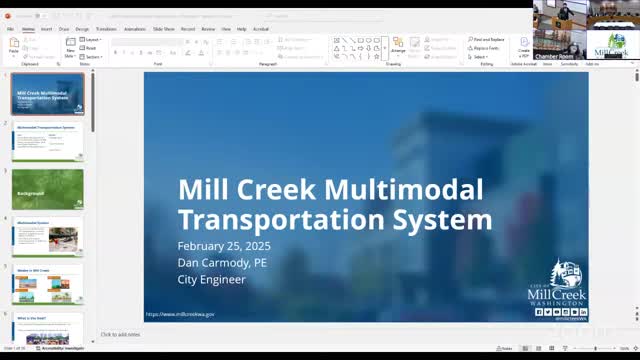
Summary
City Engineer Dan Carmody presented the citywide multimodal transportation plan, identifying pedestrian network progress, gaps in the bike network, upcoming Safe Streets for All safety analysis, and several retrofit options for Trillium Boulevard.
City Engineer Dan Carmody presented a study session on the citywide multimodal transportation system plan on Feb. 25, describing the city’s current pedestrian and bicycle network, transit connections and proposed retrofit options for busy corridors such as Trillium Boulevard.
Carmody defined multimodal as accommodating multiple modes — pedestrians, bikes, transit and vehicles — and said Mill Creek’s pedestrian network is largely present (most streets have sidewalks on at least one side), while the bike network is limited and concentrated on arterial streets. He said a Safe Streets for All (SS4A) grant study — the city’s comprehensive safety action plan — is underway to identify high‑injury locations and recommend safety retrofits prior to seeking implementation funds.
For Trillium Boulevard, Carmody presented a range of cross‑section options: paint‑only buffered bike lanes as a low‑cost retrofit; buffered curb or raised planter separators to harden separation; two‑way separated bike lanes on one side of the roadway; and shared ped/bike paths adjacent to sidewalks. He noted tradeoffs including swept‑cleaning and maintenance challenges for planted medians and the need to preserve adequate drive‑lane width for buses on routes that carry transit service.
Council members raised safety and maintenance questions. Council member Allison asked about the size and plant palette for bioretention strips; Carmody replied that 11–12 feet is a common optimum width for effective bioretention and that plantings would be drought‑ and season‑tolerant. Council member Cavalieri asked about travel‑lane widths; Carmody said collector travel lanes are typically 11–12 feet and narrowing lanes generally calms traffic. Multiple council members urged community engagement and asked the staff to return with data, crash heat maps and recommended designs.
Why it matters: The plan outlines practical retrofits and rebuild options that could reduce crashes, increase pedestrian and bicycle use, and support the city’s brand as a walkable, multimodal community. Trillium Boulevard was flagged for priority analysis because of vehicle speeds and the presence of Heatherwood Middle School.
What’s next: Staff will complete the SS4A safety study, return with consultant recommendations and cost estimates this spring, evaluate Trillium cross‑section alternatives and incorporate maintenance requirements into design choices.
Ending: Council thanked staff for the analysis and asked for follow‑up that includes community input, crash and speeding data, and estimated construction and maintenance costs for candidate sections.