Get Full Government Meeting Transcripts, Videos, & Alerts Forever!
Get email alerts on the Planning Annexation Housing topic
No spam. Unsubscribe anytime.
County launches update to countywide planning policies; annexation, affordable housing and renewable‑energy tax rules flagged
Summary
Franklin County began a countywide planning‑policy update and identified annexation procedures, population and affordable‑housing allocations, and state policy changes on greenhouse gas and renewable energy taxation as priorities; staff will engage cities and ports and seek interlocal agreement.
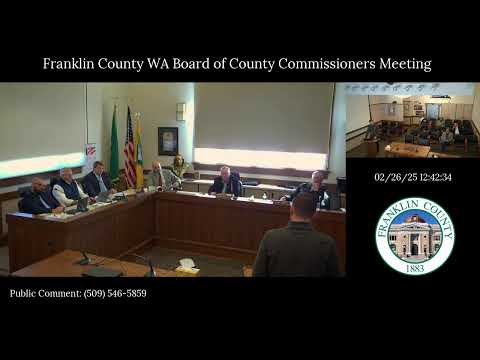
Franklin County planners and the county’s new planning consultant, Wes McCart, opened a countywide planning policy update during a Feb. 26 workshop, telling commissioners the update must align cities, towns and county policies for growth management, affordable housing allocation and new state mandates on greenhouse gas and transportation reductions.
McCart said state law changes (discussed as House Bill 1181 during the workshop) require local governments to address greenhouse gas reductions and transportation impacts as part of the comprehensive plan update; the county is eligible for a matching grant to support the work. He recommended early, written interlocal agreements with cities and the port to prevent inconsistent development rules and to ensure predictable annexation and utility extension processes.
Commissioners and staff identified several priorities: clearer annexation standards to avoid urban “donut holes” left in the county when cities annex partial blocks; a countywide approach to siting public facilities (for example, behavioral‑health and recovery campuses); review of development regulations that may slow housing production; and a strategy to manage taxation of renewable energy and solar projects so that county taxpayers are not unexpectedly shifted tax burden as projects are depreciated.
County officials asked the board whether the administrator or a commissioner should participate as the county’s lead negotiator in talks with cities. McCart said the first interjurisdictional meeting is scheduled for March 11; the county has received partial grant funding to begin the update and expects additional funds in July. Staff will pursue an interlocal agreement and bring policy drafts back to the board for review.
Commissioners also heard from local stakeholders at the workshop: County Assessor John Rosenow described how renewable energy projects can create an initial boost in taxable base that later shifts onto remaining taxpayers as projects are placed on accelerated depreciation schedules; local developers and planning commission members urged streamlining permitting and appeals (including reconsideration of a SEPA/appeal sequence and the frequency of planning commission meeting quorums). No formal policy action was taken; staff will continue stakeholder outreach and bring drafts to the board ahead of the statutory update deadline.