Get Full Government Meeting Transcripts, Videos, & Alerts Forever!
Get email alerts on the Coal Mining Material Damage topic
No spam. Unsubscribe anytime.
Bill to align Montana coal "material damage" language with federal guidance draws industry and landowner split
Summary
House Bill 587 would revise the statutory definition of "material damage" from coal mining to conform with Office of Surface Mining guidance, the sponsor said.
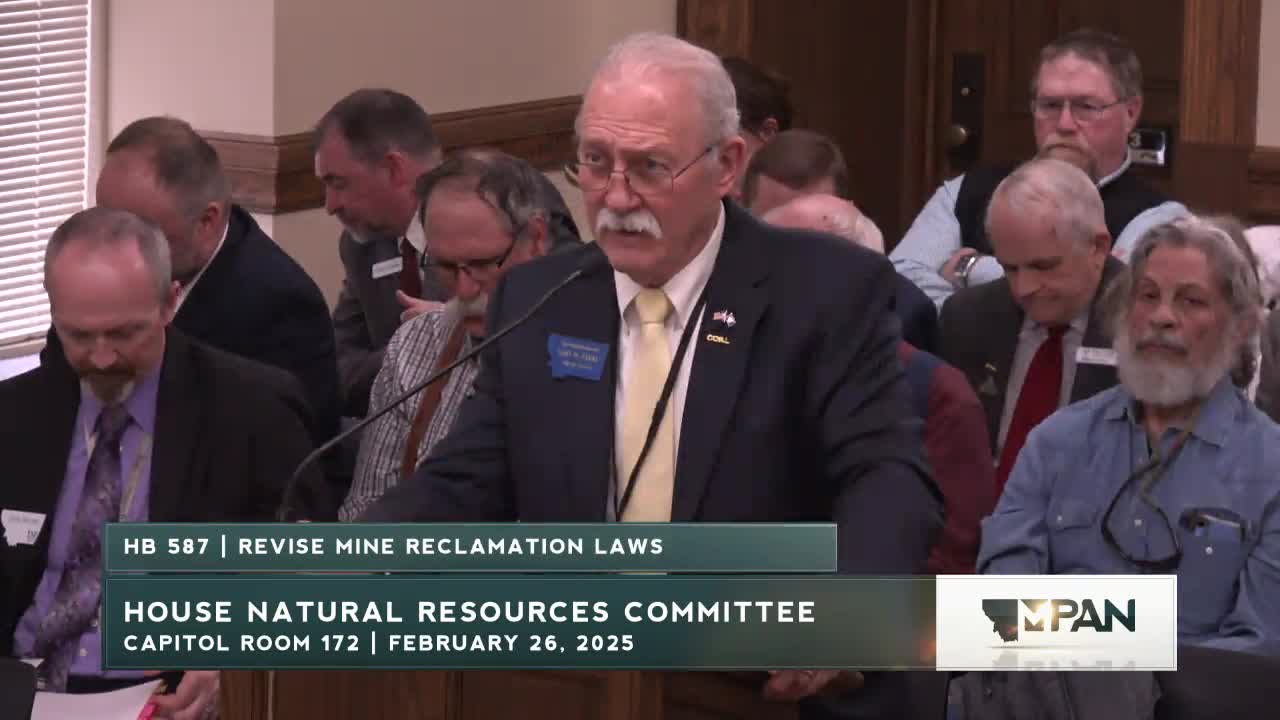
Representative Gary Perry opened House Bill 587 to revise how Montana defines "material damage" to water quality and quantity from coal mining, saying the bill adopts language OSM (Office of Surface Mining) signaled would meet federal expectations and protect Montana’s primacy for the coal program.
"Adopting the language is important for two reasons," Representative Gary Perry said: it helps Montana maintain primacy over its coal program and preserves federal funding for DEQ's reclamation and enforcement work. He said the change simply aligns state language with OSM guidance and does not otherwise change protections for downstream beneficial uses.
Industry proponents, including Westmoreland Mining and the Montana Coal Council, told the committee that OSM reviewed Montana’s previous revisions and denied them in January; the sponsors said HB 587 adjusts the definition to reflect OSM direction tied to the cumulative hydrologic impact analysis (CHIA). Daryl James of Westmoreland said the bill "very simply aligns the definition in MSUMRA [Montana’s coal program] with the direction we've been provided by OSM on what they feel is an appropriate definition." Westmoreland indicated the change is focused on definitional alignment rather than relaxing the requirement to protect downstream beneficial uses.
Opponents — including ranchers, water users, the Bull Mountain Land Alliance and environmental groups — urged the committee to reject HB 587. Ranchers and landowners described local water-quality and quantity impacts they attribute to mining activities and cautioned the bill would shift the burden of proof to landowners. Tom Baratta (Bull Mountain Land Alliance) and Clint McCray (local rancher) described subsidence, reduced spring flows, and water-quality problems they say have occurred within mining areas.
Derf Johnson of the Montana Environmental Information Center said the existing MSUMRA definition and processes have protected adjacent property owners for decades and that the proposed change is "novel, difficult to understand," and could flip the burden of proof toward landowners. He singled out language about "quantifiable" impacts and "significant degree of confidence," noting models and confidence metrics can be subjective and costly.
Director Sonya Nowakowski (DEQ) and Dan Walsh (DEQ Air, Energy and Mining Division) appeared as informational witnesses. Nowakowski said any immediate-effective-date language would prompt an immediate submission to OSM for approval, and that DEQ would not implement changes until OSM approval was received. Walsh said the department would continue to look for other data sources when reviewing permit applications and that some determinations might require rulemaking to define what constitutes a "significant degree of confidence."
Committee members raised concerns about the proposed removal of explicit references to violations of water-quality standards from the statutory language and asked whether landowners would be left to bear burdens of proof. Sponsor Perry said the language aligns with federal guidance and restores clarity for permit applicants.
Ending: The committee closed the hearing with extensive testimony from both industry and landowners. No final committee vote was taken; committee members requested additional information about historical water-quality records, the interplay with nondegradation policies and whether independent third-party data collection should be required.