Get Full Government Meeting Transcripts, Videos, & Alerts Forever!
Get email alerts on the Administrative Rulemaking Climate topic
No spam. Unsubscribe anytime.
Montana bill would require legislature to approve greenhouse-gas administrative rules
Summary
Rep. Curtis Schomer's HB 630 would bar agencies from adopting administrative rules on greenhouse gases or the social cost of carbon without later legislative approval; environmental groups and climate advocates testified it would hinder agencies' ability to protect public health and the environment.
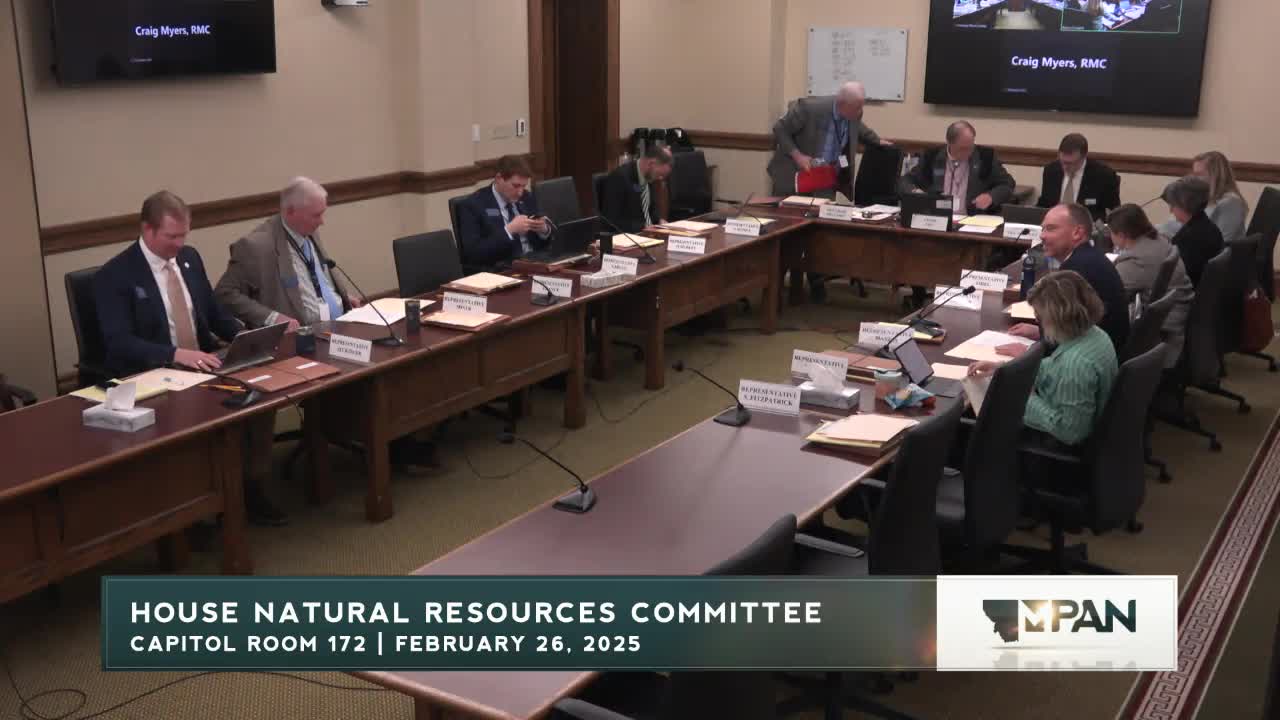
Representative Curtis Schomer, sponsor of House Bill 630, told the House Natural Resources Committee the bill would require the Legislature to approve agency administrative rules that regulate greenhouse gas emissions and the social cost of carbon.
The bill’s sponsor said administrative rules can carry the same weight as laws but are written by unelected agency officials. "The decision to adopt these types of rules should be a legislative decision," Representative Curtis Schomer said in opening testimony, arguing the Montana Constitution assigns the Legislature responsibility for the mechanism to protect a clean and healthful environment.
The bill drew opposition from environmental groups and climate advocates. Derf Johnson, representing the Montana Environmental Information Center, said agencies already must act within statutory limits and are subject to legislative checks and interim objection processes. "This bill creates more problems than it solves," Johnson said, warning it would flip the typical administrative process and could leave agencies unable to carry out statutory obligations.
Speakers from Northern Plains Resource Council and other conservation organizations testified that climate-driven losses — including drought, wildfires, and crop damages — mean agencies need authority to act on greenhouse-gas rules. Mary Catherine Dunfee and Augusta Catherine Sauer highlighted economic losses tied to extreme weather and urged the committee to reject measures that would delay agency rulemaking. Abby Husef pointed to Montana Supreme Court precedent recognizing a stable climate as included in Montanans’ right to a clean and healthful environment and argued the bill would inject more red tape between citizens and agency protections.
Sonya Nowakowski, director of the Department of Environmental Quality, and Ben Jones, administrator for the Board of Oil and Gas Conservation, appeared as informational witnesses. Nowakowski said the department is available to answer questions about the bill’s implementation and that agencies perform technical rulemaking that the Legislature does not typically have capacity to write. Committee members asked whether the bill would cover several named titles and boards; the sponsor and staff explained it would apply across boards that regulate emissions, listing Titles 61, 69, 75 and 82 as codification targets.
Committee members probed the bill’s scope and consequences. Representative Sechinger asked which departments would be affected; the sponsor and staff identified motor vehicle, the Public Service Commission, DEQ air quality, and the Board of Oil and Gas among others. Representative Konar and others questioned why the sponsor did not present a study bill rather than a sweeping limitation on departments. The sponsor responded the change was intended to give the Legislature greater oversight and limit what he described as agency overreach.
The hearing featured technical questioning about how the bill would interact with existing objection processes, the timing of rulemaking and legislative sessions, and whether it would effectively "hamstring" agencies. Nowakowski said DEQ would follow federal processes where applicable and that rule changes requiring federal approval would not be implemented until approved. Committee members noted the Office of Public Service Commission petition and the PSC’s prior social-cost-of-carbon petition as current context for the bill.
The hearing ended without a final committee vote; the sponsor reserved closing and urged support for HB 630.
Ending: The bill remains under committee consideration; committee members requested follow-up on implementation details and legal interactions with federal processes.