Get Full Government Meeting Transcripts, Videos, & Alerts Forever!
Get email alerts on the Military Deployment Law topic
No spam. Unsubscribe anytime.
Committee hears hours of testimony on bill to bar Guard from undeclared foreign combat
Summary
House Bill 404, sponsored by Rep. Lee Deming, would prohibit sending Montana National Guard units into foreign combat without a formal congressional declaration of war. The committee heard robust, often emotional testimony from the Adjutant General and veterans’ and veterans‑service organizations (opposed) and from veterans and civic groups (pro‑
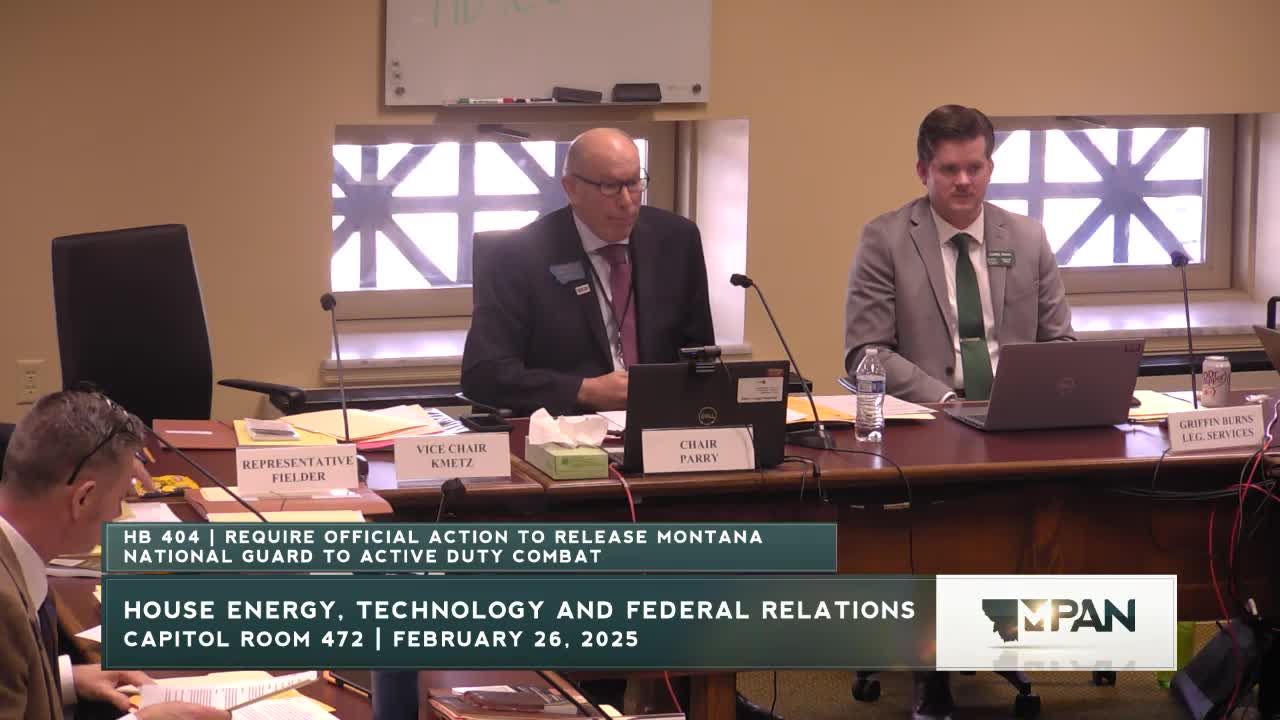
Rep. Lee Deming introduced House Bill 404 at a lengthy May 17 hearing of the House Energy, Technology and Federal Relations Committee, asking the legislature to prevent Montana National Guard members from being deployed to foreign combat without a congressional declaration of war. The bill prompted many hours of testimony from the adjutant general, veterans, military associations and concerned citizens.
Major General J. Hronek, the Adjutant General for the Montana National Guard, testified in strong opposition. He told the committee HB 404 ‘‘would have catastrophic impacts on our members and our national security’’ and warned it would create ‘‘a protected class of service members’’ that would harm unit cohesion, readiness, and longstanding state‑federal training and resourcing arrangements. ‘‘Protecting us from harm’s way…would be almost insulting to a service member going like, why is that person’s life worth more than mine?’’ Hronek said.
Several veterans’ organizations and former senior military logisticians likewise opposed the bill, saying it could trigger loss of federal funding, equipment and positions. Mike Talia, speaking for the American Legion Department of Montana and the Montana National Guard Officer and Enlisted Associations, said HB 404 ‘‘provides for no military paying allowances, provides for the provision of no military equipment, and no operation and maintenance money for the Montana National Guard’’ if the state could not meet federal requirements.
Opponents cited historical examples and argued the federal government has previously reallocated equipment when states could not fulfill federal missions. Jeff Schepp, adjutant quartermaster, warned the state could ‘‘lose members of our National Guard…federal technicians, AGR positions’’ and recalled an earlier case in Minnesota where units’ equipment was taken when units refused mobilization.
Proponents — including veterans’ groups and individual guardsmen who testified anonymously or in civilian clothing — urged passage. Dan McKnight, a 13‑year veteran and chairman of Bring Our Troops Home, urged the committee to protect Guardsmen from repeated deployments to ‘‘undeclared wars,’’ saying the bill merely requires that deployments meet constitutional standards. Several other veterans and civic‑organization witnesses argued there is no credible evidence that the federal government would cut funding or equipment simply because a state requires that Guard deployments comply with the Constitution; they pointed to legal protections in Title 32 and the Impoundment Control Act.
Testimony revealed sharp factual disagreements. Opponents emphasized the practical risk to training, federal pay and equipment if Montana units were restricted; proponents emphasized constitutional accountability and mental‑health and life‑risk concerns for Guardsmen deployed to conflicts without congressional declarations.
Committee members asked detailed legal and historical questions about authorizations for military force, Title 10 and Title 32 activation authorities, and prior court challenges. Lieutenant Colonel Todd Wayne, a judge advocate in the Army, and Janae Grotbo, the Department of Military Affairs chief financial officer, appeared as informational witnesses to answer legal and fiscal questions.
No committee vote occurred on HB 404 at the close of the hearing. Sponsor Deming urged the committee to consider the constitutional concerns he raised and said he hoped the measure would pass, while opponents warned of fiscal and readiness consequences if it did.