Get Full Government Meeting Transcripts, Videos, & Alerts Forever!
Get email alerts on the Energy Policy topic
No spam. Unsubscribe anytime.
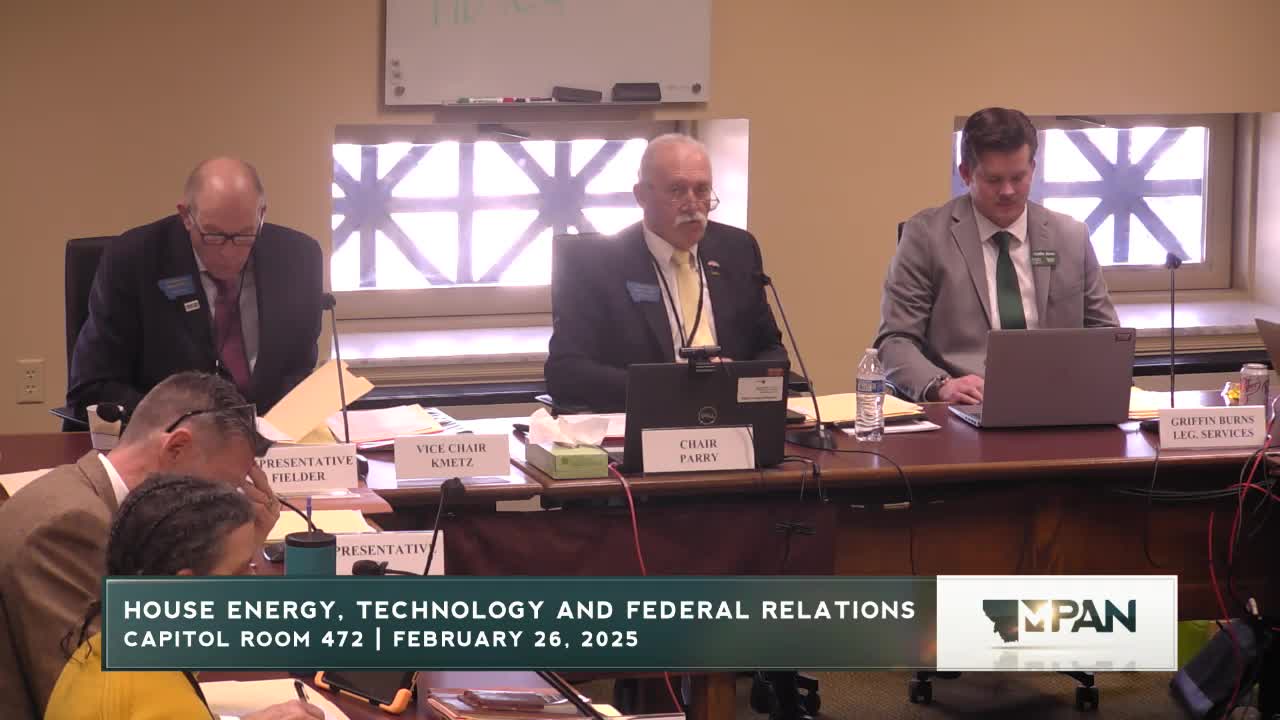
Lawmakers hear sharp debate over HJ 17 calling on federal government to speed energy development
Summary
House Joint Resolution 17, which urges the federal government to take steps to accelerate energy development, drew hours of sharply divided testimony at a hearing of the Montana House Energy, Technology and Federal Relations Committee on May 17.
House Joint Resolution 17, which urges the federal government to take steps to accelerate energy development, drew hours of sharply divided testimony at a hearing of the Montana House Energy, Technology and Federal Relations Committee on May 17. Sponsor Rep. Steve Fitzpatrick framed the measure as a call for federal action to expand mining and energy development and to review recent Environmental Protection Agency rules he described as burdensome.
Fitzpatrick told the committee the resolution ‘‘expresses the sense of the legislature that Congress and the president…need to take some actions to promote energy development,’’ citing growing demand from data centers and other users.
Proponents credited in testimony said faster permitting and more mining would strengthen energy and national security. Gordon Criswell, director of environmental and compliance at the Coal Strip power plant, said EPA rules adopted in May 2024 — including the agency’s mercury-and-air-toxics standard and a greenhouse-gas rule — would force the plant to spend ‘‘hundreds of millions of dollars’’ to comply and could hasten a retirement date. ‘‘To comply with the final MATS rule, Coal Strip owners will be forced to spend…currently estimated at over $500,000,000, to install a baghouse,’’ Criswell said.
Montana Mining Association Executive Director Matt Vincent urged quicker permitting for mines and pointed to global supply risks for critical minerals such as copper, cobalt and lithium. ‘‘A typical electric vehicle uses about six times the minerals of a conventional car,’’ Vincent said. He also cited reports that U.S. permitting-to-production timelines for mines average decades and argued for reforms to secure supply chains.
Opponents warned the resolution would undercut long-standing environmental protections. Gusty Catherine Sauer of Northern Plains Resource Council urged a ‘‘no’’ vote, saying environmental safeguards and renewable-technology innovation should be the focus instead of rolling back rules. ‘‘A sustainable energy future requires innovation in renewable technologies such as energy efficiency and responsible management of resources,’’ Sauer said.
Tribal representatives and conservation groups also opposed the resolution. Patrick Yawake, representing several Montana tribes, testified that the measure ‘‘does not take into consideration Montana tribes involvement in consultations’’ and asserted the resolution could conflict with Montana’s constitution and tribal clean-air standards. Shannon James of the Montana Environmental Information Center said the resolution ‘‘calls on Congress and the president to eliminate and weaken environmental laws that are set into place to protect public health and safety.’’
Witnesses on both sides pointed to specific federal authorities mentioned in the resolution, including NEPA, the Endangered Species Act, the Clean Air Act, the Clean Water Act and the Nuclear Regulatory Commission’s authorities. Opponents warned that urging the president to use emergency powers to override state laws and conservation protections could preempt state protections such as sage‑grouse conservation measures.
The committee took no final vote on HJ 17 at the hearing. The sponsor closed after questions from committee members and indicated he would await committee deliberations.
The hearing record includes testimony from industry, conservation groups, tribal representatives and health professionals and showcased contrasting views about whether greater energy production requires weakening or streamlining federal environmental protections.