Get Full Government Meeting Transcripts, Videos, & Alerts Forever!
Get email alerts on the Nurse Staffing topic
No spam. Unsubscribe anytime.
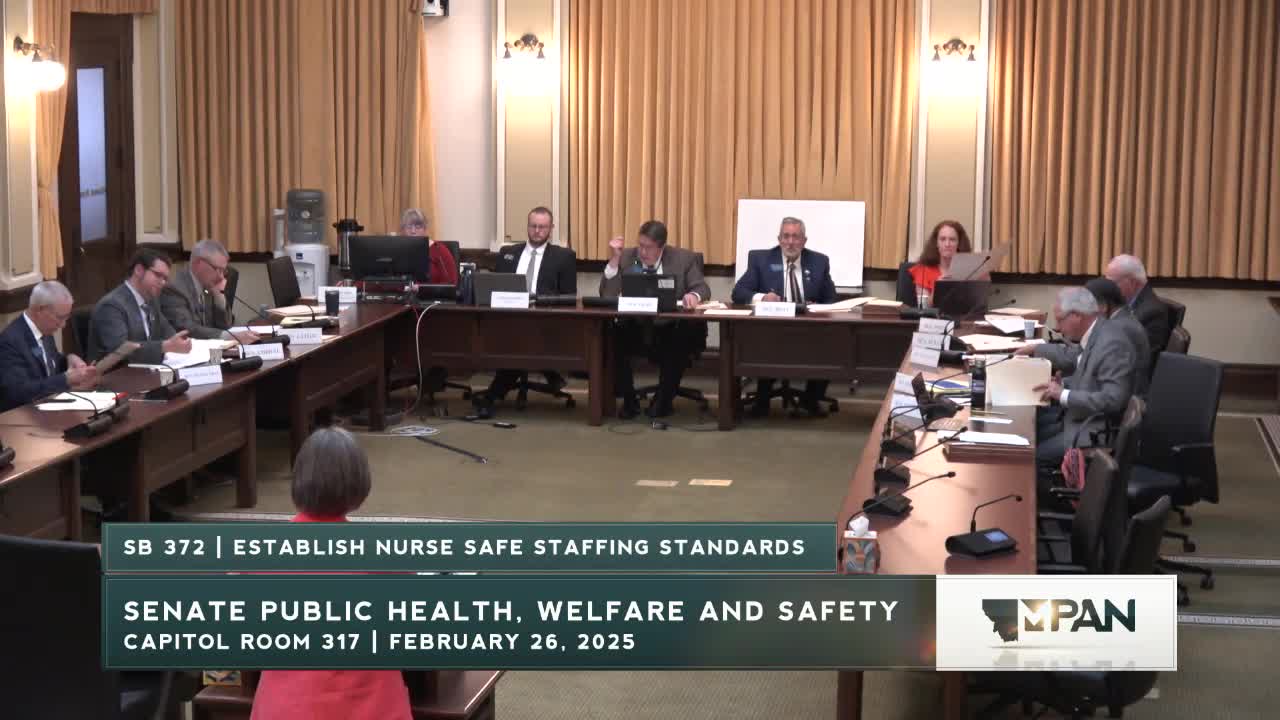
Nurses push safe‑staffing bill; hospitals warn mandated ratios could reduce beds
Summary
Senate Bill 372 would create nurse staffing committees and set minimum nurse‑to‑patient ratios. Nurses and nursing associations testified in support, citing patient safety and burnout; hospital groups opposed, warning rigid mandates would exacerbate staffing shortages and force bed closures.
Senate Public Health Committee heard pro and con testimony on Senate Bill 372, which would establish minimum nurse‑to‑patient ratios, create nurse staffing committees, require reporting to DPHHS and prohibit mandatory overtime.
Senator Cora Newman, sponsor of SB 372, framed the bill as a patient‑safety measure, saying research ties higher nurse workloads to higher mortality and infection rates and that “reasonable nurse to patient ratios such as 4 non‑critical patients or 1 critical patient per nurse helps prevent burnout and improves patient outcomes.”
The Montana Nurses Association, represented by Vicki Byrd, testified in strong support and described the bill as necessary to reduce errors, improve recovery times and retain nurses. Dozens of bedside nurses also offered personal testimony that understaffing causes burnout and compromises care.
Hospital groups and health systems opposed the bill. Heather O'Hara of the Montana Hospital Association said Montana faces a persistent nursing shortage and cautioned that a rigid statewide mandate would force hospitals to close beds and reduce access to care. St. Vincent Regional Hospital’s Chief Nursing Officer, Dr. Janet Harris, said staffing must respond to patient acuity and rapid changes during a shift and that fixed ratios remove needed flexibility.
Representatives of specialty providers noted unique staffing models: Ray Penyak of Shodair Children’s Hospital said psychiatric units rely on mental‑health technicians alongside RNs and that a flat ratio could reduce bed capacity by roughly 40 percent on some units. Several critical‑access hospital witnesses described creative staff‑sharing solutions that would be constrained by mandated ratios.
Questions from committee members focused on enforcement, rural hospital impacts, whether mandated ratios would attract nurses, and how the bill would interact with existing collective‑bargaining arrangements. Sponsor Newman said she is open to amendments, including language about staff‑to‑patient ratios and exemptions to better fit small facilities.
No final action was taken at the hearing.