Get Full Government Meeting Transcripts, Videos, & Alerts Forever!
Get email alerts on the Intoxicating Hemp topic
No spam. Unsubscribe anytime.
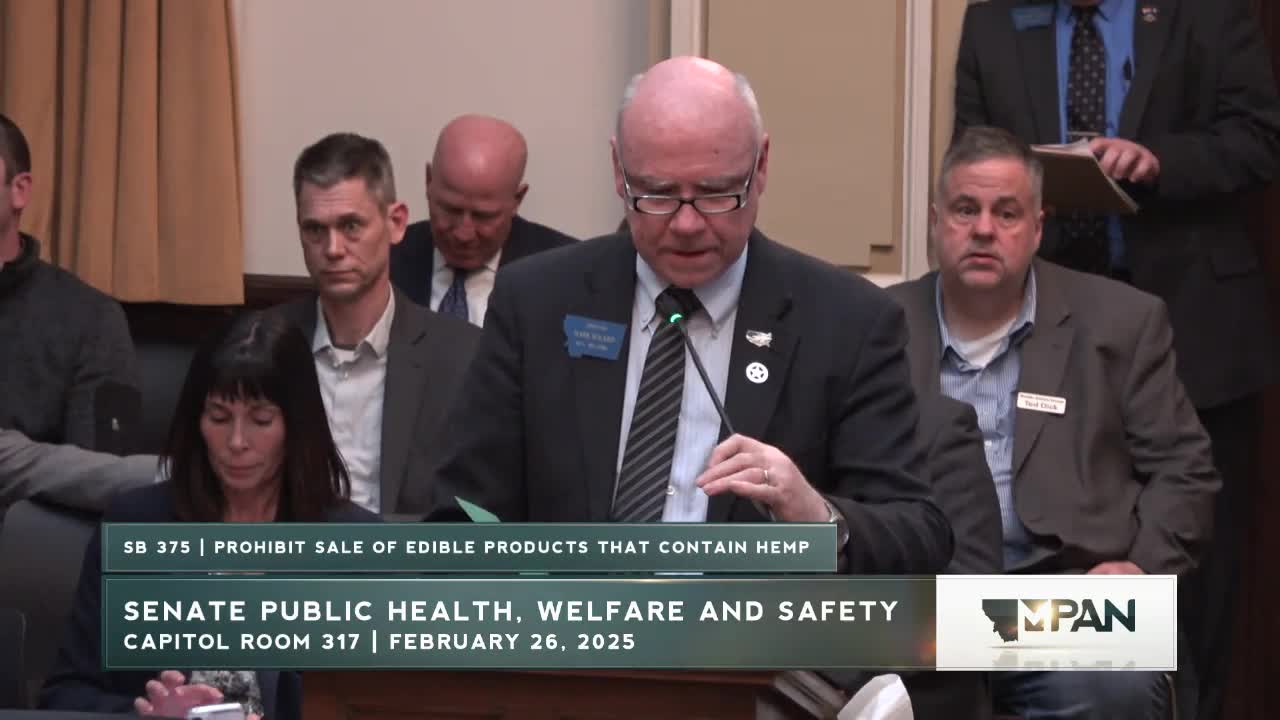
Senate hearing spotlights push to ban intoxicating hemp products in Montana
Summary
Lawmakers heard competing testimony on Senate Bill 375, which would prohibit sale of hemp products containing THC; proponents stressed youth safety and unregulated market risks while industry speakers urged clearer definitions and protections for the legal cannabis market.
Senate Public Health Committee opened a hearing on Senate Bill 375 on the proposed prohibition of intoxicating hemp products containing delta‑9 THC.
Sponsor Senator Mark Noland urged the committee to pass the bill as a first step to protect Montana residents from an expanding market of unregulated hemp-derived products, saying federal changes after the 2018 Farm Bill created “a flood of products that are nothing less than another form of cannabis, often in candy form, that is made attractive to youth and children with no regulation, no oversight, and a limited capability for our offices to rein them in.”
The bill would ban sale of hemp products that contain THC; proponents said the measure responds to emergency-room visits, poison-control calls and youth access to edible and vape products being sold without age restrictions, labeling, testing or taxation. Leanna Troesh of Safe Montana told the committee these products are sold at gas stations and vape shops and “there's no oversight with the Cannabis Control Division” for hemp‑derived intoxicants.
Melissa Lewis, who testified for Molson Coors Beverage Company, cited a multi‑state attorneys general letter and warned that a perceived loophole in a different bill (HB 49) could legalize intoxicating hemp in retail outlets alongside nonintoxicating products. Lewis said, “If a ban or moratorium is not established, intoxicating hemp products can be manufactured and sold alongside nonintoxicating products in grocery stores and gas stations with no regulation, no age restrictions, no testing requirements, no labeling requirements, and no tax considerations.”
Industry witnesses and hemp manufacturers urged caution and clearer language. Kate Holella of the Montana Cannabis Industry Association and Evan Kajander, representing the legal marijuana industry, both said they support addressing intoxicating hemp but warned the bill’s definitions could sweep in regulated marijuana products or nonintoxicating CBD goods. Melanie Kosan, CEO of Mama LLC, asked whether “contains THC” in the bill would mean any detectable THC under 2018 Farm Bill standards or truly zero THC, noting that 0.3% THC can show on drug tests.
Technical witnesses from the Cannabis Control Division and the division’s laboratory manager were present to field questions about product types and testing. Administrator Kristen Barber and laboratory manager Kathy Wiegand Palmer explained that the bill language is targeted to hemp products containing THC and that topicals that contain trace THC would be unlikely to cause intoxication.
The hearing closed with the sponsor saying he will work with stakeholders on amendments and possible enforcement language that could follow as a revenue or study bill.
Proponents and opponents asked the committee to clarify definitions and statutory thresholds so the regulated cannabis market is not inadvertently restricted while unregulated intoxicating hemp is addressed.