Get Full Government Meeting Transcripts, Videos, & Alerts Forever!
Get email alerts on the Cpace Multifamily topic
No spam. Unsubscribe anytime.
Montana committee hears bill to broaden CPACE eligibility for multifamily housing
Summary
Supporters told the Senate State Administration Committee that a narrow statutory definition has blocked two multifamily projects from accessing CPACE financing; proponents asked the committee to approve a technical change to align state statute with federal definitions and expand financing access.
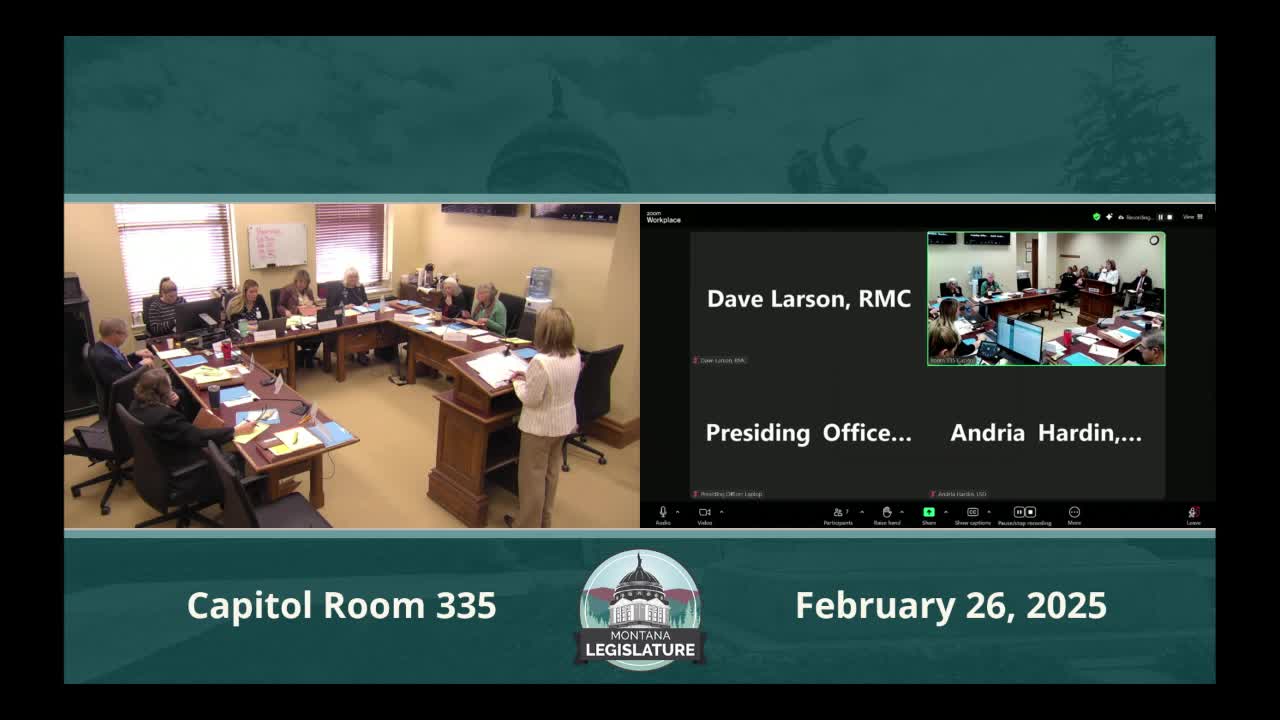
Representative Julie Darling introduced House Bill 120 to the Senate State Administration Committee as a ‘‘housekeeping’’ fix to Montana’s Commercial Property Assessed Capital Enhancement (CPACE) statute.
The bill would revise the statutory definition of “multifamily” used in the CPACE enabling statute so that typical Montana apartment buildings without elevators would qualify for CPACE financing. Representative Julie Darling said the change would expand opportunities for housing development by aligning state statute with federal multifamily definitions and by removing an elevator requirement that had blocked projects.
Adam Gill, executive director of the Montana Facility Finance Authority, the state’s CPACE administrator, described CPACE as private-market financing that is not a loan from the state. Gill said the current statutory cross-reference ties CPACE’s multifamily definition to another part of the Montana Code that defines multifamily for civil-rights and ADA purposes. That cross-reference, he said, has excluded common Montana building types (two- and three-story, no-elevator buildings) and had already prevented at least two projects — the Riverview Housing Trust project in Big Sky and a North Missoula Community Land Trust project — from using CPACE financing.
"This definition removes the elevator requirement, aligns our program with federal housing definitions for multifamily housing," Gill told the committee, saying the change would remove a barrier to market access for energy-efficiency and renewable-energy upgrades on multifamily properties.
Proponents included the Montana Renewable Energy Association and Montana Farmers Union. McKenna Sellers of the renewable energy association said many qualified contractors would perform energy-efficiency work on multifamily housing if CPACE covered those properties; Rachel Prevost of Montana Farmers Union said the change would expand energy and water conservation financing in rural communities and for ag-related facilities that qualify as multifamily under the revised language.
Committee members asked for clarification that CPACE financing is a private-market mechanism rather than a state loan; Gill confirmed it is a private financing route. He also explained the bill would decouple CPACE program eligibility from the ADA/civil-rights definition so the program has a standalone statutory multifamily definition.
Representative Darling closed by saying several local projects in Helena and elsewhere are awaiting CPACE access and that the change would help develop affordable and workforce housing.
The committee took testimony, with no opponents recorded at the hearing.
Ending: The bill drew widespread proponent testimony and technical questions about statutory definitions; the committee hearing closed with proponents urging a do-pass recommendation to expand CPACE access for multifamily projects.