Get Full Government Meeting Transcripts, Videos, & Alerts Forever!
Get email alerts on the Property Tax topic
No spam. Unsubscribe anytime.
House advances property tax relief bill after multiple failed amendments
Summary
The House recommended House Bill 231 do pass after debate and multiple amendment attempts; amendments to change rate structure or add rebates failed, and the bill passed second reading 72–27 in Committee of the Whole.
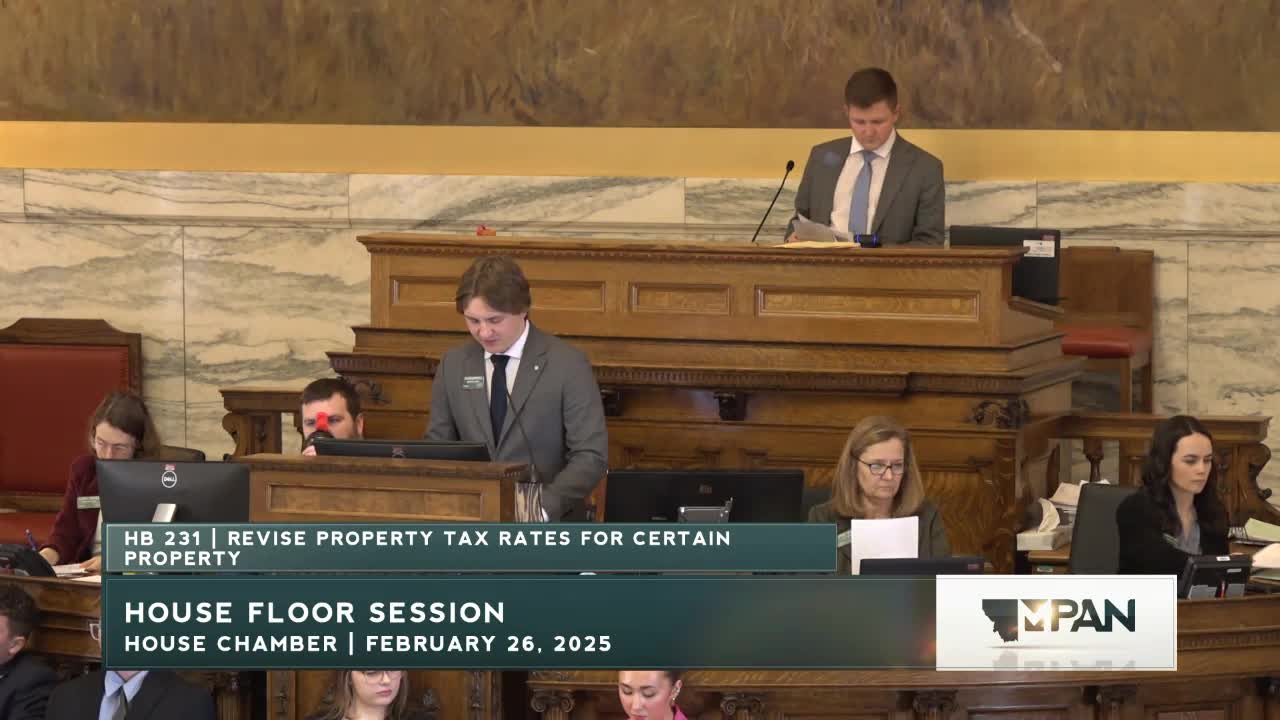
House Bill 231, a measure to revise property tax rates for certain class 4 residential and commercial property and to create application-based rebates, cleared second reading in the Committee of the Whole after extended debate and several failed amendments.
The bill’s sponsor, Representative Doug Jones, said the measure lowers effective residential tax rates and aims to ease increases that followed recent revaluations. "This bill makes a significant difference for about 230,000 Montana homeowners, 130,000 long-term renters and 30,000 small businesses," Representative Jones (sponsor) said in closing.
Why it matters: supporters argued the bill provides targeted relief without requiring homeowner applications, while opponents warned it shifts taxes to agricultural and commercial property and uses general fund dollars to backfill revenue. Representative Falk offered multiple amendments that would have increased rebates or changed the rate schedule; Falk described a proposed rebate as "$200 minimum, and $125 for every $100,000 in value up to a $1,000 rebate," and said staff estimated the approach would cost roughly $95 million per year. Those amendments were put to the body and failed in recorded votes (40–60 and 30–70 on successive proposals).
Key procedural actions: Representative Jones moved that the committee recommend HB 231 do pass. After debate and votes on amendments, the clerk recorded 72 representatives voting aye and 27 no on the committee recommendation to pass second reading; House Bill 231 passed second reading on that vote.
Discussion highlights: critics pressed the sponsor on administration and distributional effects, noting the bill requires additional Department of Revenue modeling and may produce permissive mill shifts under the state’s 95-mill school equalization mechanism. Sponsor Jones said general fund dollars would be used to backfill any local school funding reductions, and acknowledged unresolved modeling questions about out-of-state property ownership and county-level shifts.
Next steps: The bill will proceed to the Senate if it continues to advance through chamber procedures.