Get Full Government Meeting Transcripts, Videos, & Alerts Forever!
Get email alerts on the Family Court Training topic
No spam. Unsubscribe anytime.
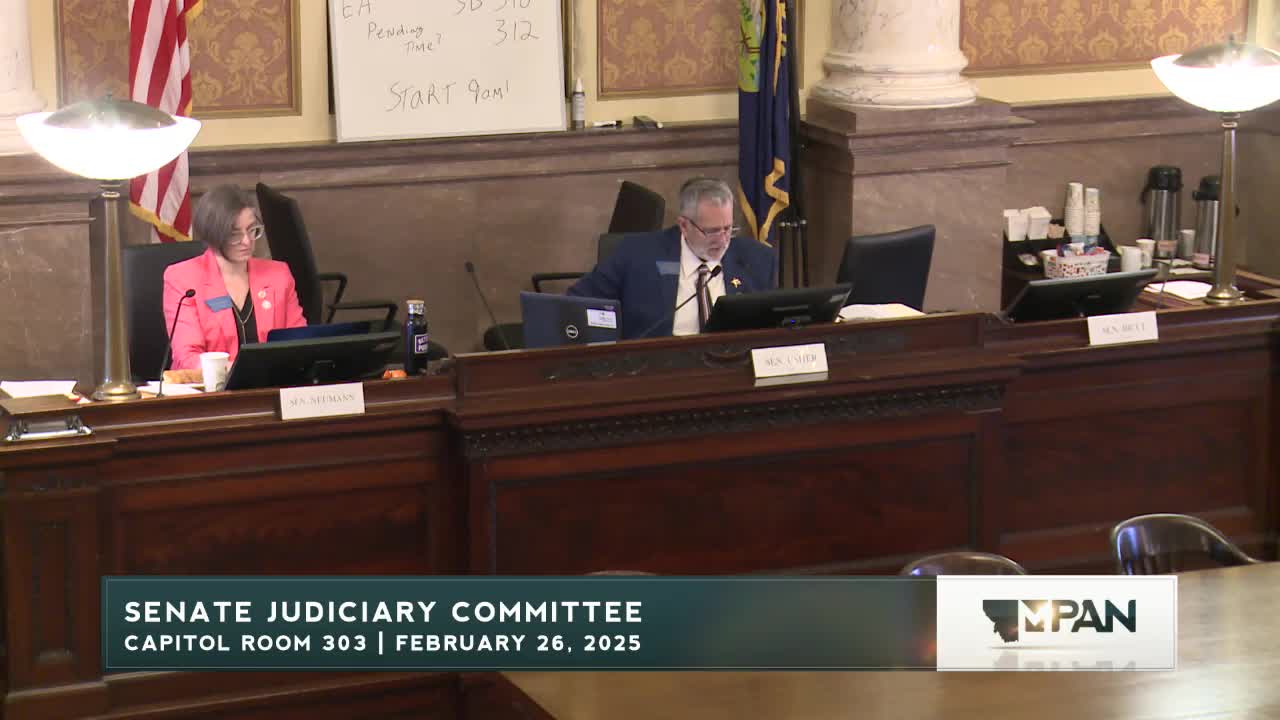
Senate Judiciary hears broad testimony on SB 318, ‘Brody’s Law,’ to require domestic-violence training in family courts
Summary
Senate Bill 318, introduced by Senator Lance as “Brody’s Law,” drew hours of testimony before the Montana Senate Judiciary Committee on proposals to require trauma-informed domestic-violence and child-abuse training for judges, standing masters, guardian ad litems and other family-court professionals.
Senate Bill 318, introduced by Senator Lance as “Brody’s Law,” drew hours of testimony before the Montana Senate Judiciary Committee on proposals to require trauma-informed, culturally appropriate domestic-violence (DV) and child-abuse training for judges, standing masters, guardian ad litems (GALs), and other family-court professionals.
The bill’s sponsor, Senator Lance, told the committee SB 318 “closes loopholes in the code that allow abusive parents to repeatedly violate parenting plans” and said the measure “strengthens the ability of the courts to recognize and adjudicate domestic violence and child abuse allegations.”
Why it matters: Proponents said the change would reduce post-separation abuse and protect children. Kyla Hailstone, director of the Montana Family Court Awareness Project, told the committee the measure is the product of multi-year research and a string of cases in which advocates say courts failed to account for past abuse. “We cannot afford to lose any more,” Hailstone said, urging the committee to pass the bill “to protect children and victims in family law.” She and other witnesses cited statewide statistics during testimony, including roughly 10,000 divorces and more than 11,000 domestic-violence cases filed annually in Montana, and said existing court training on DV is minimal or inconsistent.
What proponents said: Multiple family violence survivors and advocates recounted cases they described as post-separation abuse and testified that courts often miss psychological and coercive-control harms. Elizabeth Peterson, a proponent, described “parental alienation” as a tactic that can disguise or replace evidence of abuse in custody disputes. Survivor witnesses directly tied individual tragedies to the current system; survivor Judy Hill said, “If even one court professional had minimal domestic training on post-separation abuse issues that allowed them to recognize the abuse and intervene, my son would be alive today.” Several attorneys and child advocates said SB 318 would require that expert witnesses and GALs meet baseline qualifications and that opinions offered to the court be based on documented, peer-reviewed methods.
What opponents said: Bruce Spencer, representing the Montana Judges Association and the State Bar of Montana, said his organizations do not dispute the need for training but raised a narrow constitutional objection. He argued that Article VII, section 2 of the Montana Constitution assigns regulation of the courts to the Supreme Court and recommended petitioning the Supreme Court for any mandatory training requirements rather than imposing them by statute. The Montana Coalition Against Domestic and Sexual Violence urged an amendment to preserve so-called “blind” expert testimony (expert statements about patterns of abuse without having met the survivor) for fast civil protection-order hearings so low-income survivors can still access timely expert evidence.
Due-process and practical concerns from attorneys: Several family-law attorneys and a social-worker GAL testified in opposition or asked for changes. Emily Christ, a social worker who serves as a GAL in several cases, said requiring GALs to be licensed attorneys would reduce available advocates in rural areas and delay appointments; she said many communities rely on trained nonattorney professionals. Christopher Gillette, a veteran family-law attorney, warned that the bill’s proposed child-voice provisions could invite parental coaching and manipulation of children if safeguards are not carefully written. Opponents also questioned parts of the bill that would restrict experts from offering diagnostic opinions without evaluating both parents and the child — which, they said, could be impractical in active, contested cases.
Key specifics and clarifications in testimony: Witnesses cited numbers and program details from the record: proponents said Montana has about 46 district court judges, of whom they said 13 came to the bench with family-law experience and six with domestic-violence experience; witnesses cited ACE (adverse childhood experiences) data, saying roughly 22.6 percent of Montana children scored two or more on ACE measures (compared with a national average near 16 percent). Several witnesses asked the committee to allow targeted amendments (for example, to preserve blind testimony in protection-order hearings or to broaden the set of professionals who may serve as GALs).
Committee process and next steps: The committee heard extensive public testimony for and against the bill. Bruce Spencer recommended a petition to the Montana Supreme Court if the committee wants to impose mandatory judicial training, while proponents said the bill would simply add specialized coursework to existing continuing-education requirements. Sponsor Senator Lance closed by urging members to consider the real people the bill addresses; the hearing was then concluded without a final vote recorded in the transcript.
Ending: The committee received extensive public comment, and senators indicated they would consider technical amendments suggested during testimony. The hearing record closed with testimony spanning survivors, advocacy organizations, the State Bar and judges’ representatives; senators signaled interest in negotiated language and some committee members asked the sponsor to work with stakeholders on amendments before the bill returns for executive action.