Get Full Government Meeting Transcripts, Videos, & Alerts Forever!
Get email alerts on the Education topic
No spam. Unsubscribe anytime.
Committee hears bill to study expansion of Tribal Attendance Promising Practices (TAP)
Summary
House Bill 3218 would direct a study of expanding the Tribal Attendance Promising Practices (TAP) program. Tribal partners, ODE staff and TAP grant managers described the program model and presented district‑level results and program design elements to House Education Committee members.
House Bill 3218 would direct the Legislative Commission on Indian Services and the Oregon Department of Education to study potential expansion of the Tribal Attendance Promising Practices (TAP) grant program. Representative Hwa Nguyen's written testimony, read by Sarah Arbuckle, said TAP "has significantly improved attendance rates for Native students by fostering stronger school community connections, integrating indigenous knowledge into learning environments, and supporting student well‑being." The bill would authorize a formal study and tribal consultation to assess expansion options.
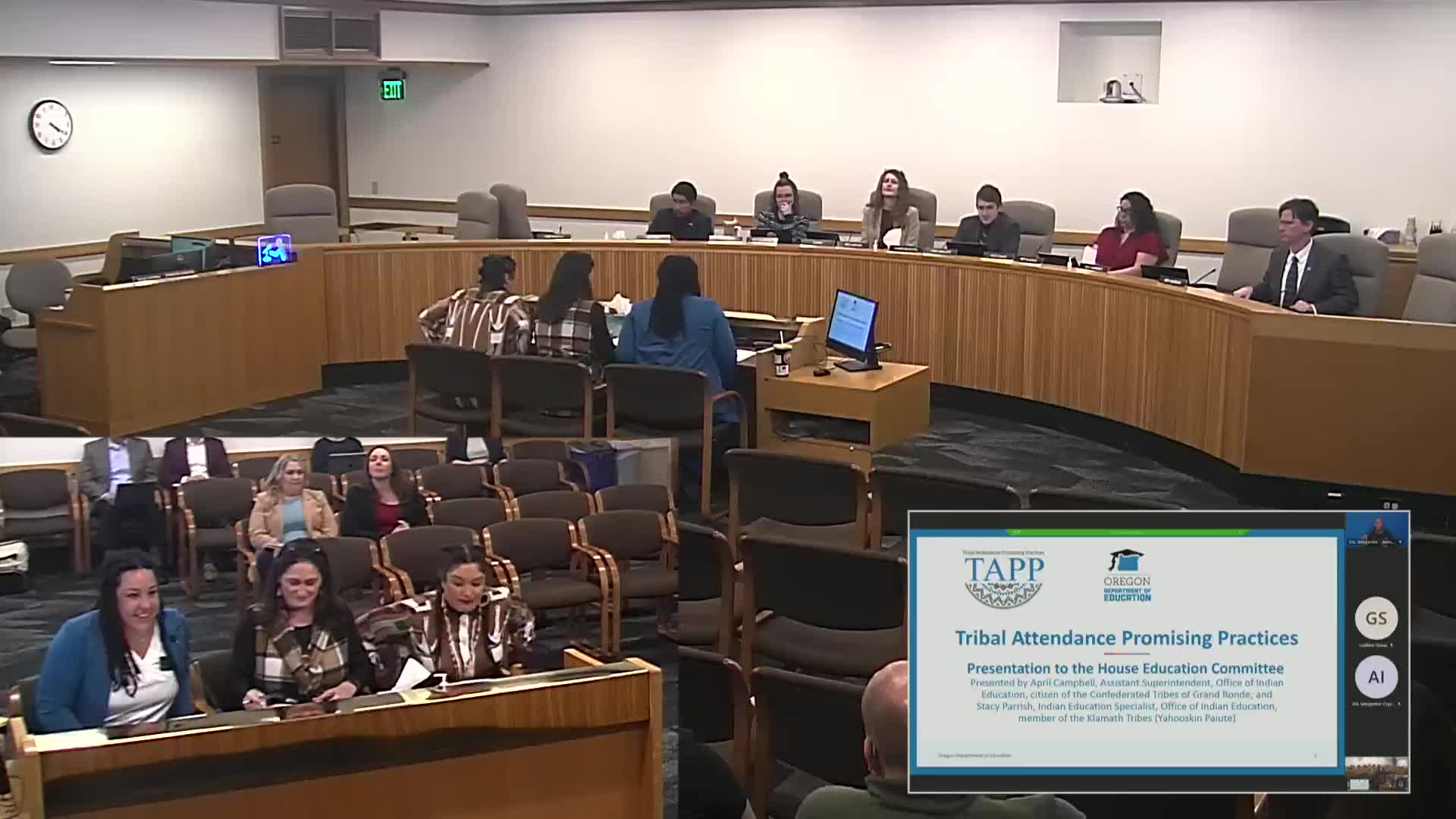
April Campbell, assistant superintendent for the Office of Indian Education at the Oregon Department of Education and a citizen of the Confederated Tribes of the Grande Ronde, described TAP's history and purpose. "TAP grants are provided directly to districts," Campbell told the committee, noting a common misconception that funds go directly to tribes. TAP was created after a 2014 conditions‑of‑education study that matched tribal enrollment to district records and found American Indian and Alaska Native students were more likely to be chronically absent.
Stacy Parrish, TAP grant manager and a member of the Klamath tribes, explained the program model: each TAP site requires a three‑way partnership among the local tribe, a TAP family advocate (a full‑time, school‑based staff position) and a district‑level project director with decision‑making authority. "TAP's approach is really unique in that it requires districts to partner with a local tribe and together the tribe and the school district co‑create a community based set of strategies," Parrish said. Those locally designed strategies align to research‑based approaches described by Attendance Works and include recognizing improved attendance, culturally responsive programming, early intervention and use of tribal services for high‑need students.
Campbell and Parrish offered program figures: TAP operates in 10 sites that together account for 41% of Oregon's tribally enrolled students; the grantee network directly serves a caseload of about 1,700 students and identifies roughly 2,228 American Indian and Alaska Native students in the 10 TAP districts, a figure that rises to over 6,400 when multiracial and Hispanic‑identifying native students are included. Parrish said several districts partner with neighboring tribes; Salem‑Keizer, for example, partners with both the Confederated Tribes of Grand Ronde and the Confederated Tribes of Siletz.
Supporters said TAP's culturally grounded, partnership‑based design produces benefits that extend to all students while centering tribal leadership and sovereignty. Campbell emphasized the government‑to‑government consultation the Department pursues with Oregon tribes and said tribal partners helped select TAP as a priority program after the 2014 study. Witnesses urged the committee to include tribal consultation and culturally appropriate metrics in any study of expansion.
No formal action was taken at the hearing. Committee members asked for additional written materials; ODE staff invited written testimony and offered to supply more detail on TAP outcomes and program design. The hearing record remains open for supplemental submissions for 48 hours following the meeting.