Get Full Government Meeting Transcripts, Videos, & Alerts Forever!
Get email alerts on the Transportation And Economic Development topic
No spam. Unsubscribe anytime.
Committee reviews Oregon Department of Veterans Affairs budget; Roseburg home match remains contingent on federal grant
Summary
The Joint Ways and Means subcommittee held an informational hearing on House Bill 5038, receiving a presentation from the Oregon Department of Veterans Affairs (ODVA) on a roughly $612 million proposed budget and updates on home loan trends, Roseburg Veterans Home matching funds, and program expansions funded by lottery dollars.
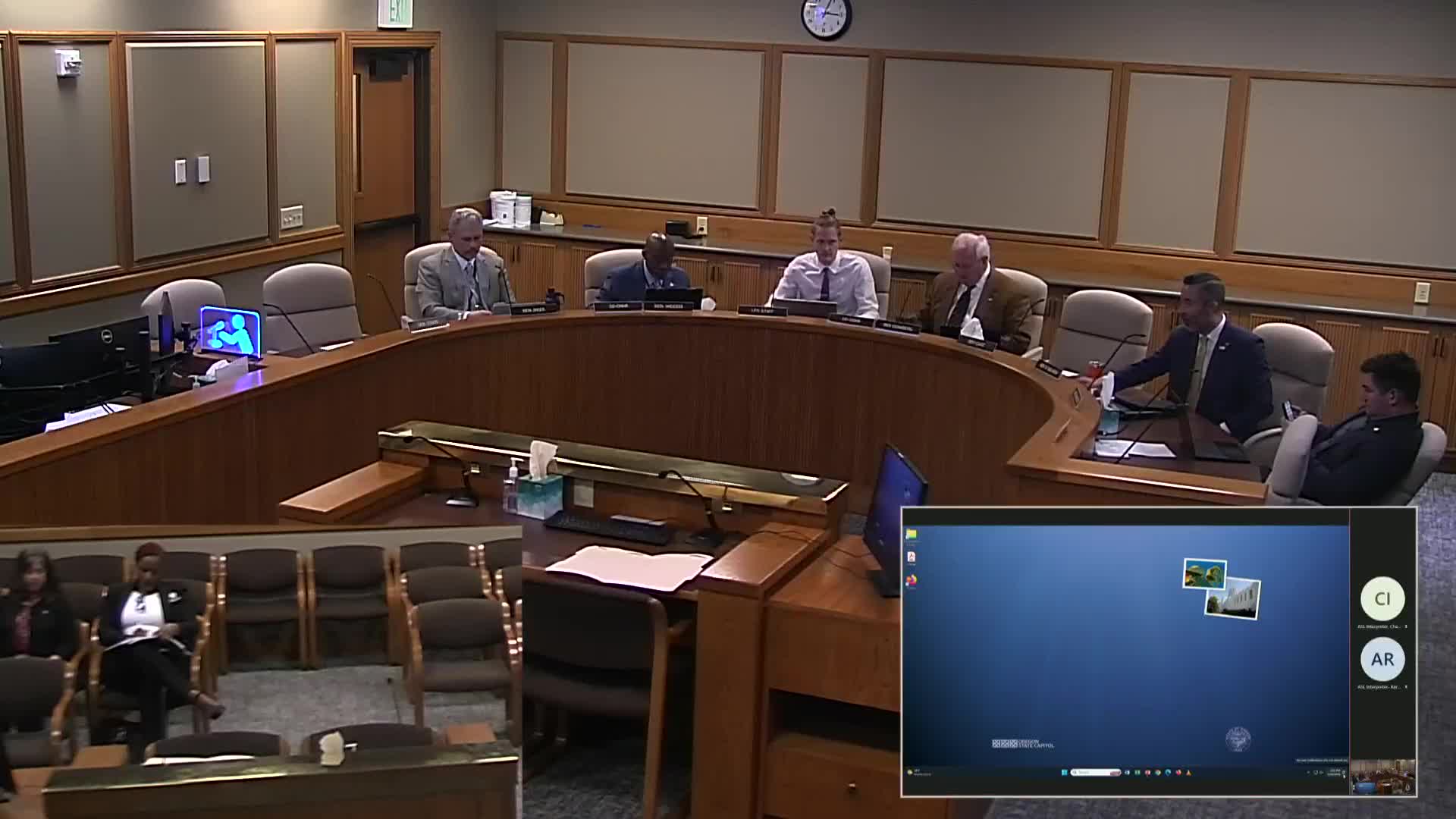
The Joint Committee on Ways and Means Subcommittee on Transportation and Economic Development held an informational hearing on Feb. 26 to review House Bill 5038, the Oregon Department of Veterans Affairs (ODVA) budget bill. ODVA Director Dr. Nikia Council Daniels and agency staff presented a governor’s recommended budget of approximately $612 million across all fund types and answered committee questions on home loan originations, the Roseburg Veterans Home match, and expansions funded by Measure 96 lottery dollars.
The hearing matters because ODVA’s budget funds direct services to more than a quarter-million veterans in Oregon, operates two veterans homes and a home loan program that supplies much of the agency’s operating revenue, and seeks state matching funds needed to secure a federal State Veterans Home Construction Grant for Roseburg.
Director and agency overview
Dr. Nikia Council Daniels, director of the Oregon Department of Veterans Affairs, told the subcommittee the governor’s recommended 2025-27 budget “reflects the state’s continued commitment to delivering essential benefits, programs, and services that support Oregon’s more than quarter million veterans and their families.” She said ODVA’s request covers operations, home loan functions, veterans homes, appeals and special advocacy, strategic partnerships, and aging veteran services.
Daniels and Chief Financial Officer Nicole Dolan explained that about 62% of the proposed total is “nonlimited” other funds tied to the home loan and veterans homes programs. The agency is requesting a programmatic operating budget (excluding nonlimited debt service and the Roseburg capital request) of roughly $191 million and a total request across all fund types of about $612 million.
Home loan program and revenue trends
Tamara Brickman, analyst with the Department of Administrative Services Chief Financial Office, told the committee ODVA’s home loan originations have trended down because of market conditions, and the agency is exploring rule changes to permit refinance products to expand revenue. As Brickman put it, “the agency is considering maybe through administrative rule, introducing a refinance program” to help stabilize revenues used to fund operations.
ODVA staff said the home loan program historically generates the bulk of the agency’s operational revenue by issuing loans backed by qualified veterans mortgage bonds (QVMBs). The agency currently manages about 1,500 home loans worth roughly $390 million and reported strong recent origination years, noting $82.2 million in home loan originations in 2024 and a delinquency rate of 0.64% for accounts 90 days or more past due.
Roseburg Veterans Home match and federal grant status
A central piece of discussion was the Roseburg Veterans Home, for which the legislature allocated a state match in the governor’s recommended package 125. Brickman and Daniels said the budget includes approximately $35.4 million in state matching funds to qualify Oregon for the U.S. Department of Veterans Affairs State Veterans Home Construction Grant (SVHCG). Daniels said the project has been moved onto the federal priority list (the agency’s materials referenced placement on the USDVA priority 1 list) but emphasized the federal selection and final funding remain contingent on the USDVA appropriation cycle; she said the agency expects federal confirmation in April of the federal fiscal year.
Veterans homes operations and contractor staffing
ODVA reported the two existing homes (Lebanon and The Dalles) operate primarily with contracted providers. Daniels told the committee that ODVA directly employs only four positions charged with oversight of the homes; the majority of day-to-day caregiving staff are provided by a contracted operator identified in the presentation as VCCO Westcare. Chief Financial Officer Nicole Dolan explained the homes’ revenues come from three basic sources: federal VA per diem and benefits, Medicaid/Medicare reimbursements, and resident private pay. Daniels described the homes as “self sustaining” because those revenues cover operating costs.
Program expansions, Measure 96 and grant funding
Daniels outlined programmatic growth since the 2016 passage of Measure 96, which constitutionally dedicates a portion of net lottery proceeds to veteran services. The governor’s budget preserves and expands lottery-funded grants and programs, including veteran emergency financial assistance (including $500,000 dedicated to housing and homelessness), rural health care transportation grants, education-related grants, and expanded advocacy and outreach positions for underserved veteran populations. Strategic partnerships and pass-through grants to counties, tribes and community partners make up a sizable portion of the agency’s lottery-funded work.
Data gaps, performance measures and requests for follow-up
Committee members pressed ODVA on data limitations. Dr. Daniels and staff said much of the agency’s demographic and service-era data derive from federal sources and acknowledged a gap in state-level veteran demographics (for example, precise counts of veterans who served in combat were not available at the hearing). Daniels said the agency is proposing budget packages to build state data and performance measurement capabilities and that she would follow up with additional data if available.
ODVA reviewed key performance measures (KPMs), including loan delinquency (0.64% in FY24), loan origination value ($82.2 million in 2024), and veterans home occupancy (about 79% in FY24, just below the 80% target). Daniels suggested that some targets could be adjusted upward given recent performance.
What the committee asked ODVA to provide
Committee members asked for follow-up details that ODVA agreed to provide: additional demographic breakdowns where available (including combat deployment estimates if obtainable from federal sources), the number of employees supplied by the homes’ contracted operator, and any clarifying materials on the timing and conditions for Roseburg’s federal grant award.
Next steps
The subcommittee closed the informational hearing and scheduled a public hearing for the following day. ODVA will return to continue the presentation and answer additional questions; the committee also requested written follow-ups through the chair.
Ending
The hearing provided an overview of ODVA’s 2025-27 budget request, highlighted several follow-up information items for staff, and underscored that the Roseburg Veterans Home remains contingent on federal award decisions even though the state has budgeted a matching appropriation.