Get Full Government Meeting Transcripts, Videos, & Alerts Forever!
Get email alerts on the Education topic
No spam. Unsubscribe anytime.
Oregon lawmakers hold hearing on bill to study chronic absenteeism and expand attendance tools
Summary
House Bill 3199 would direct the legislative policy and research director to study state and local approaches to improve school attendance and require state agencies to assist; the committee heard testimony from education officials, youth, and community partners.
House Bill 3199 would require the legislative policy and research director to conduct a statewide study of policies, grant programs, support programs and other initiatives used in Oregon to improve school attendance and chronic absenteeism, and it would require state agencies to assist the director and any contracted entity with the study. The measure, as described to the committee, would require the director to submit a report to the Oregon Legislature by Dec. 1, 2025, and declares an emergency so parts would take effect immediately.
The bill drew more than a dozen witnesses who described chronic absenteeism as rooted in transportation, mental‑health needs, family instability and lack of engagement. "These barriers are often more complex than simple truancy," Katie Cetanovich, chief of staff to Senator Suzanne Weber, read from Weber's written testimony. "House Bill 3199 aligns with these recommendations by ensuring that Oregon takes a proactive, compassionate approach to attendance issues by prioritizing engagement over punishment." Cetanovich noted Senator Weber could not attend the hearing in person.
"House Bill 3,199 requires the legislative policy and research director to conduct a study regarding policies, grant programs, support programs, and other initiatives implemented in Oregon to improve school attendance," a committee staff member summarized at the start of the hearing. Cassie Medina, Assistant Superintendent for the Office of Education Innovation and Improvement at the Oregon Department of Education, told the panel the agency had "no opinion on the bill" as an executive branch agency but described how ODE calculates regular attendance (students attending 90% or more of enrolled days) and that the 2023–24 school year showed a nearly four percentage point increase in regular attendance compared with the prior year.
Andrea Barnum, director of systems capacity and improvement at ODE, and other agency staff described targeted investments the department currently makes, including Everyday Matters coaching and integrated community partnership grants intended to build regional capacity through education service districts (ESDs). Barnum described four broad categories of root causes — barriers, aversions, lack of engagement and misconceptions — and said many parts of ODE, including transportation and special‑education programs, are involved in attendance work.
Representatives of education and school leadership groups supported the bill and its dash‑1 amendment, which would among other changes increase funding for the Oregon Early Indicator and Intervention System (the bill would raise the per‑student statutory base from $3 to $5) and set a minimum funding floor for small rural districts through rulemaking. Parisa Chanrami of the Coalition of Oregon School Administrators said the amendment also seeks to standardize parental notification systems and "clarify that if a district already has a parental notification component in place, there is no need to purchase a new system that might be duplicative." The Oregon School Boards Association emphasized the state's chronic absenteeism rate is "just over 34 percent," that rates vary by subgroup and that the bill focuses on building data and tools rather than a single enforcement approach.
Students and youth advocates told personal stories tying attendance to after‑school activities and supports. Mackenzie Vogt, a commissioner on the Multnomah Youth Commission, said the commission voted unanimously to back HB 3199 and urged lawmakers to center youth voice. Three students from Umatilla High School — Gael, Olive and Alexia — testified that programs such as robotics and school‑based care teams provided reasons to attend and practical help when family responsibilities interfered. "Mentors, caring teachers and the care team helped me get going in the right direction," Gael said.
Labor and educator groups urged investment in proven supports and warned that inconsistent coding of absences and delayed state‑level data make real‑time intervention difficult. "32.4? No — Oregon's chronic absenteeism is higher; in 2023–24 it was 34.3 percent," Cynthia Brongam Muñoz of the Oregon Education Association told the committee, citing the same statewide figure other witnesses used and comparing it to the national rate of about 26 percent. Stand for Children and other testifiers urged a user‑friendly early warning system that works across districts' existing student information systems so schools can identify at‑risk students earlier.
Committee members asked for follow‑up information from ODE about district goals, how the department tracks progress and examples of district‑level targets for the student investment account grants. ODE staff said district targets vary and offered to provide specific goal examples and bright‑spot data after the hearing. Parisa Chanrami and Andrea Barnum also said more regular (quarterly) public reporting of attendance data would be included in the bill's provisions.
No formal vote or committee action took place at the hearing. Witnesses urged the committee to preserve flexibility for local partners while improving consistency in coding and reporting, and to fund systems that give districts and schools timely data and staff capacity to provide early outreach and supports.
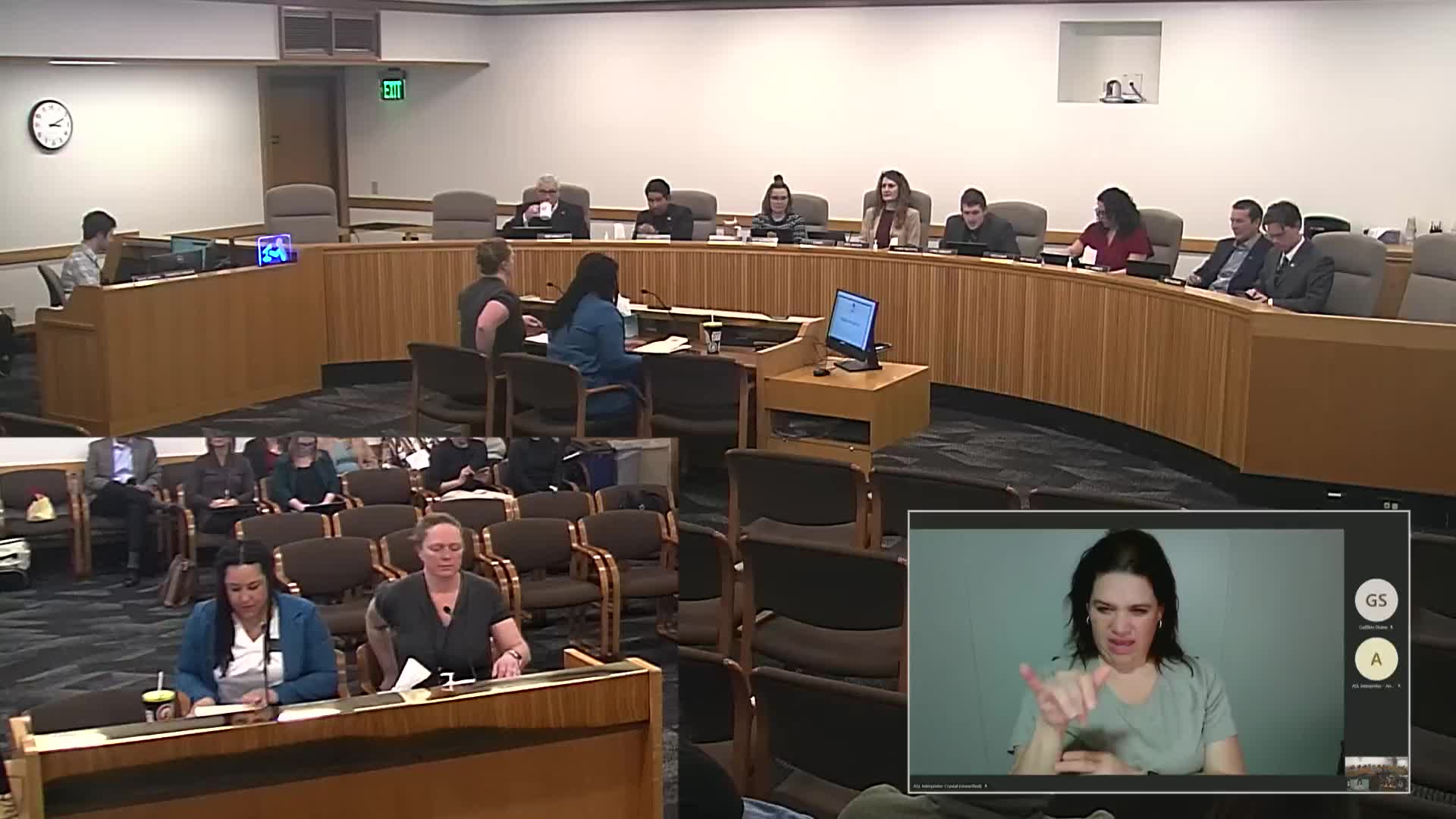
The committee heard the bill for roughly an hour and a half in a paneled public hearing and asked staff to supply follow‑up materials, including district goal examples and grant details, for members' review before further action.