Get Full Government Meeting Transcripts, Videos, & Alerts Forever!
Get email alerts on the Education topic
No spam. Unsubscribe anytime.
Teacher Standards and Practices Commission warns of staffing, licensing and budget shortfalls; public testimony set for next day
Summary
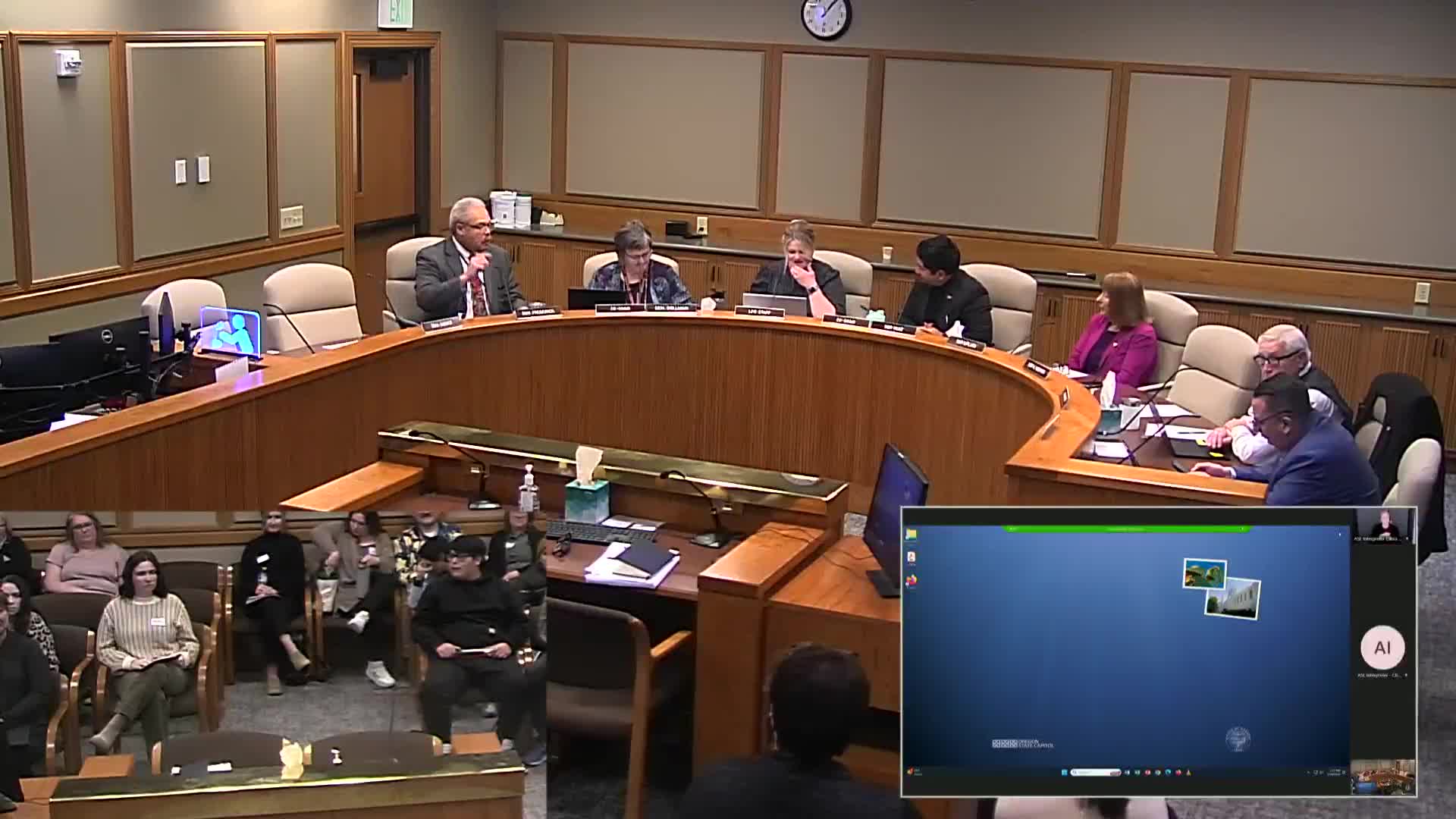
Interim TSPC executive director Melissa Goff told the House Education Subcommittee on Feb. 26 that the Teacher Standards and Practices Commission (TSPC) is facing investigator shortages, growing case backlogs and a possible multi-year budget shortfall unless the Legislature increases funding or the commission raises license fees.
Interim TSPC executive director Melissa Goff told the House Education Subcommittee on Feb. 26 that the Teacher Standards and Practices Commission (TSPC) is facing investigator shortages, growing case backlogs and a possible multi-year budget shortfall unless the Legislature increases funding or the commission raises license fees.
Goff summarized staffing and licensing data, proposed agency legislation and the fiscal tradeoffs facing TSPC during an informational hearing on the agency’s budget bill (mentioned in committee as House Bill 5037; committee discussion contained inconsistent references to bill numbers). She said public testimony on the bill was scheduled for the committee the following day.
Why it matters: TSPC issues teacher licenses, investigates allegations of educator misconduct and maintains disciplinary records. Gaps in investigative capacity and licensing delays can affect how quickly districts learn about active investigations and how long classrooms go uncovered by qualified staff, especially in rural districts with hard-to-fill positions.
TSPC presentation and key figures
Melissa Goff, interim executive director, told the committee TSPC received 463 case referrals in calendar year 2024 and that the agency continued to close cases at a steady rate but remains concerned about cases that were not investigated during the school year. She said almost 80 percent of cases resulted in charges or other formal administrative actions while a comparable number were administratively closed, and that 44 cases in 2024 resulted in sanctions that were brought before the commission.
Goff said current investigative staffing consists of four permanent investigators and one limited-duration investigator, plus one temporary investigator; she reported current investigator caseloads of about 1:112 and a projected caseload of roughly 1:140 for next year. On staffing and service needs, she said, “If we were staffed with the public service representatives that we need ... the estimated increased cost would be $13,425,000 for the next 10 years.” She added a preliminary estimate that meeting recommended staffing would require increasing license fees by about $56 per educator, while noting that the calculation had not yet been verified by the agency’s financial partner.
Licensing, fees and vacancy data
TSPC staff described three types of substitute licenses: full substitute (three-year term, can serve as long-term temporary substitute), restricted substitute (requires bachelor’s degree, assignments limited to no more than 10 consecutive days by statute while the individual pursues preparation), and district substitute (for individuals without a bachelor’s degree and limited to the sponsoring district). Goff said emergency licenses (no college degree) and restricted licenses (degree in a different field) are a substantial portion of the current classroom workforce.
On workforce numbers, TSPC cited openings posted on its jobs portal (data dated Feb. 23): 35 math openings, 28 science openings, 35 ESOL openings and 117 special education openings. The agency noted that special education positions are constrained by federal law requiring at least a college degree for special educators. TSPC officials said some counties with small numbers of openings represent red‑level crisis areas where one or two vacancies have outsized impact.
The agency reviewed fee history: a base license fee of $100 was raised to $140 in 2015 and then to $182 after 2019 legislation (referenced as Senate Bill 155). Goff said that without legislative increases or fee changes, TSPC’s revenues remain essentially flat because the number of applicants is expected to level off near pre-COVID totals of about 24,000 annually.
Agency-proposed legislation discussed
Goff outlined three agency bills presented as technical or enforcement changes:
- Senate Bill 802: would adjust the 90‑day window that allows applicants to begin working while TSPC processes an application so the 90 days would start after the applicant’s background check clears; Goff told the committee the bill would extend processing time by two to three weeks with no fiscal impact.
- Senate Bill 804 (dash‑1 amendment pending): would create civil penalties (up to $1,000 per violation in the original draft) to deter misconduct, address failures to report misconduct and address districts that allow unlicensed educators to remain in assignment. Goff said the dash‑1 amendment removes a provision that would have shifted attorney’s fees to respondents if an ALJ upheld a finding, because judiciary members warned it could deter people from pursuing due process. She cautioned that penalty revenue would not fully fund needed investigator hires but could offset some Department of Justice (DOJ) costs. The presentation listed about $241,000 in non‑personnel DOJ costs for investigations and hearings; Goff said the dash‑1 would reduce the expected revenue from penalties by removing the hearing‑fee recovery provision.
- Senate Bill 805: would shorten the time TSPC keeps patron (public) complaints open while the agency waits for a district to attempt remedy, reducing the period from 12 months to 6 months so the complaint queue more accurately reflects active matters.
Investigations and definitions
Committee members asked about how investigation status appears to hiring districts. Goff said educators must self‑report active investigations during hiring processes and that statutes limit what TSPC can disclose while matters are pending; she explained that the most serious matters are marked as “under investigation” but other details generally cannot be shared while active. On definitions, Representative Wright asked for clarification on “boundary violations” and “grooming.” Goff explained that grooming refers to a pattern of written, verbal or in-person behavior intended to place a student in a compromising position over time and that grooming does not always fall within statutory categories that would trigger prioritized 90‑day handling under past legislation.
Customer service and IT project
TSPC reported key performance measures showing improved email response times (three days target) and application processing (30‑day evaluator review target). Director Elizabeth Keller, director of licensure, spoke to improvements in processing despite several past data system conversions. The agency said it is in stage gate 2 on a major educator data system intended to replace its current e‑licensing and investigation systems; the project requires additional spending authority for the current biennium and further funding in 2025–27.
Committee discussion and next steps
Legislators asked whether TSPC functions could be folded into the Oregon Department of Education (ODE) and whether ODE’s investigators or IT projects could substitute for TSPC’s needs. Goff and Christina Edgar, director of professional practices, said ODE lacks an existing data system that would meet TSPC’s needs and that ODE is undertaking its own large data project; TSPC staff said cross‑agency data interoperability is a priority but that ODE investigators and staff could not, as currently staffed, absorb TSPC’s caseload.
No formal committee votes were recorded at the informational hearing; the co‑chairs closed the informational hearing and the committee’s staff reminded the public that a formal public hearing with testimony on the TSPC budget bill would be held the following day.
Ending
TSPC asked the Legislature to consider either agency funding in the budget or a fee increase to address staffing and IT needs; the agency said it would present updated fee projections and staff scenarios to committee staff. Public testimony on the agency’s budget bill was scheduled for the next day, when members of the public and stakeholders could register on OLIS.