Get Full Government Meeting Transcripts, Videos, & Alerts Forever!
Get email alerts on the Budget Commission For The Blind topic
No spam. Unsubscribe anytime.
Human Services subcommittee holds public hearing on HB 5003, Commission for the Blind budget
Summary
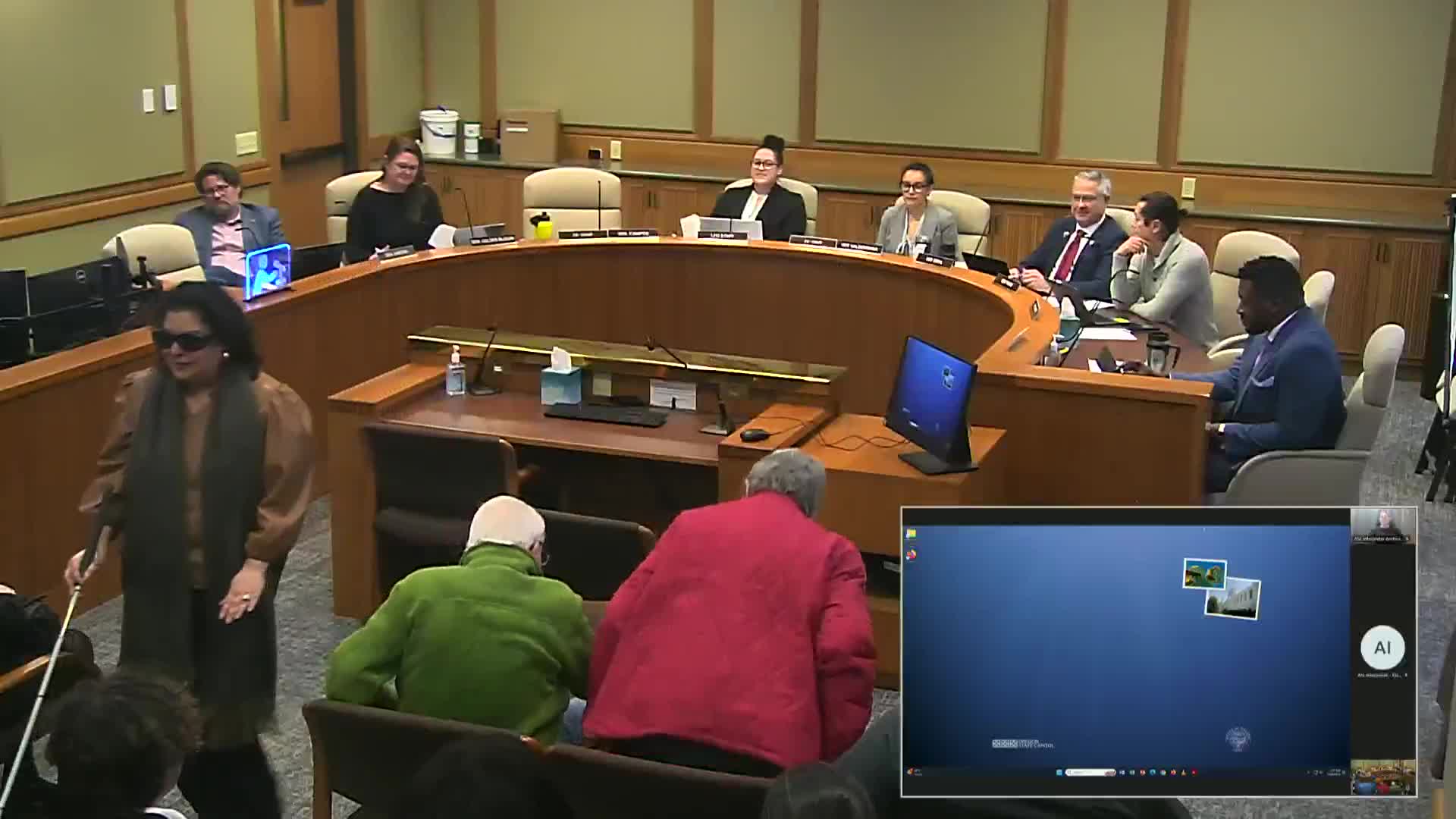
The House Human Services Subcommittee on Feb. 26 held a public hearing on HB 5003, the governor's budget for the Oregon Commission for the Blind, hearing presentations from the Department of Administrative Services and agency leaders and testimony from clients and advocates.
The House Human Services Subcommittee on Feb. 26 held a public hearing on HB 5003, the governor's budget for the Oregon Commission for the Blind, hearing presentations from the Department of Administrative Services'chief financial office and agency Executive Director Dasia Johnson and testimony from agency clients and advocates.
Mary Michelle Sants of the Legislative Fiscal Office opened the hearing and introduced presenters. For the record, Hari Velopandian, representing the Department of Administrative Services Chief Financial Office, summarized the governor's recommended 2025'27 budget for the Commission for the Blind and said the proposal addresses two main issues: support for the agency's independent-living program serving an aging population and reclassification of positions following a complexity-level change from the Oregon Management Project. "My name is Hari Velopandian, and I'm here representing the DAS chief financial office," he said.
The governor's recommendation includes adding a permanent rehabilitation specialist (described as a 0.75 full-time-equivalent position that begins six months into the biennium) for the independent-living program and multiple leadership reclassifications tied to the agency's new service level. Velopandian said the recommended budget is concentrated in personal services (59 percent), services and supplies (21 percent) and special payments (20 percent), with federal grants remaining the primary revenue source.
Executive Director Dasia Johnson reviewed agency programs, clients served and risks. "Our mission at the Commission for the Blind is to empower Oregonians who are blind to fully engage in life," Johnson said. She told the committee the commission operates four core programs: vocational rehabilitation (the largest by funding), the Orientation and Career Center for the Blind (the agency's intensive training center in Portland), the Business Enterprise Program (vending and food-service small businesses) and the independent-living program that primarily serves older Oregonians.
Johnson said the agency serves nearly 2,000 individuals in a recent federal fiscal year and that referrals rose from 1,244 in 2019 to 1,741 in 2024, with a 15 percent year-over-year increase from 2023 to 2024 largely in independent-living requests. She noted the vocational rehabilitation program is funded under Title IV of the Workforce Innovation and Opportunity Act and receives a favorable federal match (about $4 federal to $1 state); the independent-living grant carries a 9-to-1 federal match. Johnson warned that because most resources are federal, any federal funding disruption (for example a continuing resolution at the federal level) could pose risks to services.
Committee members asked about federal funding uncertainty and staffing. Representative Nelson asked whether there were federal flags the committee should watch; Johnson replied, "At this time, we are waiting for the continuing resolution to be resolved at the federal level. Historically, we have not had any challenges with our federal funding, and so we are hopeful and optimistic that that issue will be either they'll renew the continuing resolution or they'll fund the program for the remainder of the federal year." Members also pressed the agency about recruiting orientation-and-mobility specialists; Johnson described a "grow your own" approach with Portland State University's certification program and national internships to improve recruitment.
Presenters described outcomes and cost savings the agency tracks. Johnson said the program's average wage placement for closed cases was just under $30 per hour and presented an estimate of roughly $1.9 million in total earnings and nearly $400,000 in state and federal taxes from clients closed in the last federal fiscal year. On the older-blind front, she said 76 percent of seniors served in the last federal fiscal year were still living independently, a result the agency frames as preventive of more costly higher-level care.
Public testimony featured clients and advocates describing personal benefits from Commission services and urging continued funding. Cahill McCafferty, a Portland client, told the committee, "They've really changed my life already and my outlook on life as well for the future." Stevie Neon, a 19-year-old from Salem who described themselves as deafblind, said the Summer Work Experience Program gave them skills and community: "Without those resources, I think I would've been a whole lot more lost than I am right now." Several other speakers described how orientation, assistive technology, talking-book access and training helped them regain independence or maintain employment.
Witnesses also discussed the Business Enterprise Program's efforts to innovate; Johnson told the committee the agency is piloting a food cart near the Capitol Park as an alternative vending model and named the projected operator. Committee members closed the hearing without a vote; no formal action was taken during the Feb. 26 meeting.
The subcommittee recorded the hearing as part of the budget review process; staff and legislators may follow up as budget deliberations continue.