Get Full Government Meeting Transcripts, Videos, & Alerts Forever!
Get email alerts on the Higher Education Retirement topic
No spam. Unsubscribe anytime.
Committee adopts emergency amendment and advances bill allowing early-retirement packages at state colleges
Summary
House Bill 1326, as amended to include an emergency clause, lets state-supported colleges and universities offer voluntary early-retirement incentives to eligible full-time staff provided the institution realizes net personnel-cost savings; the committee approved the amendment and passed the bill.
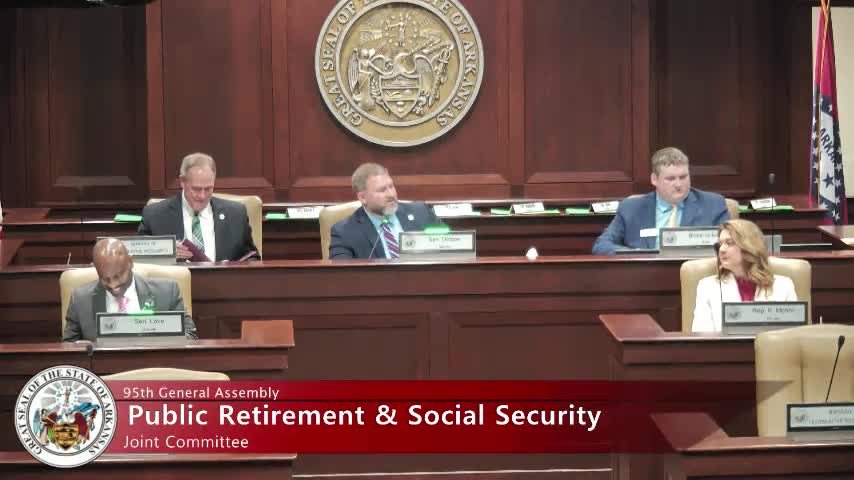
Representative Warren presented House Bill 1326 and an amendment adding an emergency clause to make the bill effective immediately so institutions could use the incentives at the end of the upcoming semester. The committee adopted the emergency amendment by voice vote and then passed the bill as amended.
Representative Warren told the committee HB1326 would allow state-supported colleges and universities to negotiate early-retirement packages on a voluntary basis for eligible full-time staff. Warren said required components are that the employee be full time, meet the institution’s retirement eligibility, participate in an in-state sponsored alternate retirement system, and that the institution realize a savings in personnel costs after offering the package.
Shane Broadway, identified in the record as an expert witness, described the financial mechanics: institutions often pay a portion of insurance or short-term salary costs upfront but must show a net savings to taxpayers or the institution over time. Broadway cited the Henderson State situation as background for current changes and emphasized the bill’s design to allow institutions broader flexibility than prior narrowly targeted provisions.
Committee members questioned safeguards and fiscal limits. Senator Love asked about a previously scratched-out 5% cap that would have limited aggregate allowances in any fiscal year to 5% of prior-year personnel costs; Warren and Broadway said the cap was removed because a uniform percentage can be unduly restrictive across institutions with very different budgets. Broadway and Warren pointed to other safeguards: the requirement that a savings in personnel cost be realized, board approval at the institution level, reporting requirements (including reports of days cash on hand to the Arkansas Department of Higher Education) and oversight by legislative audit.
Warren said the bill does not change state retirement systems and named the affected systems generically (the transcript references state-supported retirement systems such as teachers’ and public employee systems); he and Broadway said the incentives are designed to be financially neutral or net-saving to the institution over time. Broadway told the committee the reporting of days cash on hand to ADHE was a key safeguard created after the Henderson State difficulties: “If we'd have known or somebody would have known that number of the board at the time or others would have known that number at the time, ADHE, somebody could have intervened.”
Members also discussed contract-specific categories such as athletic coaches, whom Broadway said are usually covered by separate contract buyouts and not by the ordinary faculty/staff incentive provisions.
The chair called for a motion to adopt the emergency amendment; the amendment was adopted by voice vote. The committee then voted to pass House Bill 1326 as amended; the chair announced “motion carries.” The transcript does not contain a roll-call tally.
The bill now advances with an emergency clause that sponsors said would allow institutions to implement early-retirement windows at the end of the semester; sponsors and witnesses said institutions must demonstrate net personnel-cost savings and follow board approval and reporting requirements.