Get Full Government Meeting Transcripts, Videos, & Alerts Forever!
Get email alerts on the Coroner Procedures topic
No spam. Unsubscribe anytime.
House Bill 15‑68 amended to clarify when coroners must send drug‑related deaths to crime lab; witnesses describe operational benefits
Summary
Representative Paul Childers amended House Bill 15‑68 to add a Senate sponsor and to change language that determines when county coroners must send suspected drug, alcohol or poison deaths to the crime lab; the Arkansas Coroners Association and the state crime lab director testified in support of the clarifying language.
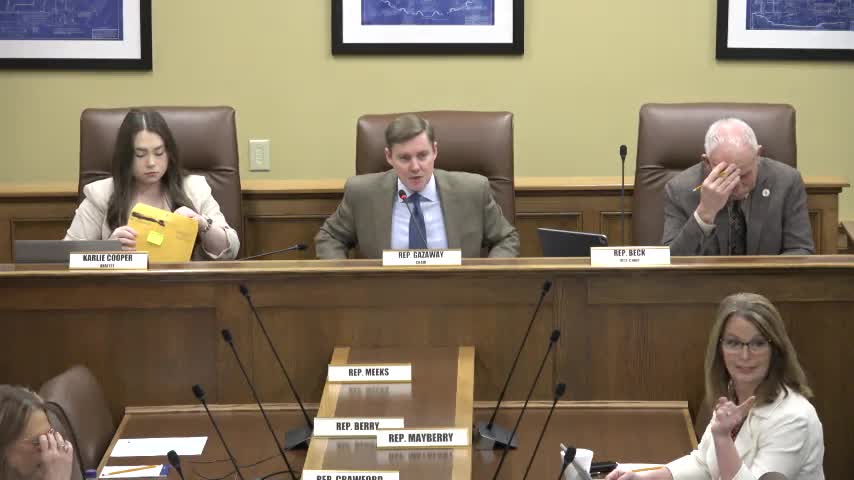
At a meeting of the STATE AGENCIES & GOVT'L AFFAIRS- HOUSE committee (date not specified), Representative Paul Childers introduced an amendment and presented House Bill 15‑68, a bill that clarifies when county coroners must send suspected drug, alcohol or poison deaths for forensic autopsy and toxicology testing.
Representative Paul Childers, State Representative for District 83, said the bill deletes the term "significant interval" from existing law and instead adds a definition of "hospitalized" so coroners and crime labs can distinguish inpatient cases (where medical records exist) from emergency‑room deaths that should continue to be sent for autopsy. Childers also said he needed to add a Senate sponsor; he offered a member's amendment to add Senator Hammer. The committee had a motion to adopt the amendment with Representative Mayberry and Representative Underwood recorded as the moving and supporting members; the amendment was adopted by voice vote.
Kevin Cleghorn, president of the Arkansas Coroners Association, testified the change was mostly clarifying and would help coroners and crime labs manage workloads and identify overdose "hot spots." Cleghorn said, "The term now right now just says a significant interval, and that's a very broad term. That's a very broad time frame, whether it's in the emergency room versus inpatient." He explained that when a decedent is admitted under a physician's care and medical records are available, the coroner may not need to send the case to the crime lab for a full forensic autopsy; emergency‑room deaths should continue to go to autopsy under Act 553. Dr. Brown, identified in the transcript as the chief pathologist and director of the crime lab, was present to answer technical questions.
Representative Childers closed by saying he considered the bill "a good bill" and asked for a favorable vote. The transcript records a subsequent motion to pass the bill by Representative Hawk, but it does not record a final roll‑call or voice vote on the bill itself in the provided transcript; the committee adjourned after that motion was made.
The recorded effect in committee is the adoption of the amendment to add a Senate sponsor and the clarifying language; the transcript does not include final committee passage with a recorded vote tally.