Get Full Government Meeting Transcripts, Videos, & Alerts Forever!
Get email alerts on the Urban Forestry topic
No spam. Unsubscribe anytime.
South Pasadena commission approves removal of mature oak at 1813 Marengo Avenue
Summary
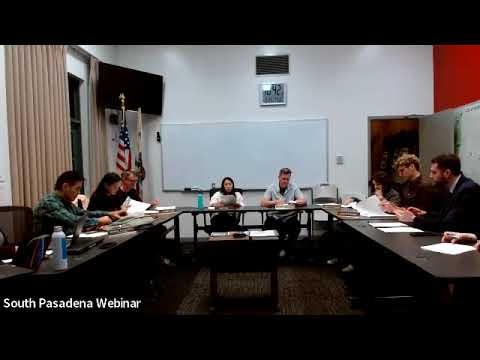
The Natural Resources and Environmental Commission voted unanimously Feb. 25 to approve a tree removal permit for a mature oak at 1813 Marengo Avenue after staff and the applicant presented arborist findings and a replacement plan; neighbors voiced objections and safety concerns.
The Natural Resources and Environmental Commission approved a tree removal permit renewal Feb. 25 for a mature oak at 1813 Marengo Avenue following staff recommendations and public comment.
Staff told the commission the city arborist inspected the oak on Dec. 4, 2024, and concurred with the applicant's arborist that the tree was in poor health and structurally unstable. Staff cited two municipal-code criteria supporting removal: that the tree was diseased or damaged and that replacement plantings would provide greater benefit than retaining the existing volunteer oak. Staff also outlined permit fees and replacement requirements: an initial inspection fee of $241 was paid, a $364 removal permit fee would be charged upon approval, and the applicant must deposit $848 (two replacement trees valued at $424 each) to be refunded when replacement requirements are met.
The homeowners said the volunteer tree grew within a former fence line, has damaged an existing fence and presented a safety concern for the household. Erica (applicant) told the commission she and her family bought the property in August, described a history of overgrown vegetation and said the triangular lot has limited space to accommodate large replacement trees. Erica said the family would prefer to replant on-site but asked the commission to consider allowing forfeiture of the deposit if on-site planting proved impossible; staff explained the city’s current process makes the deposit a forfeiture to a replacement fund if replacements are not installed within the required period.
Neighbors and public commenters disputed parts of the applicant's arborist report and raised preservation concerns. Andrew Gladys, a nearby resident, argued the large oak appeared to be decades old, warned against excessive canopy pruning and said existing hardscape and mulching near roots already stress the tree. A Zoom neighbor who said they signed the objection letter said the bottlebrush on the site had an 18-inch cumulative caliper and asked the commission to review how the city treats multi-trunk shrubs versus trees.
Commission discussion referenced the municipal code's four approval criteria for removal permits: risk to persons or property, unreasonable hardship to the property owner if denied, disease/damage making a tree nonviable, and when replacement plantings would provide greater benefit. Several commissioners said they found staff's analysis persuasive, noted the site's safety concerns and the difficulty of fitting two large replacements on the lot, and encouraged using this case to inform future code updates.
The motion to approve the renewal of the tree removal permit passed on a roll-call vote: Chair Siegel — yes; Vice Chairing — yes; Commissioner Deville Bork — yes; Commissioner Law — yes; Commissioner Robojewski — yes; Commissioner Yeat — yes. Staff noted that if replacement trees are not planted on site the deposit becomes a forfeiture after the city’s required planting window (the permit specifies deadlines; staff said forfeiture becomes final one year after approval if replacement requirements are not met).