Get Full Government Meeting Transcripts, Videos, & Alerts Forever!
Get email alerts on the Enrollment And Formula topic
No spam. Unsubscribe anytime.
Committee examines correspondence enrollment declines and foundation-formula impacts on district funding
Summary
DEED presented projections showing declines in both brick-and-mortar and correspondence average daily membership for FY26; lawmakers raised concerns about hold-harmless provisions, school-size multipliers and how correspondence growth and subsequent declines affect district finances.
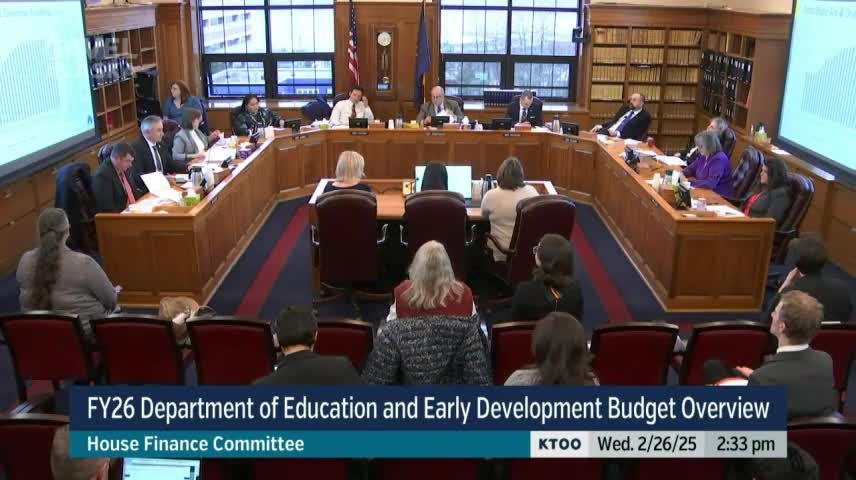
Department officials told the House Finance Committee the state projects a decrease in average daily membership (ADM) for FY26 and outlined how correspondence and brick-and-mortar trends factor into funding calculations.
Deputy Commissioner Karen Morrison explained the department’s projections: the department reported a total projected ADM decrease of 2,053 students, of which 1,270 is a projected decrease in brick-and-mortar ADM and 783 is a projected decrease in correspondence ADM. Morrison summarized proportional changes by saying, for the current comparison, the brick-and-mortar decrease represented 61.9% of the loss while correspondence accounted for 38.1%.
Why it matters: committee members expressed concern about funding volatility tied to correspondence programs. Representative Stack and others noted that districts that saw student movement to correspondence during the pandemic may later lose funding when hold-harmless periods expire and the formula rebalances. The department explained that the formula includes provisions — multipliers, hold-harmless protections for closures and a 5% drop threshold that triggers protections — and that recent legislative changes tried to recognize services districts provide to correspondence students.
Lawmakers asked the department to provide more granular demographic breakdowns of students newly enrolled in the Alaska Performance Scholarship (APS) program, and to explain district-level impacts from correspondence shifts. The department agreed to supply additional data about the 900-plus newly reported APS recipients and to provide further analysis showing where enrollment shifts are concentrated by district.
Ending: DEED will provide district-level breakdowns of the ADM changes, demographic data for newly eligible APS recipients and analyses of how correspondence trends interact with hold-harmless and school-size multipliers within the foundation formula.