Get Full Government Meeting Transcripts, Videos, & Alerts Forever!
Get email alerts on the Broadband topic
No spam. Unsubscribe anytime.
DEED: fewer broadband grant applicants and Starlink adoption reduced FY26 broadband ask
Summary
Department officials told House Finance that some districts no longer apply for the state broadband assistance grant because they have alternative service (for example, Starlink) or exceed program speed thresholds; lawmakers asked for a district-level count of remaining broadband needs.
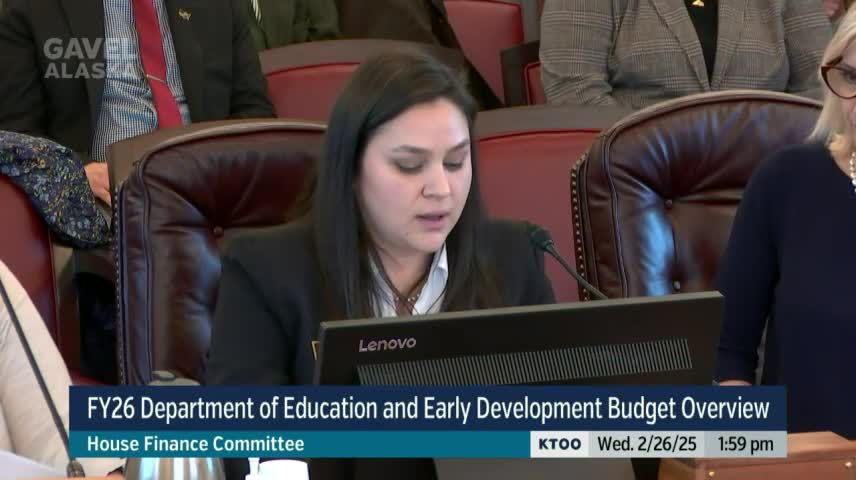
At the House Finance Committee presentation on Feb. 26, Department of Education and Early Development officials said projected FY26 spending for broadband assistance grants is lower because some districts have changed technologies or exceeded program thresholds.
Heather Heineken, director of finance and support services for the department, told the committee she did not have a full year-to-year comparison available immediately and offered to provide the data later. Commissioner Dina Bishop and staff explained the practical reasons: some districts have shifted to commercial satellite services and other technologies and therefore do not qualify under the program’s eligibility limits.
Deputy Commissioner Karen Morrison described the eligibility rule that limits state broadband assistance to connections up to 100 megabits per second: districts that have moved to faster or alternative services may be ineligible for those particular grants. Morrison cited an example the department has tracked: “Lower Yukon moved, straight to, Starlink, and they have burstable services. And so they are not utilizing the FCC money nor our local money because they have moved to a different technology.”
Why it matters: lawmakers said the change could reflect broadband progress in some areas but leave truly remote districts still underserved. Representative Hannon asked the department to enumerate how many districts remain unable to get service above 100 Mbps and to identify which are most in need of state assistance.
The department agreed to provide a count of districts that still require assistance and additional detail about the FY26 grant request and prior-year appropriations.
Ending: committee members asked for a district breakdown and historical appropriations comparison to determine whether the lower FY26 grant figure reflects fewer applicants or completed connectivity projects.