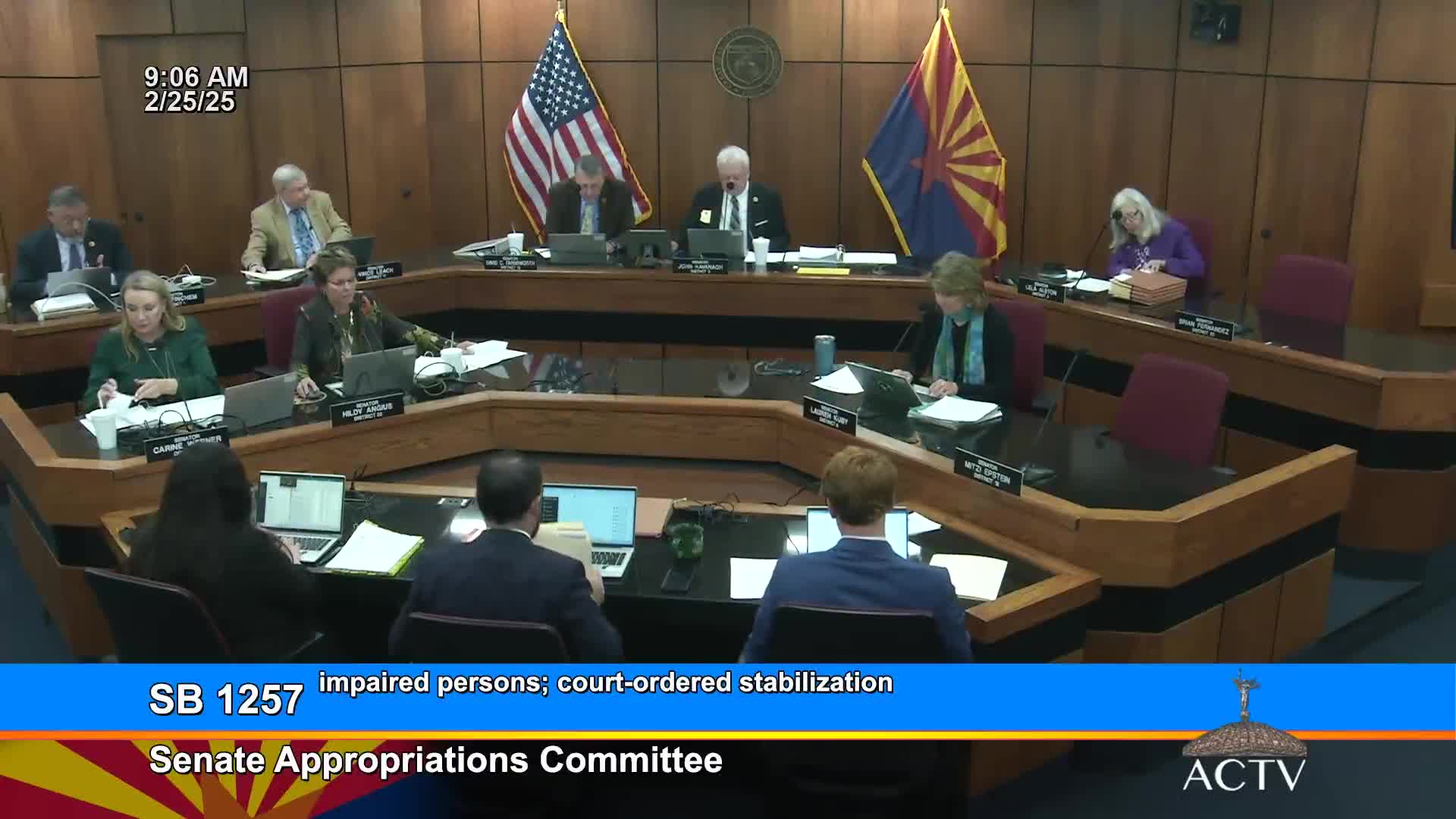
Senate panel backs court-ordered five‑day stabilization for people impaired by substances, amid civil‑liberties concerns
Loading...
Summary
The Senate Appropriations Committee gave Senate Bill 12‑57 a due‑pass recommendation after public testimony both supporting a five‑day court‑ordered stabilization pathway for people impaired by substance use and warning about legal and service‑capacity risks. Vote: 8 ayes, 2 nays.
The Arizona Senate Appropriations Committee recommended passage Thursday of Senate Bill 12‑57, a bill that would allow admitting officers at evaluation agencies to petition a court for up to five calendar days of court‑ordered stabilization treatment for persons impaired by intoxication, withdrawal, or substance‑induced symptoms.
Supporters, including a coalition of Tucson stakeholders and clinicians who operate crisis response centers, told the committee the measure addresses repeat safety and public‑order incidents tied to methamphetamine and other substances by allowing clinicians time to see whether persons who appear impaired will clear and accept voluntary treatment. Dr. Margie Balfour, a psychiatrist with Connections Health Solutions, said the clinical literature and experience indicate that impairment from methamphetamine can take up to five days to clear and that two days is often insufficient to stabilize a patient and engage them in treatment.
Opponents in public testimony, including Jeanne Woodbury on behalf of the ACLU of Arizona and Arizona Attorneys for Criminal Justice, urged the committee to reject the bill because it may expose the state to lawsuits, could be applied to people with serious mental illness and create “revolving‑door” commitments if community treatment capacity is inadequate, and because involuntary short‑term detox has limited evidence for producing long‑term recovery. Woodbury also said the state lacks secure residential beds and that repeated short holds could be destabilizing for individuals.
The bill would require evaluation agencies to assess a person daily and discharge or convert to voluntary admission once the person no longer meets the definition of “impaired person.” It prohibits detained persons from being treated for impairment without consent except in emergencies for safety and requires that costs of stabilization proceedings and services be billed to AHCCCS or another third‑party payer, not to the individual or evaluation agency. The sponsor and supporters said the process is optional for counties and is intended as a tool for high‑risk individuals who repeatedly appear impaired, not as a long‑term civil‑commitment regime.
Committee debate and public testimony emphasized two continuing implementation questions: whether counties and crisis centers have the bed capacity and staff to keep people for up to five days, and whether the state has legal exposure if people with co‑occurring serious mental illness are moved under a substance‑focused pathway. Senator Leach (sponsor) and clinicians said the measure is intended to move people from Title 36 Chapter 5 (emergency behavioral health holds) to Chapter 18 (substance use treatment pathways) in appropriate cases; ACLU witnesses and others warned that without additional funding and bed capacity the bill risks generating litigation and short cyclical stays.
The committee moved the bill with a due‑pass recommendation. The roll call vote was 8 ayes and 2 nays.
Outcomes: The committee recorded the motion to give Senate Bill 12‑57 a due‑pass recommendation; the tally printed in the hearing transcript was 8 ayes, 2 nays.
The bill text sets specific guardrails — a five‑calendar‑day maximum under the court order, daily clinical reassessment, limits on forced treatment except for emergencies, and a payer rule shifting costs to AHCCCS or third‑party payers — but does not appropriate new state general fund monies in the committee version heard Feb. 24. Supporters and opponents told the committee they intend to keep negotiating implementation details, particularly clarifying who pays, how counties opt in, and how courts will review petitions.
The committee hearing record includes detailed clinical testimony from crisis‑center staff, local county officials from Pima County describing the regional problems that motivated the bill, and civil‑liberties testimony urging caution and additional safeguards. The bill will proceed to further floor consideration where authors and stakeholders said they expect to continue working on definitions and operational questions.