Get Full Government Meeting Transcripts, Videos, & Alerts Forever!
Get email alerts on the Airport Zoning And Noise topic
No spam. Unsubscribe anytime.
Flagler County presents airport zoning draft; council seeks answers on noise, safety and growth
Summary
County staff briefed the Palm Coast City Council on a draft airport zoning ordinance required by Florida Statutes Chapter 333 and on airport surfaces, noise contours and the runway protection zones. Council members pressed for parcel counts, updated noise contours in the upcoming airport master plan, and information on tower manning and radar.
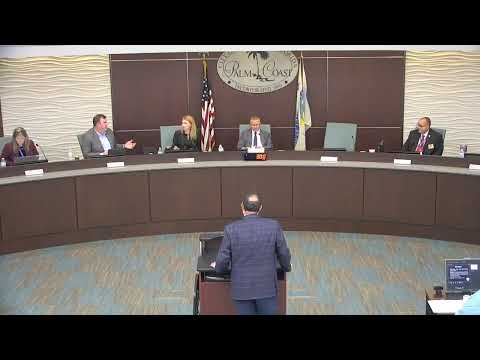
Adam Mangle, Growth Management Director for Flagler County, briefed the Palm Coast City Council on March 3 about draft airport zoning regulations that the county is developing to comply with Florida Statutes chapter 333 and FDOT guidance.
Mangle said the statutes require local governments whose boundaries fall within airport hazard areas to adopt airport-protection zoning and procedures for permitting structures or other obstructions that could interfere with aircraft operations. “Airport zoning requirements are found in chapter 333 Florida Statutes,” he said during his presentation.
The county’s draft ordinance would create two mapped areas: an airport height-notification zone (a set of overlapping surfaces including horizontal and conical surfaces that trigger federal notice or permitting if an object or structure extends into them) and an airport overflight zone (which combines runway protection zones and noise contours and includes tighter limits on specified land uses). Mangle showed maps of the airport’s runways, the horizontal/conical/approach/transitional surfaces and the existing noise contours derived from an environmental assessment done as part of the runway extension.
Roy Seager, director of Flagler Executive Airport, told the council the airport will update noise contours as part of the upcoming airport master plan. “We will be doing an update to our noise contours in the upcoming airport master plan,” he said. County staff and airport officials said the master-plan update will begin in mid-2025 and will include a noise-contour update; that process can take many months and FAA review may follow.
Council members raised safety and quality-of-life concerns during lengthy questioning. Councilmember Pontier and others asked about the frequency of operations, the effect of touch-and-go training flights (multiple takeoffs and landings counted as separate operations) and whether unmanned tower hours increase safety risks. Seager and other county staff said the tower is a contract tower that is manned during daytime hours (the meeting record showed the tower is manned roughly 6 a.m. to 8 p.m.) and that radar and other situational-awareness systems for contract towers are handled by FAA funding streams outside local control. Seager said he has sought radar/systems funding from federal sources and noted FAA plans to deploy situation-awareness displays to contract towers.
Mangle said county staff had previously provided a draft ordinance to the FDOT aviation office and that the county intends to continue the adoption process this spring. The county outlined near-term steps: appoint an airport zoning commission, present the draft to the county planning and development board on March 11, aim for first reading of the ordinance on April 7 and second reading and adoption on April 21 (dates provided by county staff during the briefing and subject to scheduling). Mangle also said staff would answer council questions about parcel counts in each zone and other technical clarifications.
There was discussion about what would happen if future updates to the master plan or runway configuration expanded noise contours or runway-protection areas so that those mapped zones crossed into privately owned parcels. County staff said the draft ordinance addresses nonconforming uses and includes procedures for disclosure and handling of nonconformities; staff also noted avigation easements and past development agreements that included disclosure language for affected subdivisions.
No vote on an ordinance occurred at the March 3 council meeting; the briefing was informational. Council members asked the county to provide additional data (parcel breakdowns by surface zone, operations counts by manned/unmanned tower hours, and clarification of the timeline for the master-plan noise-contour update) and discussed possible options to address safety concerns, including exploring different tower-manning approaches, funding for situational-awareness systems and operational policies to reduce nighttime training flights.