Get Full Government Meeting Transcripts, Videos, & Alerts Forever!
Get email alerts on the Animal Shelter Contract And Capacity topic
No spam. Unsubscribe anytime.
Advocates, council press for review of Flagler Humane Society contract and capacity
Summary
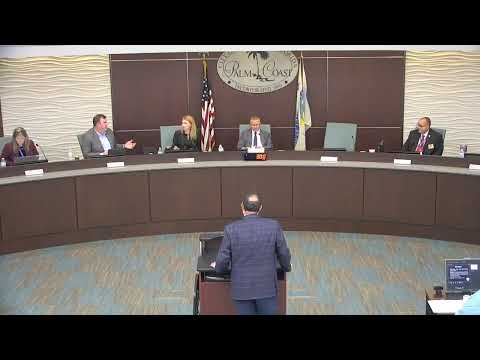
Wendy Tramarci, a representative of Bridal Refuge Flagler, told the Palm Coast City Council on March 3 that Flagler County and local cities together spent roughly $416,000 in fiscal year 2024 on Flagler Humane Society and urged local governments to consider creating a second municipal animal shelter.
Wendy Tramarci, a representative of Bridal Refuge Flagler, told the Palm Coast City Council on March 3 that Flagler County and local cities together spent roughly $416,000 in fiscal year 2024 on Flagler Humane Society and urged local governments to consider creating a second municipal animal shelter.
Tramarci said Flagler County contributed about $284,000, Palm Coast about $90,000, Bunnell roughly $26,000 and Flagler Beach about $16,000. She told the council her group visited municipal shelters in other counties and found widely varying kennel counts, staffing levels and operating budgets. “We are only 1 of 13 counties in Florida to not operate a municipal shelter out of 67,” she said.
The presentation argued the county’s current shelter capacity and governance expose the community to risk if the private shelter cannot—or chooses not—to continue operations. Tramarci told the council Flagler Humane Society (FHS) operates 56 kennels and, according to the presentation she delivered, showed staffing figures and operating-cost comparisons that she said point to inefficiencies. She also said municipal shelters the group visited reported annual operating budgets typically below the $6 million figure FHS cited in earlier discussions and that an average from the visits was about $2.5 million.
Council members and members of the public contested some of those claims at the meeting. A board member who identified herself as a FHS board member said the shelter employs veterinarians and medical staff on multiple days per week and that the figure of “40 employees” includes nine thrift-store staff and multiple part-time roles. John Reynolds, a FHS board member, said the shelter runs programs for aggressive dogs and other services that affect intake and outcomes. Several public speakers, including Caroline Johnson of SMART and other volunteers, described volunteer-run lost-pet and foster networks that they said reduce shelter intakes and costs.
Vice Mayor (name not given) and Council members said the presentation nonetheless raised questions about transparency, accountability and how tax dollars are being used. Councilman Gampero and Councilman Miller both said they want to see alternatives and clarified that FHS is a private entity the city cannot directly operate but that the city can seek other service providers or municipal options.
City Manager (name not given) told the council staff would review any redline contract text, work with county staff and the Humane Society, and return with information this summer because the contract currently on file runs through Sept. 30. The manager and council set a near-term timeline: staff will gather answers to council questions, meet with county partners and target a joint city–county meeting in April to discuss options and next steps. The city manager said staff would send the presentation and questions to the Humane Society so the group can respond and meet with its board.
No formal motion or vote on the contract occurred at the March 3 meeting. Instead, the council directed staff to compile clarifying information, seek responses from the Flagler Humane Society and schedule a joint meeting with the county in April. Staff also said they would return with budgetary impacts and alternatives to allow the council to consider whether to renew the contract when it expires on Sept. 30.
Supporters of the Humane Society and several residents also spoke in defense of FHS programs, citing spay/neuter, vet and foster programs and arguing that volunteer-led efforts and the shelter’s programs have reduced intake and euthanasia in recent years. Several speakers recommended working cooperatively to improve oversight and performance rather than ending the contract immediately.
The council’s next steps, as recorded at the meeting, were: (1) staff to collect and deliver requested data and clarifications from the presentation to the council and the Humane Society; (2) staff to coordinate with Flagler County for a joint city–county meeting targeting April; and (3) staff to identify “worst-case” alternatives should the council choose not to renew the contract when it expires Sept. 30. The city manager said any recommended changes could have budgetary effects and should be returned to council for consideration.
The presentation and the public exchange made the issues of shelter capacity, contract oversight and options for municipal or alternative sheltering a near-term item for the council’s work plan.