Get Full Government Meeting Transcripts, Videos, & Alerts Forever!
Get email alerts on the Beach Management Funding topic
No spam. Unsubscribe anytime.
Flagler County proposes $120M beach and dune plan; half‑cent sales tax and MSBU offered as funding options
Summary
Flagler County presented an 18.1‑mile beach and dune plan with initial construction estimated near $120 million and recurring renourishment costs, proposing a mix of sales tax revenue, an MSBU, TDC funds and grants to close a multi‑million dollar shortfall.
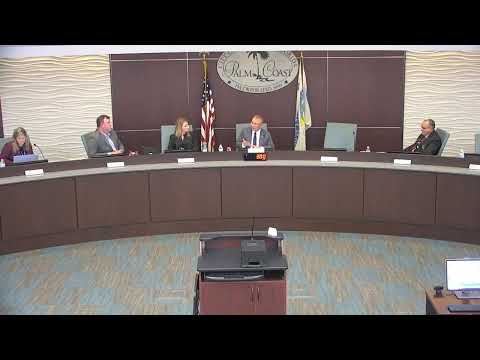
Flagler County Administrator Heidi Petito presented a countywide beach and dune management plan and a proposed funding strategy to Palm Coast City Council at a workshop, outlining construction costs, maintenance forecasts and several potential revenue options.
Petito said the county’s coastal plan divides the shoreline into multiple reaches. Reach 1, an Army Corps project completed last year in Flagler Beach, placed about 1.7 million cubic yards of sand across about 3.4 miles at a reported total cost near $29 million. Reach 2 is planned as a 5.5‑mile dredge using an offshore sand source and is estimated at roughly 1.8 million cubic yards and $35 million. Petito said initial county estimates put total construction costs for the county’s 18.1 miles at about $120 million with a local share (matches and non‑federal portions) of roughly $42.4 million.
To sustain the shoreline after initial construction, consultants recommended periodic renourishment on about a six‑year cycle. The county’s equivalent annual cost for ongoing maintenance was presented at about $12 million per year (a six‑year total near $72 million). Petito said the county currently has about $5 million available in the fiscal year 2025 budget and estimated a $22.4 million shortfall to complete initial construction over three years even with pending grants and other contributions.
Funding options presented by staff included: carving out part of the county’s current half‑cent local option sales tax (a county decision requiring a supermajority), creating a municipal service benefit unit (MSBU) on the barrier island with a proposed illustrative flat fee (the staff example used $160 per parcel), allocating TDC capital funds for an initial period, using a small dedicated portion of ad valorem property tax for publicly owned beaches, pursuing state and federal grants (DEP, FEMA/DEM, Army Corps feasibility and federal matching programs), and a potential dedicated portion of existing millage rather than a millage increase.
Petito emphasized the economic importance of the coastline: “Last year alone, we had just under a million tourists in Flagler County,” she said, and cited the county tourism director’s estimate that tourism had an approximately $890 million annual economic impact. She added that about 50% of visitors come for the beach and argued that investing in beach resiliency protects the tourism economy, public access and property values.
Council members pressed several policy and equity questions. Councilman Gambiero urged putting any half‑cent sales tax increase to a public referendum so voters could decide directly; he said residents already face utility and other rate pressures. Other council members expressed concern about dedicating capital funds from the Tourist Development Council (TDC) and asked whether revenue collected countywide should be applied to the beach when some constituencies (inland residents or municipalities) use county services differently.
Technical and permitting constraints also shaped the discussion. Petito and staff explained parts of the coastline have hard bottom and environmental sensitivities that may preclude dredge operations and raise costs — truck‑haul sand costs can be about three times dredge unit prices in the county’s estimates (staff cited roughly $25 per cubic yard for dredge material versus $75 per cubic yard for truck haul). Several speakers also urged continued pursuit of Army Corps studies and hazard mitigation grants; Petito said the county has pending grant work and had submitted FEMA CAT G documentation with an estimated $12 million claim and $2 million local match.
Next steps and disagreements: Petito said staff will continue interlocal coordination with coastal municipalities, refine the funding strategy and return to the Flagler County Board of Commissioners for formal consideration; she also planned to present the proposal to the TDC and to the county board in early March. Council members requested written analyses of likely impacts to city budgets and services and said they wanted more time to weigh whether county‑wide sales tax revenue should be used for beaches or for public safety and other needs. Gambiero and others asked that, if the county pursues a new half‑cent sales tax, the county consider taking the proposal to voters.
Ending: The county sought council feedback and municipal coordination before a public decision; staff said they will refine the funding package, provide more detailed fiscal impacts for Palm Coast, and continue to pursue state and federal grants and Army Corps studies.