Get Full Government Meeting Transcripts, Videos, & Alerts Forever!
Get email alerts on the Airport Zoning topic
No spam. Unsubscribe anytime.
Palm Coast residents press county over proposed airport zoning overlay, citing noise, flight training and property concerns
Summary
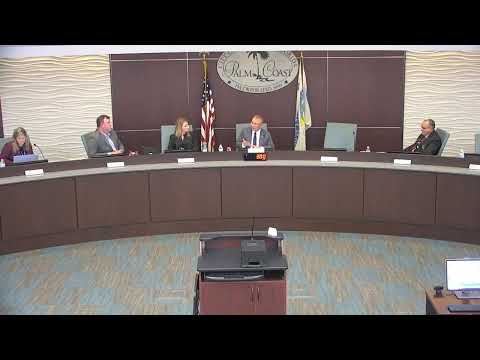
At a Palm Coast City Council workshop, residents and city officials pressed Flagler County staff about a proposed airport zoning overlay, asking for clearer maps, potential property impacts and whether the FAA preempts local controls.
Residents and city officials raised questions and objections about a proposed Flagler County airport zoning overlay during public comment and staff presentations at a Palm Coast City Council workshop.
Residents from neighborhoods near Palm Coast’s general aviation airport said low-altitude training flights, frequent touch‑and‑go operations and imprecise notices about the overlay’s geographic reach are creating anxiety over noise, property values and possible future restrictions.
The county’s presentations described the overlay as a starting point built on the FDOT model and on Florida statute chapter 333, and county staff said they plan to publish interactive maps and the adopted ordinance text before any interlocal agreement is considered. County legal and aviation advisers warned of federal preemption over local restrictions on airspace, and staff suggested the most practical path to reduce neighborhood training flights may be working with the FAA or hiring an aviation attorney to pursue operational limits, such as touch‑and‑go restrictions.
Why it matters: The overlay would create defined airport zones and standards the county says will protect flight safety and public welfare. Residents worry the ordinance’s text could create nonconforming properties or require easements or acquisitions if airport boundaries or noise contours later expand.
During public comment, Darlene Shelley cited state and federal guidance and urged local officials to consider “additional regulations to protect public health, safety, and welfare of their local communities.” Gina Wise of Quail Hollow said the proposal felt like a land‑use ordinance written after much building had occurred and asked, “Where is the public’s disclosure when people purchase their homes?” Faith Walker, a Z‑section homeowner who bought her house in 2022, described repeated low flights over her home and said residents “wake up every morning at 7AM by the sounds of airplanes.”
County staff and outside presenters responded item by item. A county planner said adopting the FDOT model in substantial form would meet the minimum requirements of chapter 333 and that the airport zoning commission the county proposes to create would review the zones and permitted uses shown on maps. Staff told the council the draft ordinance, as written, would not itself create nonconforming lots now, but that nonconformities could arise if either the runway protection zone expands beyond airport property or the airport’s 65‑dB day‑night average (DNL) noise contour grows outward.
Flagler County legal and aviation presenters detailed limits on local authority. County counsel’s office and an outside presenter reviewed federal case law and statutes, noting that Congress delegated authority over navigable airspace to the FAA and that the Airport Noise and Capacity Act of 1990 and subsequent court decisions limit local noise ordinances. The county’s attorney said “the federal government has preemption over any state or local ordinance when it comes to our aviation space,” and advised the county and city to pursue FAA processes where operational restrictions (for example, limits on touch‑and‑go training) are desired.
Staff described two practical next steps. First, the county will produce an interactive mapping tool—possibly integrated into the property appraiser map or the county site—so property owners can check whether a parcel falls within any of the draft zones. Staff said the intent is to have that available before the ordinance adoption so residents can comment with clearer information. Second, staff recommended exploring an FAA engagement strategy and suggested the county and municipalities consider jointly paying for specialized aviation legal counsel to analyze whether the FAA would approve operational limitations and how best to pursue them.
City council members and residents asked for more detailed materials. Several speakers requested copies of the complete presentation slides and supporting documents; county staff agreed to distribute the fuller presentation referenced during the meeting. Staff also said that, should the county adopt the ordinance, they would return to the city with the text of any required interlocal agreement for the council to consider.
What’s next: County staff said the adoption hearing is scheduled in the county process and that, if adoption occurs, the county will return to the city with the text of an interlocal agreement. Staff also said they expect to publish parcel‑level mapping prior to final adoption so homeowners can see whether their property could be affected by noise contours or runway protection zone changes.
Ending: The workshop left open several legal and practical questions — including whether operational changes can be imposed through FAA processes and how the county will notify affected owners — and county staff pledged to provide the requested maps, case law references, and the fuller presentation to the council and the public.