Get Full Government Meeting Transcripts, Videos, & Alerts Forever!
Get email alerts on the Early Education Pre K topic
No spam. Unsubscribe anytime.
Senate committee hears bill to expand state-funded prekindergarten; no vote taken
Summary
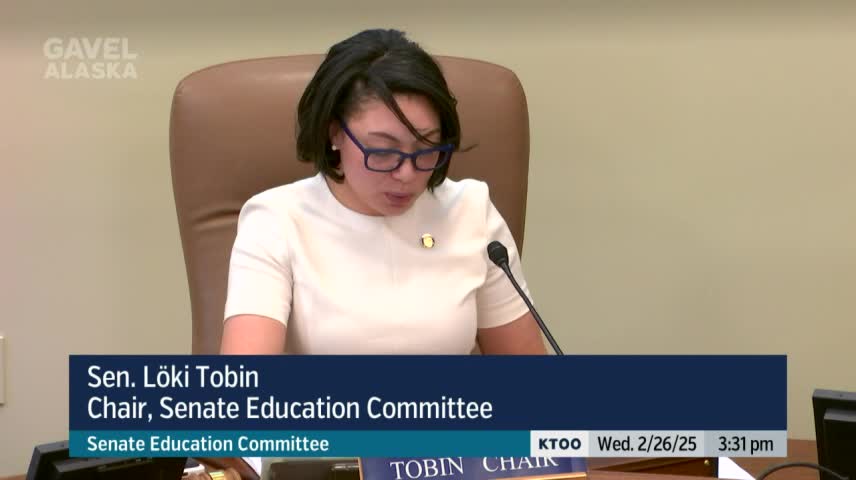
The Senate Education Committee held the first hearing on Senate Bill 93, a measure to expand state‑funded early education, on Wednesday, Feb. 26, in Juneau.
The Senate Education Committee held the first hearing on Senate Bill 93, a measure to expand state-funded early education, on Wednesday, Feb. 26, in the Belts Committee Room at the State Capitol in Juneau.
SB 93 would change the way prekindergarten students in DEED‑approved district programs are counted for funding: the bill would treat each enrolled 4‑ or 5‑year‑old as a full‑time equivalent student (1.0 average daily membership) instead of one half (0.5 ADM). It would also repeal a $3 million annual cap on foundation formula funding for prekindergarten programs and remove statutory repeal language that would otherwise end the current funding structure in 2034. The bill sets an effective date of July 1, 2025.
The measure’s proponents told the committee the change would provide stable, predictable funding for district‑run prekindergarten programs and make expansion more viable statewide. “Senate bill 93 will turbocharge pre k across the state with over 9,000,000 in funding,” staff to Sen. Lukey Tobin said while introducing the bill. The committee received invited testimony from two outside experts, district officials and child‑care advocates, and heard one online public commenter.
Why it matters: Proponents say counting prekindergarten students as full‑time in the funding formula and removing the statutory cap will increase state support and allow more districts to establish or expand DEED‑approved programs. The Department of Education and Early Development (DEED) currently approves district prekindergarten programs for inclusion in average daily membership (ADM) counts; as of testimony, Anchorage School District had full DEED approval, while Skagway and Valdez had conditional approval for 2024–25 and DEED was accepting further applications.
What committee members asked: Senators pressed staff and witnesses on quality standards, regulatory barriers and the fiscal impact. Committee questions addressed whether the bill changes DEED’s existing program standards (it does not), the difference between Head Start and DEED approval requirements, and how the state would measure educational outcomes.
On standards and regulations, committee staff and DEED staff referenced last year’s legislation (House Bill 148) that removed a statutory requirement that prekindergarten programs meet Head Start performance standards for DEED approval. Mike Mason, staff to Sen. Tobin, said that “the regulation change has not been propagated by DEED” despite the statutory change, and that proponents expect the bill plus prior statutory changes to enable more programs to qualify for foundation formula funding.
Research and evaluation: The committee heard a detailed research presentation from Tyler Watts, associate professor of psychology and education at Teachers College, Columbia University. Watts summarized the national evidence base: “preschool program access typically has strong positive effects on children’s academic skills at the point when they enter kindergarten,” he told the committee, while cautioning that longer‑term results are mixed and that program quality and local context matter. Watts recommended building evaluation — including lottery‑based designs where feasible — into any scale‑up to measure effects in Alaska specifically.
Local program experience: Jessie Nesit, director of early learning at the Anchorage School District (ASD), described capacity and demand in Anchorage. ASD operates 37 general education preschool classrooms and used a risk‑based lottery system for limited slots; the district had room for about 598 slots in 2024–25 while receiving more than 1,400 applications. Nesit said the change to a 1.0 ADM would allow ASD to open roughly 10 additional classrooms, serving an estimated 170 to 180 additional students.
Fiscal estimates: Heather Heineken, director of finance and support services for DEED, presented the fiscal note analysis. DEED provided two fiscal notes: one for the Public Education Fund (OMB component 2804) and an informational analysis for the foundation program (component 141). The governor’s FY2026 budget included $7.7 million the department said would be sufficient to cover current and anticipated program needs if SB 93 were enacted. DEED’s illustrative projections showed incremental annual needs beginning at roughly $2.65 million in FY2027 and rising to about $3.8 million by FY2031 under current growth assumptions; the department said the projections assume modest, steady program growth but do not identify which districts would enroll in each year.
Public testimony and stakeholder views: Carolyn Storm, executive director of the Coalition for Education Equity, and Stephanie Berglund, CEO of THRED (a statewide child‑care resource and referral organization), testified in support. Testimony emphasized developmental evidence for early childhood investment and the economic and family benefits of increased preschool access in both urban and rural Alaska.
Committee action: The committee did not vote on SB 93. After the hearing and closing remarks, the chair set the bill aside and moved to other agenda items. Maggie Grenier, staff to Sen. Tobin, told the committee that “Senate bill 93 is only gonna expand them,” referring to existing DEED‑approved prekindergarten programs and the intent to grow them with stable formula funding.
Next steps: SB 93 had its first hearing; the committee has not issued a recommendation. DEED officials and witnesses urged that any expansion include rigorous, localized evaluation plans and noted some implementation work remains — chiefly DEED’s regulation updates to reflect statutory changes enacted previously and the department’s ability to provide technical assistance to districts that lack resources to meet high‑quality standards.
Ending note: The committee received a substantial body of testimony and fiscal analysis but took no formal action on SB 93 at the Feb. 26 meeting. Committee members signaled interest in the bill’s goals while seeking more detail on implementation, regulatory updates and the timeline for districts to become DEED‑approved.