Get Full Government Meeting Transcripts, Videos, & Alerts Forever!
Get email alerts on the Tariffs topic
No spam. Unsubscribe anytime.
Experts tell Alaska lawmakers tariffs would raise costs, risk state exports
Summary
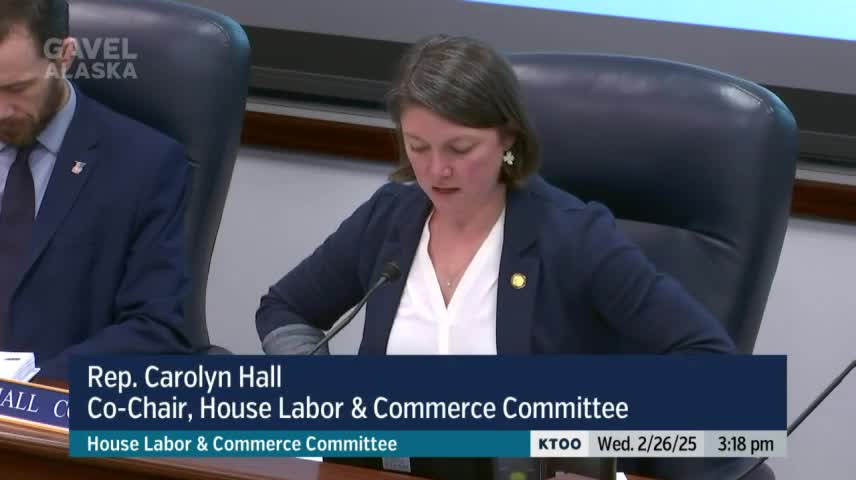
At an Alaska House Labor and Commerce Committee hearing Feb. 26, economics and trade experts said proposed U.S. tariffs would raise consumer prices in Alaska, increase costs for resource producers and could trigger retaliatory tariffs that harm Alaska’s seafood and mineral exports to major markets such as China.
A House Labor and Commerce Committee informational hearing on Feb. 26 drew testimony from economists and trade officials who warned that recent federal tariff proposals would raise costs for Alaskans and could reduce market access for Alaska exporters.
The testimony focused on how tariffs raise domestic prices, create economic inefficiencies and can trigger retaliatory measures abroad that directly affect Alaska’s commodity-based exports. "Alaska will face greater costs in producing natural resources and in doing business and that Alaskan consumers will pay higher costs for the goods they consume," said Kevin Berry, professor and chair of the economics department at the University of Alaska Anchorage.
Berry, who framed his remarks with basic trade models, told the committee that tariffs act as a tax on imported goods and reduce consumer welfare while typically creating only limited production gains. He cited studies of U.S. tariff episodes to show how costs shifted to consumers: after tariffs on washing machines and related laundry equipment, median washer prices rose about $86 and dryer prices about $92, the federal government collected roughly $82 million a year in tariff revenue while consumers paid about $1.5 billion a year in higher costs, and domestic employment in the affected sector rose by roughly 1,500 jobs — a highly inefficient tradeoff by his calculation.
Berry also summarized federal estimates of inflation effects: a 25% tariff on Canada and Mexico and a 10% tariff on China could add roughly 0.5 to 0.8 percentage points to U.S. inflation, atop a roughly 3% year-over-year rate cited for January. He warned that tariffs on inputs — such as machinery, electronics or transportation equipment — raise production costs for domestic industries as well, noting that short-lived tariffs may not encourage new domestic manufacturing where plant startup costs are high.
Greg Wolf, president and CEO of the Alaska International Business Center, said the immediate risk to Alaska comes from retaliation by major buyers of Alaska products. "It's a tax,... it's the Americans who pay the tariff. No one else," Wolf said, explaining that U.S. importers pay tariffs at U.S. ports. He told the committee Alaska exported about $5.93 billion in goods to overseas markets last year and that China was the state’s largest market, buying about $1.5 billion in Alaska minerals and seafood in the most recent year.
Wolf warned committee members that foreign retaliation already has targeted American commodity exports and could place Alaska exporters at a disadvantage compared with sellers from countries that face lower or no tariffs. He described scenarios in which Alaska products are processed abroad and could be subject to tariffs both when they enter the processing country and again on return to U.S. markets.
At the ports, Jesse Groom, vice president of the Alaska International Longshoremen and Warehouse Union in Seward, told the committee that the state’s supply chain has already shown signs of disruption: "We primarily bring in pipe, fracking sand, building supplies," he said, and reported that several shipments scheduled for spring had been delayed or canceled as shippers awaited tariff clarity.
Committee members asked presenters for clarification on which goods had previously been targeted by tariffs. Berry and others noted that semiconductors and pharmaceuticals were among the categories publicly discussed for new tariffs and that recent actions had included increases on aluminum and steel and proposals for tariffs on autos and certain electronics; Berry described the policy debate as sector-specific rather than universally beneficial.
Why this matters: Alaska sells undifferentiated commodity goods (seafood, minerals) into global commodity markets, Berry said, which can make it harder for Alaska producers to shift tariff costs onto foreign buyers. At the same time the state imports energy, machinery, electronics and other inputs that tariffs would make more expensive, raising costs for resource development and construction.
The committee did not take formal action on trade policy; members were encouraged to contact presenters for follow-up. The hearing record includes written slide sources and academic papers cited by Berry, and committee staff noted the presentations are available for further review.