Get Full Government Meeting Transcripts, Videos, & Alerts Forever!
Get email alerts on the Workers Compensation topic
No spam. Unsubscribe anytime.
Labor Department outlines workers' compensation costs, fraud, contractor tests and new 'stay-at-work' coordinator
Summary
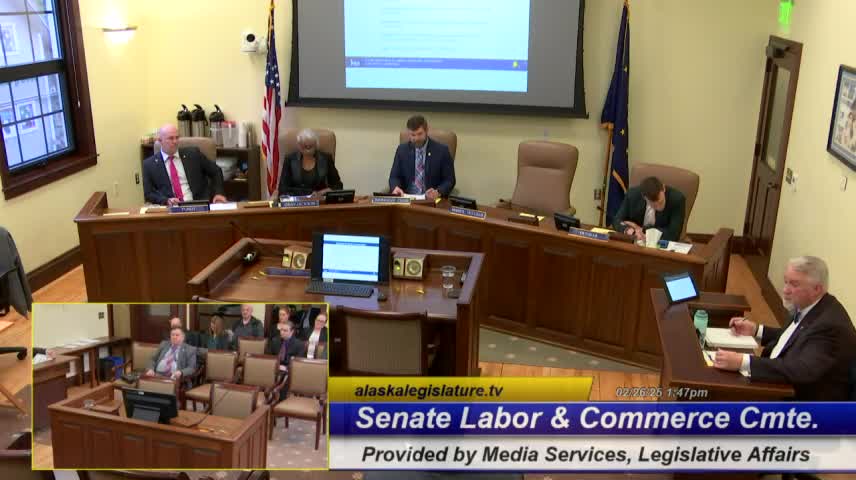
Director Charles Collins briefed the Senate Labor and Commerce Committee on workers' compensation program finances, fatality reporting, fraud investigations, independent-contractor guidance for seasonal workers and a new stay-at-work coordinator created by last year's SB 147.
Charles Collins, director of the Division of Workers' Compensation, told the Senate Labor and Commerce Committee on Feb. 26 that Alaska oversees hundreds of millions in benefit payments and is making operational changes intended to reduce costs and improve return-to-work outcomes.
Collins said the division “oversee[s] quite a bit of, well, over $200,000,000 in benefit payments alone” for 2023 and described the separate funds his division manages, including the benefit guarantee fund for injuries at uninsured employers and several legacy funds such as the Second Injury Fund and the Fishermen's Fund.
The nut graf: Collins framed the briefing around three program goals—paying valid benefits, preventing and investigating fraud, and improving re-employment—while warning the committee the division's administrative account (the worker safety and compensation administrative account, WSCA) is not keeping pace with operating costs.
Most important details first: Collins said 2023 was financially positive for the benefit guarantee fund, with intake exceeding payouts that year. He also said the division paid money from the benefit guarantee fund in 2023 (the director read an approximate figure for that payout during the hearing). Collins identified multiple causes of on-the-job fatalities reported in Alaska—motor vehicle crashes, aircraft or helicopter crashes and “act of a crime” incidents—and explained how workers' compensation payments interact with third-party settlements, saying employers' insurers have a first lien on recovery from third parties.
On fraud and uninsured employers: Collins described a special investigations unit that follows tips submitted to an 800 line and email. He said the division received 105 tips in fiscal year 2024 and follows up on every one; many investigations involve out‑of‑state seasonal employers who lack Alaska coverage. Collins said penalties for uninsured employers can be reduced by payment plans, because the division's enforcement priority is compliance rather than putting businesses out of operation.
Independent contractor guidance: In response to questions from Chair Senator Bjorkman and other committee members, Collins read from AS 23.32.030(12) (the workers' compensation statute) and summarized the division's multi‑factor test for independent‑contractor status: an express contract; freedom from direction and control over means and manner of work; payment of business expenses; opportunity for profit or risk of loss; relevant business licenses; multiple customers; and other indicia such as a separate business location. He said fishing guides frequently require a case‑by‑case review because some guides clearly meet the independent‑contractor criteria while others—those using a lodge's boat and equipment, working set shifts and serving only the lodge's customers—are more likely to be treated as employees and therefore must be covered by the employer's workers' compensation policy.
Stay-at-work coordinator and re-employment: Collins reported that, following passage of SB 147 last year, the division implemented a stay‑at‑work coordinator position that went into effect Jan. 1. He named the new coordinator as Grama Morefield and said she has already begun working with at least one claim. Collins described the coordinator's role as “right in the middle position there communicating with the injured worker, the medical providers ... the employer” to explore accommodations, modified duties or rehabilitation services that might return injured employees to work.
Program funding and WSCA shortfall: Collins walked the committee through four dedicated accounts his division administers and flagged WSCA—which is funded by a fee on premiums and self‑insurance—as insufficient for current administrative needs. He noted the WSCA receives 2.7% of premiums from market insurers and 2.9% from self‑insured employers, but said premium volumes and the fee base have declined since the state reduced loss costs, leaving WSCA revenue short of operating requirements; the director said past years saw transfers and sweeps from WSCA totaling several million dollars. Collins warned the committee the division will likely need either a fee adjustment or general‑fund support if WSCA is not changed.
Insurance audits and premium true‑ups: Collins described how the National Council on Compensation Insurance (NCCI) sets loss costs, while insurance auditors later review employers' payroll and class codes and issue “true‑up” bills for prior policy periods—sometimes producing large retrospective adjustments. He told Senator Dunbar retrospective credits can occur but are less common than additional charges.
Committee follow-up and next steps: Chair Bjorkman and members asked technical questions about contractor classifications and audit disputes; Collins recommended engaging the Division of Insurance and NCCI staff for deeper questions about rate setting and audit processes. The committee closed the item with an invitation to continue the informational series on workers' compensation at a future meeting.
Ending: Collins thanked the committee and invited members to visit the division's team in Anchorage to see the stay‑at‑work program in operation.