Get Full Government Meeting Transcripts, Videos, & Alerts Forever!
Get email alerts on the Airbag Fraud topic
No spam. Unsubscribe anytime.
Bill would criminalize sale or installation of counterfeit or nonfunctioning airbags
Summary
Representative Frank Tomaszewski told the Judiciary Committee House Bill 74 would make it a crime to knowingly sell, install or manufacture counterfeit or nonfunctioning airbags; American Honda and industry witnesses told the committee that dangerous knockoffs have caused injuries and deaths elsewhere and that state law would aid federal efforts.
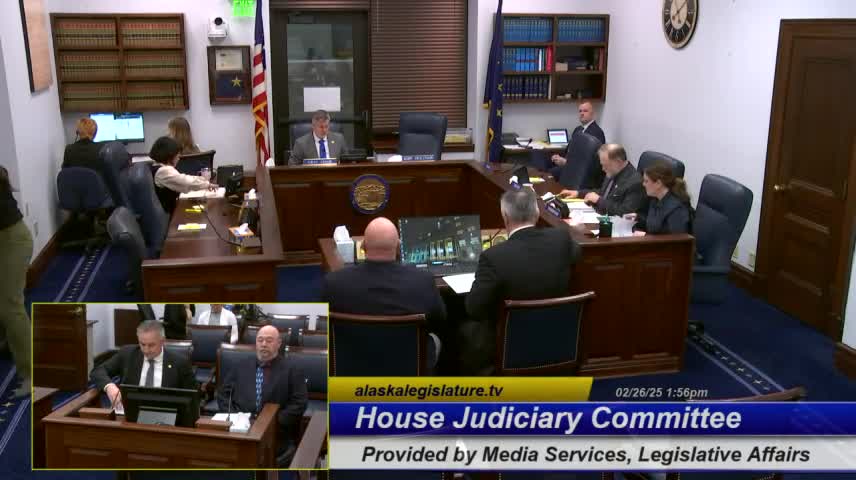
Representative Frank Tomaszewski told the House Judiciary Committee on Feb. 26 that House Bill 74 would create an airbag-fraud offense that makes it a class A misdemeanor to knowingly sell, install or manufacture counterfeit or nonfunctioning airbags and a class C felony if death or serious physical injury results. "In Alaska today, there is no law to prohibit the installation or reinstallation of airbags that do not meet federal safety standards," Tomaszewski said, explaining that the bill was brought to the legislature by automakers and the Automotive Anti-Counterfeiting Council.
David Goff, staff to Tomaszewski, summarized the bill’s provisions and scope. The bill would add a new section to AS 28.35 defining "airbag fraud" to cover counterfeit or nonfunctioning airbags and to set criminal penalties. The draft includes explicit exclusions for parties who lack knowledge — for example, vehicle owners, employees of dealerships, and insurers disposing of totaled vehicles — and states that it does not create a duty to inspect a vehicle for counterfeit or nonfunctioning airbags before sale. The bill also preserves civil liability: it does not preclude other civil claims.
Craig Orland, director of local and state government relations for American Honda Motor Company, described industry evidence of counterfeit and unsafe replacement airbags and supported the bill. "We've seen airbags filled with all sorts of debris, such as sawdust, newspaper, rag, trash bags, and t shirts," Orland said, adding that some counterfeits have been dangerous enough to require bomb-squad response when authorities intercepted shipments. He told the committee the products primarily originate overseas and that state law would facilitate cooperation with federal enforcement and prompt e-commerce platforms to delist dangerous products.
Committee members asked why the bill exempts insurers that sell or dispose of totaled vehicles and why the statute does not impose a duty on dealers or owners to physically inspect airbags. Orland and staff said physical inspection of airbags requires removal and diagnostic work and would impose an impractical burden if required for every vehicle transfer; they noted modern vehicles have diagnostic systems that indicate airbag faults when they exist. Tomaszewski said he raised the bill after a family collision in which his own airbags deployed and observed the difference safety-compliant devices can make.
No amendments were adopted at the hearing and the committee set the bill aside for later action. The sponsor set an amendment deadline for Feb. 28 at 5 p.m.