Get Full Government Meeting Transcripts, Videos, & Alerts Forever!
Get email alerts on the Red Dog Nana Teck topic
No spam. Unsubscribe anytime.
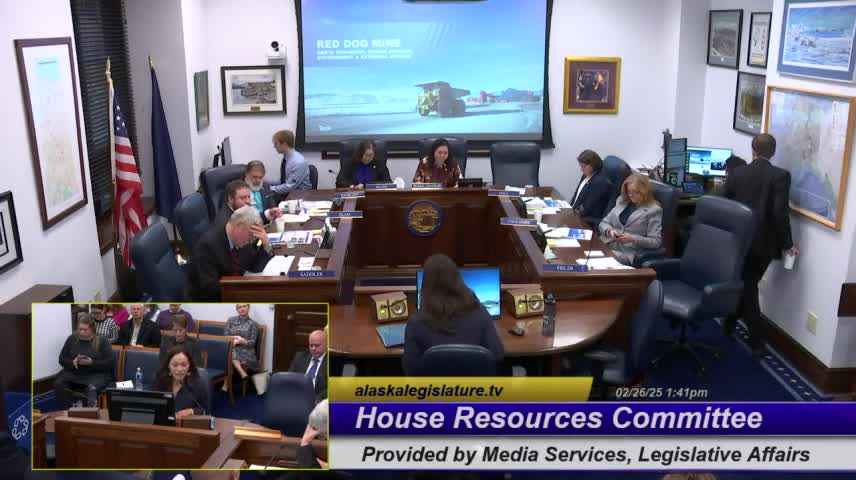
Teck and NANA ties: Red Dog’s shipping, royalties and workforce highlighted to House Resources Committee
Summary
Teck’s Red Dog operation and its partnership with NANA drive substantial regional revenues and jobs, company adviser Greta Shirk told the committee, noting a mine life through 2031 on NANA lands and ongoing exploration on adjacent state lands to potentially extend operations.
Greta Shirk, senior advisor for government and external affairs for Teck Alaska, summarized Red Dog Mine’s operations, regional economic ties and workforce figures in testimony to the House Resources Committee on Feb. 26.
Shirk said Red Dog is a major regional economic engine tied closely to NANA and the Northwest Arctic Borough. “Red Dog is the sole tax or taxpayer to the Northwest Arctic Borough,” she said, and the company’s payments-in-lieu-of-taxes and royalty arrangements underpin municipal and regional budgets. Under current agreements, Red Dog pays into a village improvement fund with a floor and ceiling that Shirk said runs from $4 million to $8 million annually, and a village commission allocates those funds to local infrastructure and energy projects.
The nut of Shirk’s presentation was that Red Dog’s operations provide direct and indirect jobs, significant shareholder distributions through ANCSA 7(i)/7(j) frameworks, and logistical challenges and benefits tied to Arctic operations. She told the committee Teck employed about 653 regular staff as of December 2024, “53% of which are NANA shareholders,” and that the broader seasonal workforce can push total personnel toward about 1,000. She also said roughly 73–74% of employees are Alaskans.
Logistics and shipping are central to Red Dog’s operations. Shirk described a short shipping season of roughly 100 days and said the mine uses the DeLong Mountain Transportation System and a port about 53 miles from the pit. She said the mine runs eight diesel generators (about 5 megawatts each) and burns roughly 40,000 gallons of diesel daily to power operations. The operation ships roughly 1.2–1.3 million metric tons of concentrate annually, Shirk said.
Shirk described ancestral and modern governance arrangements: the 1982 operating agreement and later arrangements built hiring preference tiers for NANA shareholders, with residents of Noatak and Kivalina given priority, then other NANA shareholders, and then Alaska shareholders. She also reviewed ANCSA 7(i) and 7(j) distributions and warned the committee the 7(i)/7(j) flows tied to Red Dog’s production on NANA lands are expected to change if on‑land deposits are exhausted — the company’s permited mine life on NANA lands currently runs through about 2031.
On exploration, Shirk said Teck is building an access road to state‑land deposits (Anurak and Akdigoruk on the presentation map) to allow year‑round drilling and testing; the company estimates an additional five years of exploration will be required before determining whether those state‑land deposits are economic and could extend mine life beyond 2031.
The committee asked about safety, shipping season variability and workforce programs; Shirk described safety programs, apprenticeship and shareholder development investments, and the operation’s subsistence committee that advises on harvest and marine issues. No formal committee action or vote followed the presentation.