Get Full Government Meeting Transcripts, Videos, & Alerts Forever!
Get email alerts on the Organized Retail Theft topic
No spam. Unsubscribe anytime.
House bill would create organized retail theft offense and 2% marketplace fee to fund enforcement
Summary
Representative Zach Fields told the House Judiciary Committee that House Bill 97 would define organized retail theft in statute, lower theft-value thresholds and impose a 2% sales tax on marketplace facilitators to fund law enforcement.
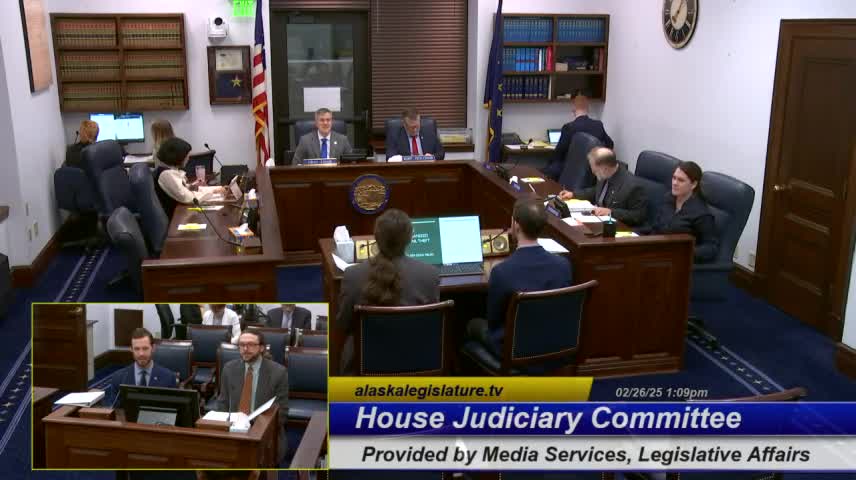
Representative Zach Fields, sponsor of House Bill 97, told the House Judiciary Committee on Feb. 26 that the bill would create a statutory organized retail theft offense, lower monetary thresholds for theft classifications and add a 2% sales tax on marketplace facilitators to fund enforcement. "States across the country have passed laws to combat organized retail theft," Fields said, and he cited a Homeland Security definition describing organized retail crime as "the association of 2 or more persons engaged in illegally obtaining items of value from retail establishments through theft and or fraud as part of a criminal enterprise."
Fields said retailers in Anchorage and elsewhere are responding to rising theft with locked displays, chains and private security, and that large online marketplaces make reselling stolen goods easier. "This is not just individual desperate people trying to steal things," he said. He and invited small-business testifiers described repeat incidents in which groups take amounts below felony thresholds at multiple stores in a single day to avoid higher penalties.
John Stazer, who identified himself as representing Mountain View Sports Center, said the losses have been "staggering" and supported HB 97's combination of criminal changes and a third-party seller tax. "There's an entire industry profiting from the resale of stolen merchandise," Stazer said. Deborah Benito of Sourdough Mercantile also testified in support, saying thieves "know the law, and they know to stay below the threshold."
Evan Anderson, staff to Representative Fields, walked the committee through the bill's sectional changes to Alaska Statutes. The proposal amends theft definitions in AS 11.46 to lower thresholds across theft-in-the-first- through fourth-degree provisions, adds a new section defining organized retail theft (AS 11.46.215), and makes conforming changes in related theft and fraud provisions. It also amends sentencing law (AS 12.55.155(c)) to allow courts to treat organized retail theft as an aggravating factor and adds a new Title 43 chapter (43.72) to impose a 2% tax on marketplace facilitators, with a $250,000 annual sales or 200-transaction registration threshold and a provision creating an organized retail theft fund in the general fund. The sponsor also proposed an immediate effective date via uncodified language.
Deputy Attorney General John Skidmore told the committee how HB 97 differs from the administration's organized-theft proposal. Skidmore said the administration's bill lacks the marketplace tax, uses different monetary thresholds, and treats some categories of organized theft more broadly (for example, including cargo-in-transit losses). He said Representative Fields' bill creates a new theory of theft specific to commercial retail and that Fields' bill uses a two-person threshold to define organized retail crime, while the administration's bill uses three or more people. Claire Bradford of Legislative Legal Services advised there is a small risk of a single-subject challenge and a small equal-protection risk tied to taxing only marketplace facilitators, though she said courts typically require only a rational relation to a legitimate purpose.
Committee members asked about practical limits and drafting choices. Representative Mena asked whether informal platforms such as Instagram could fall within the marketplace facilitator definition; sponsors and Legislative Legal Services said they would refine language and consult with stakeholders. Representatives also asked where the $250,000/200-transaction threshold originated; staff said it was raised in response to stakeholder feedback from last year's version and is subject to amendment. Several members pressed on whether lowering theft thresholds might simply change offenders' tactics; Fields and staff said the intent is to reduce the economic pressure on local retailers and that anecdotal testimony suggests current thresholds enable repeated low-value thefts that cumulatively cause severe losses.
No formal vote was taken; the committee set the bill aside for later consideration. The hearing record shows invited testimony from two small-business witnesses and legal briefing from the deputy attorney general and Legislative Legal Services.