Get Full Government Meeting Transcripts, Videos, & Alerts Forever!
Get email alerts on the Mining Greens Creek Hecla topic
No spam. Unsubscribe anytime.
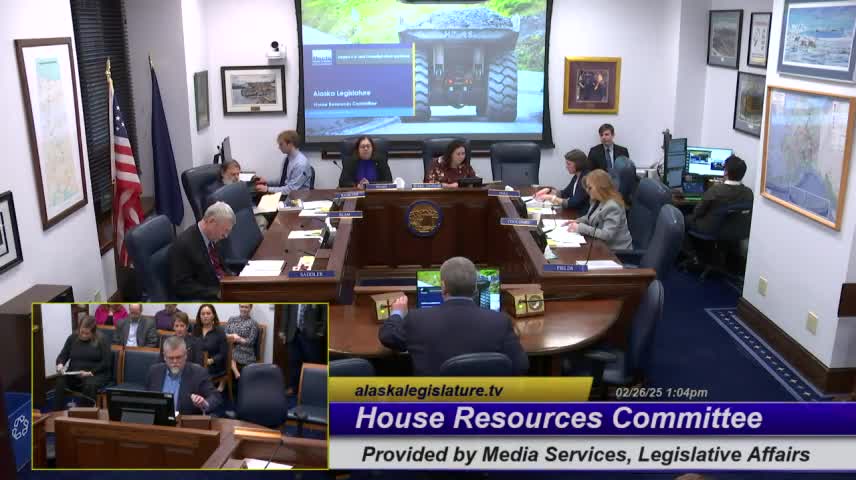
Hecla presents Greens Creek finances, workforce and tailings plan to House Resources Committee
Summary
Hecla Mining told the Alaska House Resources Committee on Feb. 26 that Greens Creek — a long-running underground mine near Juneau — faces rising costs, projects roughly a 12-year mine life, and received approval last year to expand its tailings capacity through at least 2040.
Mike Satri, director of government affairs for Hecla Mining Company, told the House Resources Committee on Feb. 26 that Greens Creek is a major U.S. silver producer facing higher operating costs and a constrained market for concentrate processing.
Satri said Hecla “is the largest silver producer both in The United States and Canada,” and emphasized silver’s growing industrial role, particularly for photovoltaic cells. He told the committee Greens Creek currently has “a mine life of about 12 years” and that the company received approval last year, through a supplemental environmental impact statement process, to expand its tailings facility and secure space through at least 2040.
The nut of Satri’s presentation was twofold: Greens Creek remains an economically significant operation for Southeast Alaska, but global market and cost pressures are changing its near‑term economics. Hecla reported it expects to produce roughly 8.1–8.8 million ounces of silver next year, will spend about $60 million in capital on site improvements, and cited roughly $290 million in total projected costs for that production year. Satri also said the company has invested more than $1 billion in the mine and has generated more than $2 billion in free cash flow since the operation began.
Committee members pressed on costs, processing capacity and workforce. Satri told lawmakers the U.S. lacks domestic smelting and refining capacity for the concentrates Greens Creek produces; the mine ships zinc and lead concentrates that require outside refiners. He warned tariffs or trade negotiations could increase costs and complicate exports, saying concentrate sales “can be quite the complicated market.”
On workforce and local ties, Satri said Greens Creek employs about 520 people, roughly 52% of whom live in Alaska and about 32% of whom live in Juneau. He described the operation as largely fly‑in/fly‑out to remain competitive on pay and schedules, and said Hecla partners with the University of Alaska Southeast and other training programs to develop local trades and technical staff.
Satri described Greens Creek’s mining and processing cycle and noted environmental and reclamation work. He said roughly half of tailings are trucked to the port while the other half are mixed with cement and placed underground to support mined areas; Hecla has used dry‑stack tailings at its Hock Inlet facility. He also said Hecla is working with the University of Alaska Fairbanks and private companies on pilot methods to recover additional critical minerals from the mine’s tailings and that, on paper, those tailings contain significant gross metal value — although recovery would carry costs and require further work.
On safety, Satri said Greens Creek’s record shows no fatalities over its history and that the company’s reportable incidents to MSHA in recent years have tended to be minor personal injuries such as sprains. He told the committee Hecla conducts root‑cause analysis and maintains onsite medical capability for serious incidents.
The committee did not take formal action on the presentation. Satri said he and Hecla remain available to answer follow‑up questions and suggested arranging another site tour for members.