Get Full Government Meeting Transcripts, Videos, & Alerts Forever!
Get email alerts on the State Of The City topic
No spam. Unsubscribe anytime.
City manager outlines 2024 ‘state of the city,’ focusing on recovery, housing and infrastructure
Summary
City Manager Bill Burrow delivered a State of the City report summarizing 2024 recovery from severe weather, housing initiatives, new zoning code rollout, infrastructure investments and public-safety metrics.
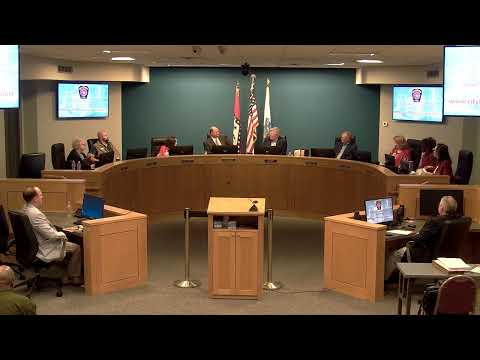
City Manager Bill Burrow delivered the Hot Springs City state of the city report, saying it is “my privilege to deliver the state of the city address” and summing up 2024 accomplishments and remaining priorities.
Burrow told the board that the city recovered from an April storm and an EF-2 tornado that left a 12-mile path of damage impacting 243 homes and six businesses. He credited city workers, utilities and volunteers for restoring power and clearing roads within a week and for processing debris: “the Hot Springs compost facility processed 36,000 cubic yards of green waste” and public works hauled “1,339 tons of ash” to the landfill following controlled burning of debris.
The report outlined multiple policy and capital items. Burrow said the city awarded a contract to IPS for a new integrated smart parking system with mobile payment, kiosks and license-plate recognition, and that the council updated parking penalties and zones as implementation begins. On housing, he described progress on a 10-year housing plan, zoning changes to allow modern manufactured homes and accessory dwelling units, staff work on a land-bank concept (which staff determined is not cost effective), and a $750,000 Paul Bruin historic revitalization grant to convert historic properties to affordable housing. He also said a pro-housing grant application to HUD is under review.
Burrow reviewed the new zoning and development code, “Code Forward,” adopted in November 2024 and set to take effect March 1, 2025, and said staff prepared user manuals and training for the rollout. He described environmental and utility investments, including a Gulf of Basin pump station now “over 35% complete” and a Davidson wastewater treatment upgrade planned at $35 million to expand capacity.
On economic data, Burrow reported that the city collected $29,148,000 in sales tax revenue in 2024 and that advertising and promotion tax collections rose 2.61% year over year. He noted continued tourism and hotel investment, referenced Oaklawn’s performance and ongoing hotel renovations downtown, and said casino revenues were $5,200,000 (an 8.5% increase over the prior year).
Public-safety metrics were a central part of the report. Burrow highlighted a 14.77% decrease in property crimes and a 31.1% drop in shots-fired calls in 2024, crediting technologies such as ShotSpotter and targeted enforcement. He also reviewed Fire Department activity—3,100 calls, 85 structural fires, an average response time of 4 minutes, 36 seconds and $55,000,000 in property preserved—and Animal Services activity, including 2,582 calls and a 41% increase in calls handled.
Burrow closed by emphasizing fiscal strength: a general fund reserve of $10,600,000 and an unreserved balance of $31,500,000, and by reiterating the city’s focus on quality of life and growth in 2025.
Mayor Pat McKay and several directors asked follow-up questions during and after the presentation. Director Phyllis Beard asked about scheduling a landlord summit in March to connect landlords with HUD and the Hot Springs Housing Authority; Burrow said staff were trying to confirm availability. Directors also requested additional parcel-level detail about Code Forward map changes and clarification about timing for demolition work at the former Saint Joe Hospital site as it moves through environmental surveys and EPA processes.
Burrow’s address was the city manager’s formal annual report and was presented as the city manager’s report during the meeting; directors raised scheduling and implementation follow-ups rather than taking immediate additional policy votes.