Get Full Government Meeting Transcripts, Videos, & Alerts Forever!
Get email alerts on the Commercial Wind Solar Incentives topic
No spam. Unsubscribe anytime.
Committee advances SB 192 (5th Sub): adjusts wind and solar incentives to require storage tied to peak daily generation
Summary
The House Public Utilities and Energy Standing Committee voted unanimously to advance SB 192, Fifth Substitute, which modifies commercial wind and solar incentives by adjusting exemption dates and tying required storage to peak daily generation for qualifying systems.
The House Public Utilities and Energy Standing Committee voted unanimously to advance SB 192, Fifth Substitute, which modifies commercial wind and solar incentives by adjusting exemption dates and tying required storage to peak daily generation for qualifying systems.
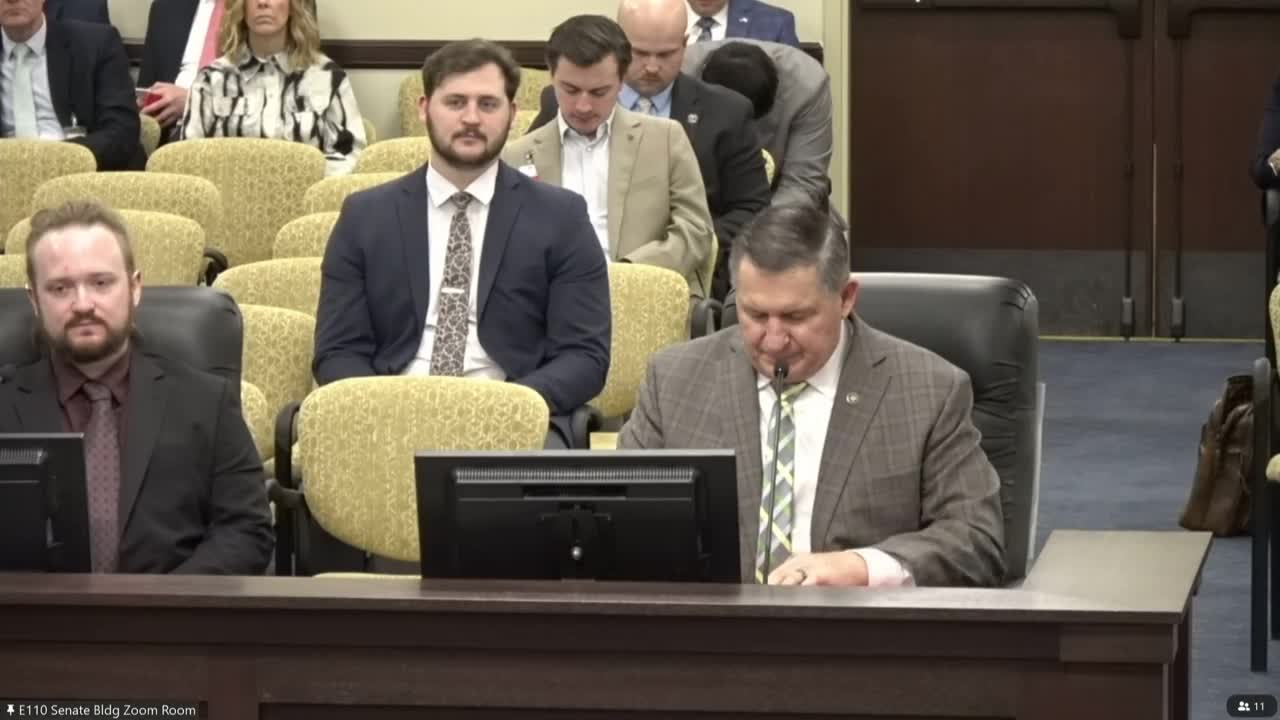
Senator Owens, the bill sponsor, described the fifth substitute as a change “to adjust the energy storage requirement exemption dates and moves it from a May 7 to January 1, just so no gaming could take place that someone went and signed a place into the queue, just to hold the spot.” The change aims to reduce opportunities for projects to secure queue positions without real intent to build.
The bill requires commercial wind and solar generating facilities of 660 kilowatts or more to include storage systems sized relative to peak daily generation. Tim Kowalczyk, emerging technology strategist at the Office of Energy Development, told the committee: “The big change that you'll see here or what the generation is tied to, what the storage is tied to is, peak daily generation, which simply says, go out and find your most generating month. That's what you'll size your storage to.” Kowalczyk added that the statute pins the storage requirement to a “range of usefulness” and that the numeric requirement could be adjusted as technology and industry practice evolve.
Committee members pressed for technical clarifications. Representative Albrecht asked whether the 660 kilowatt threshold refers to nameplate or operating capacity; Kowalczyk confirmed the existing code uses nameplate capacity. On the question of required discharge hours, sponsor Senator Owens said the intent is to “stretch the industry,” noting there are 6-hour systems now but they are rare; Owens said he had initially proposed 12 hours but settled on 6 after consulting with industry. Kowalczyk clarified: “The 6 hours required here is not the same as saying a 6 hour battery. ... The 6 hour requirement pinned to daily net generation does not mean you need to have a 6 hour battery to provide that much generation. You could fill it with whatever storage you wanted to do.”
The committee also discussed dispatch: whether utilities would call dispatchable storage for peak periods. Kowalczyk and Senator Owens said utilities would be the likely dispatchers and that incentives would be tied to the storage being called upon during peak need. Senator Owens and Kowalczyk noted the substitute also includes tail provisions to account for projects already in development and that other pending bills could later alter or cut off incentives in future years.
There were no public commenters for or against the bill at the committee hearing. Representative Shipp moved to adopt the fifth substitute and moved that the committee give SB 192, Fifth Substitute, a favorable recommendation; the chair called the question and said the motion passed unanimously. Senator Owens provided a summation following the vote and thanked industry participants who assisted in crafting the language.
The bill advanced in committee and will proceed to the next stage of the legislative process; committee members requested additional fiscal and production-credit payout figures, which were not provided at the hearing.