Get Full Government Meeting Transcripts, Videos, & Alerts Forever!
Get email alerts on the Children Online Privacy topic
No spam. Unsubscribe anytime.
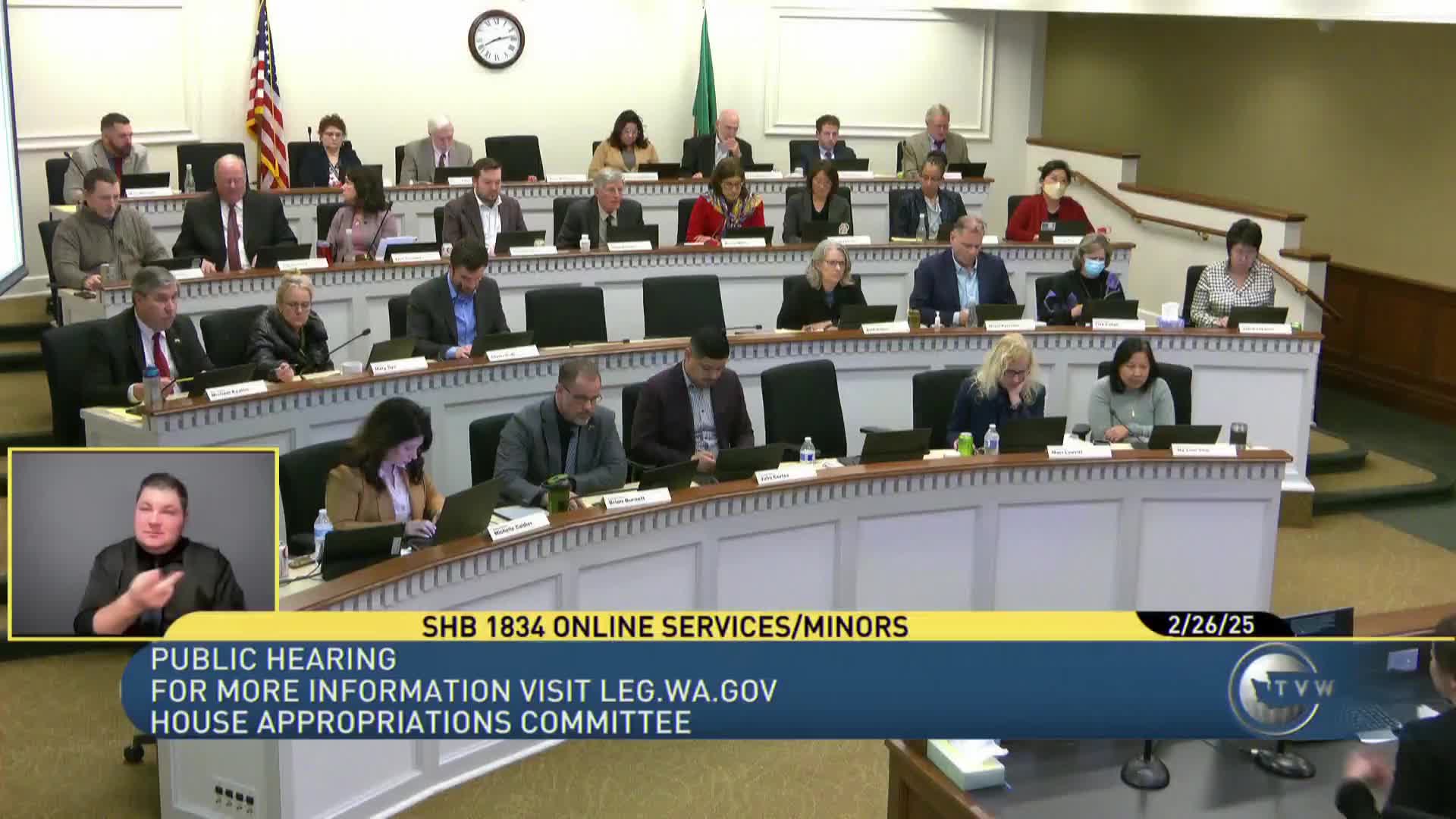
Committee hears competing views on bill to restrict online ‘addictive feeds’ and strengthen minors’ privacy
Summary
Substitute House Bill 18-34 would impose age-estimation, limit collection and use of minors’ personal and location data, restrict nighttime/school-hour notifications and ban ‘addictive feeds’ targeted to minors; supporters cited child mental-health benefits, opponents raised First Amendment and implementation concerns.
Megan Mulvihill, staff to the Consumer Protection and Business Committee, told the committee Substitute House Bill 18-34 would establish requirements for online services, products or features likely to be accessed by minors, including age estimation or applying minor-level privacy protections to all users.
Mulvihill said the bill would restrict collection, sale, sharing and retention of minors’ personal information and precise location data, bar profiling and “dark patterns,” require high-default privacy settings for minors, and require an obvious sign when minors are being tracked. The bill would also limit notifications to minors during school hours and nighttime, and it would prohibit operators from delivering an “addictive feed” to a minor.
Megan Mulvihill and Jessica Van Horn told the committee the Attorney General’s Office would have enforcement responsibilities under the Consumer Protection Act; Van Horn said a fiscal note was not yet available and that enforcement costs are indeterminate but could include litigation and investigation expenses. Adam Iman, legislative director in the Attorney General’s Office, testified in strong support and said the office was preparing an amendment to address concerns about retaining age-verification data for limited purposes.
Representative Kallen, the bill sponsor, described the legislation as an attempt to reduce harms to children from algorithm-driven content and notifications, citing public-health trends in youth anxiety, depression and suicidality. “This legislation is all about trying to make a difference,” Kallen said, adding that platform tools and parental controls are insufficient to address algorithmic design that personalizes addictive content.
Industry witnesses warned of constitutional and operational issues. Rose Feliciano of TechNet opposed the bill and said defending similar laws in court could cost the state millions. Amy Boss of NetChoice said the U.S. Supreme Court has construed personalized social-media feeds as protected expression and urged lawmakers to await pending litigation in other states. Morgan Owen of the Association of Washington Business said the bill’s data-retention rules could block platforms’ existing teen-account tools.
Takumi Nishita, special advisor for youth behavioral and environmental health to Governor Ferguson, and Dr. Stephan Blanford, executive director of Children’s Alliance, urged passage, saying the bill would protect children’s well-being and could reduce demand for later clinical intervention.
Committee members asked whether age-verification rules might interfere with law-enforcement investigations; Adam Iman said he believed the bill allows lawful investigative access but said he would confirm with his team. The hearing concluded after public testimony and staff briefing; no formal vote was taken.