Get Full Government Meeting Transcripts, Videos, & Alerts Forever!
Get email alerts on the Education topic
No spam. Unsubscribe anytime.
Senate Education Committee advances nominees, adopts policies and moves several education measures to calendar
Summary
The Senate Education Committee met to consider confirmations, standards and textbook appointments, and multiple bills. The committee moved a slate of nominations to the calendar, approved measures on safe-haven education and other K–12 items for further consideration, and debated changes to parental leave and virtual-school rules.
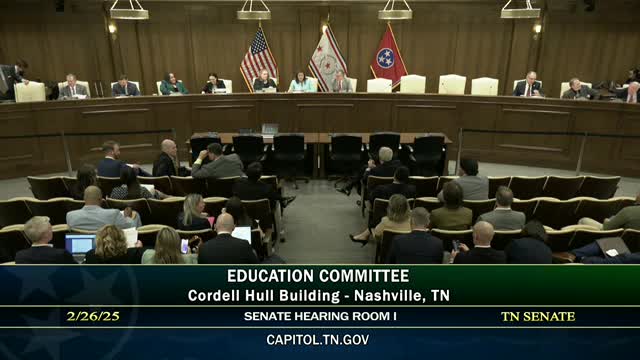
The Tennessee Senate Education Committee met in session to consider nominations, standards-committee appointments, and a package of education bills and resolutions. Committee members heard brief testimony from nominees for the Public Charter School Commission and for English language arts standards committees, reviewed a textbook commission reappointment, and debated several bills before moving most to the committee calendar or next committee stop.
The meeting opened with confirmations for the Public Charter School Commission. Eddie Smith introduced his five years of service on the commission and said the body had worked to “stand up” the commission, hire an executive director and set academic and business operations policies. Terrence Patterson, chair of the commission’s academic accountability committee, said the commission’s priority is “to authorize more high-quality schools and school options across the state” and described his experience as a district chief of staff and parent.
The committee then considered nominations to the English language arts standards committee. Lucas Hillard and Brittany Singletary each described their classroom experience—Hillard as an AP and high-school English teacher and Singletary as a fifth-grade teacher who said she uses the standards daily in planning. Senators questioned nominees about standards wording, grade-level focus, and how the standards relate to curriculum and text selection; candidates emphasized that standards define expected skills while curriculum decisions (choice of texts) are separate.
Later the committee reviewed a reappointment to the Textbook and Instructional Materials Commission. Billy Bridal (listed as a high-school teacher at Millington High School) provided his background and described the commission’s process of recruiting Tennessee teachers to serve as reviewers for subject adoptions.
On legislation, sponsors presented bills that the committee largely approved to move forward. Senator Massey explained SB 319 as requiring instruction about Tennessee’s Safe Haven law to be incorporated into health or family-life courses, and the committee approved the bill for placement on the calendar. Senator Massey also presented SB 612, a recurring $5 million grant fund to support career and technical education (CTE) instructional materials; the committee moved that bill to finance. Other measures discussed included a proposed last-dollar early-education scholarship (described by the sponsor as a “Promise and Futures” concept) and a resolution to designate March as Tennessee Athletic Trainers Month; the resolution was placed on the calendar.
A cleanup and modernization bill from the Department of Education (filed as SB 1272 with technical amendments) prompted most discussion about parental-leave language. The department explained the amendment’s change to require that parental leave be taken in minimum one-week increments rather than in single days, noting the change was intended to balance districts’ staffing concerns with educator leave rights. Several senators voiced concern that the change could conflict with the original intent of uninterrupted leave after a birth or adoption; the department said it would provide more detailed tracking and implementation information to the committee.
Other topics addressed in question-and-answer included third-grade reading and literacy standards, how standards differ from curriculum/text selection, the size and staffing of district virtual schools, and the department’s proposal to convene a working group to recommend best practices for English learners. The committee also heard presentations from higher-education leaders—representatives from East Tennessee State University, the Tennessee Higher Education Commission and Middle Tennessee State University—who reviewed enrollment, capital-maintenance needs and workforce programs.
Votes at a glance (committee action summary) - SJR 87 (Eddie Smith confirmation, Public Charter School Commission): moved to committee calendar (motion carried). - SJR 88 (Terrence Patterson confirmation, Public Charter School Commission): moved to committee calendar (motion carried). - SJR 121, SJR 120, SJR 119 and related standards appointments (English language arts standards committee nominees including Lucas Hillard and Brittany Singletary, Annie Dockery’s nomination noted as distributed but she was on bed rest): moved to calendar. - Billy Bridal (Textbook and Instructional Materials Commission): presentation made; confirmation deferred to next week (no committee vote today). - SB 319 (require Safe Haven law instruction in health/family-life courses): favorable recommendation to calendar. - SB 612 (CTE curriculum funding; $5,000,000 recurring grant fund administered by Department of Education): moved to finance committee. - SB 802 (Promise and Futures child-care/early-education scholarship concept): sponsor moved to General Subcommittee for further consideration. - SJR 45 (designating March as Tennessee Athletic Trainers Month): moved to calendar. - SB 246 (English learner strategy; Department of Education to convene working group and report findings by 2026-01-01): moved to calendar. - SB 1272 (Department of Education cleanup and modernization amendments, including parental-leave and virtual-school provisions): passed by committee as amended and moved to calendar; some members requested additional clarification from the department about parental-leave reimbursement and operational impacts.
Why it matters: The committee forwarded a mix of confirmations and bills that affect classroom instruction (for example, required instruction about the Safe Haven law), governance (charter authorizations and textbook panels), and school operations (parental leave, virtual-school caps, and support for CTE materials). Several items will now proceed to the full Senate calendar or to other committees for fiscal review.
What’s next: Confirmations and the measures moved to calendar will be scheduled for floor consideration. Bills that were routed to finance or general subcommittees will receive follow-up hearings or fiscal review. The Department of Education agreed to supply additional technical information requested by senators (for example, on parental-leave reimbursement mechanics and district reporting on leave use).