Get Full Government Meeting Transcripts, Videos, & Alerts Forever!
Get email alerts on the Homelessness Housing Senior Pilot Hrsn topic
No spam. Unsubscribe anytime.
Lane County Human Services outlines senior-housing pilot, Medicaid-funded housing supports and rent-assistance hub
Summary
Staff told commissioners the county will launch a senior-focused pilot with Lane Council of Governments, expand access to Medicaid 1115 HRSN housing services through coordinated care organizations, and operate a centralized rent/eviction prevention hub that dispersed $1.9 million in 2024.
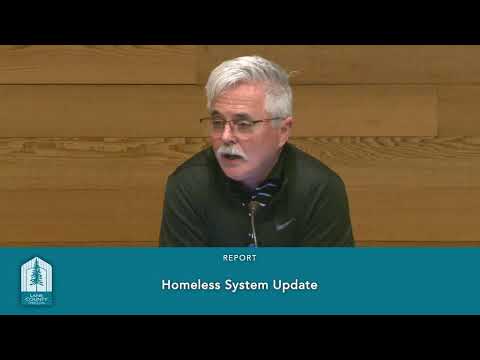
Lane County Human Services Division managers updated the Board of Commissioners on Feb. 25 about a multi-part effort to reduce homelessness among seniors, expand housing-related services funded by Oregon’s Medicaid 1115 waiver (Health-Related Social Needs, HRSN), and streamline rent and eviction-prevention assistance through a centralized hub.
Kate Budd, Human Services Division manager, said the county and partners have developed a pilot that will add two Lane Council of Governments (LCOG) complex care managers to focus solely on seniors experiencing homelessness. Budd said the pilot will use a "senior by-name list" and regular care-conferencing meetings to coordinate housing, clinical care, benefits and flexible funds for seniors. "The overall outcome for this pilot is for Lane Council of Governments to permanently house a hundred seniors, within about a year and a half period," Budd said.
James Ewell, homelessness and community action manager, reported that Lane County’s data show the majority of people entering the homeless services system were living in-county when they lost housing. "Seventy-nine percent of individuals have answered that they were residing in Lane County when they lost their housing," Ewell said, based on intake entries to the homeless management information system (HMIS) between July 2023 and the end of January 2025. Ewell said the sample includes nearly 13,500 individuals.
Staff also described implementation of the Medicaid 1115 waiver housing component, known in Oregon as HRSN. Stephanie Talbot, rent and energy assistance supervisor, said the HRSN housing services are aimed at Oregon Health Plan (OHP) recipients with clinical and social risk factors and that housing services under the waiver can provide up to six months of rent and utilities. She said the housing services require a current rent agreement or lease and that, as a result, the benefit is designed to stabilize people already in housing rather than directly house people who are currently unsheltered. Talbot said rent payments made under this program are reimbursable at 100% and that tenancy supports (case-management time) are billable in 15-minute increments.
Talbot said the HRSN eligibility criteria for housing include being an OHP enrollee, having an acute medical or mental-health diagnosis that creates clinical risk, and meeting a social risk threshold (defined for housing services as household income at or below 30% of area median income). Talbot and Budd said the human services division is contracting with both coordinated care organizations (PacificSource and Trillium) and local partners; some providers, such as Homes for Good, have already begun using the benefit in subsidized housing.
County staff said they are adding capacity to match a high local demand: staff reported a backlog of HRSN applications and said applicants from November were still being served. They also noted practical items still to resolve before full rollout, including integrating the Unidus/Connect Oregon data system with the local HMIS and ensuring a single, low-barrier application pathway through the county’s rent-assistance hub.
On the county’s existing rent-assistance programs, Talbot said the division’s 2024 in-house rent and eviction-prevention programs distributed roughly $1,900,000 to 75 distinct local landlords and that the county uses a hub model to simplify tenant access. Separately, the state’s landlord mitigation program — an executive-order fund to reimburse landlords for damage and lost rent — has a $20,000 limit per landlord claim; Budd said that mitigation cap will remain as the program transitions to state administration.
Commissioners asked about funding sources and sustainability. Budd said the senior pilot includes a lump-sum grant from the Lane Community Health Council (a PacificSource public-benefit partner) and that the HRSN services operate under Oregon’s Medicaid 1115 waiver (state contract with the Centers for Medicare & Medicaid Services) and are therefore subject to potential federal or state changes to Medicaid funding. Commissioners expressed support and also asked staff to provide dashboards and ongoing performance reporting.
Why it matters: County staff described programs intended to stabilize households and reduce the health harms associated with long-term homelessness — particularly among seniors — while using Medicaid funding and locally managed flexible funds to increase capacity and reduce landlord barriers.
What's next: Staff told the board they expect the senior pilot to begin in March and HRSN housing services to be available locally in April, pending final contracts and data-integration steps. County staff also said they will add dashboard reporting and integrate Unidus with the local HMIS to track outcomes.