Get Full Government Meeting Transcripts, Videos, & Alerts Forever!
Get email alerts on the Traffic Safety Impaired Driving topic
No spam. Unsubscribe anytime.
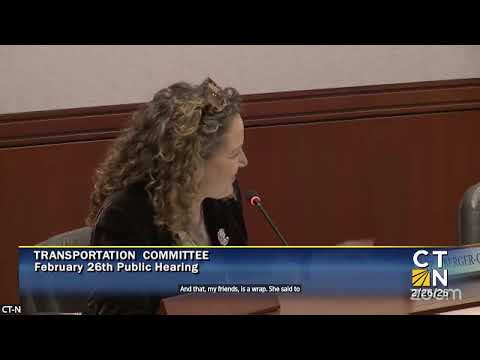
NTSB, state officials press Connecticut lawmakers to lower legal BAC to 0.05
Summary
Federal and state safety experts urged the Transportation Committee to approve legislation lowering Connecticut's per se blood-alcohol limit from 0.08 to 0.05, citing international experience, Utah's data and research on deterrence; debate focused on enforcement, equity and drug-impaired driving.
Tom Chapman of the National Transportation Safety Board told the Transportation Committee the NTSB "strongly support[s] legislation that will lower the legal BAC per se limit to 0.05." Chapman testified that more than 100 countries use a 0.05 or lower threshold and that Utah's experience showed a deterrent effect after the state lowered the limit, with no large increase in arrests. He cited national statistics showing alcohol remains a leading cause of fatal crashes and told lawmakers research indicates lowering the per se limit can reduce fatal alcohol-related crashes by roughly 11 percent.
Commissioner Gary Iucolito of the Connecticut Department of Transportation reinforced the safety argument. He described alcohol as "still very much our biggest problem in terms of impaired driving" and told the panel lowering the limit would "shift behavior and act as a deterrent." Several senators and representatives pressed Chapman and the commissioner on implementation questions: whether Utah's results were affected by tourism patterns or local laws, whether field sobriety tests and existing enforcement tools remain valid at the lower threshold, and how the state would handle interactions with drug-impaired driving.
Law enforcement and public-safety speakers emphasized enforcement resources and complementary tools. Questions at the hearing covered the limits of detectability between 0.04 and 0.05, the role of public education campaigns, and the importance of technologies such as ignition-interlock devices and in-vehicle impairment detection. Chapman and others stressed that 0.05 is not a single solution but a proven measure that, combined with enforcement and technology, can save lives.
Committee members asked for state-specific data and comparisons to other states. Witnesses said Connecticut has room to improve testing and data collection so that policymakers can track impacts precisely. The hearing included separate but related testimony on drug-impaired driving and the rising prevalence of cannabis combined with alcohol; the NTSB and DOT witnesses described polydrug impairment as an increasing concern and urged a multimodal response.
The committee heard political and operational questions about how the change would be communicated to drivers, how it would affect hospitality and tourism, and whether penalties or enforcement approaches should differ for the lower range between 0.05 and 0.08. Supporters argued that the primary benefit is deterrence and behavior change; opponents and cautious members sought more state-level evidence and assurances about enforcement fairness and resource needs. The hearing closed with requests that the agencies return with additional Connecticut-specific analyses and with continued committee discussion on companion enforcement and education measures.