Get Full Government Meeting Transcripts, Videos, & Alerts Forever!
Get email alerts on the Opioid Response Naloxone topic
No spam. Unsubscribe anytime.
Subcommittee backs resolution urging larger Narcan spending from opioid-abatement funds
Summary
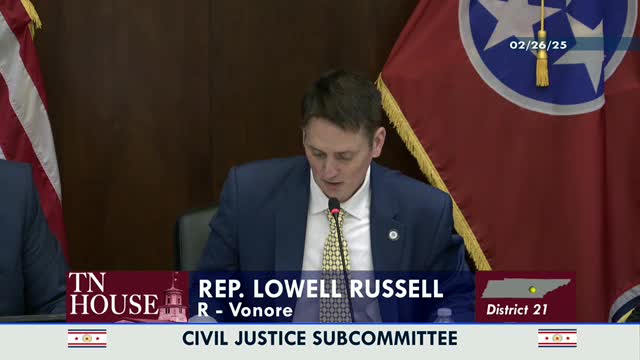
The Civil Justice Subcommittee voted unanimously to advance House Joint Resolution 100 calling for a larger share of Tennessee's opioid abatement funds to be used for naloxone (Narcan) distribution and public awareness.
Chairman Representative Faison of the Civil Justice Subcommittee on Thursday brought forward House Joint Resolution 100, urging a larger portion of Tennessee's opioid abatement funds be used to distribute naloxone and increase public awareness.
The resolution, which the subcommittee voted 7-0 to send to full judiciary, asks state decisionmakers to prioritize widespread access to naloxone (brand name Narcan) as part of the state's response to opioid and fentanyl overdoses.
The measure's sponsor, Representative Faison, framed the proposal as a life-saving immediate step while longer-term prevention is expanded. "If we claim to be pro life, we should be pro life throughout a human's life," Faison said. He told members Tennessee ranks near the top of states for opioid and fentanyl overdoses and described the proposal as an urgent use of settlement funds received following litigation against Purdue Pharma.
George Massengill, who identified himself as a person in long-term recovery and representative of the nonprofit Reach United, told the subcommittee a rapid public distribution of naloxone can reduce deaths. "We just launched a campaign in Fentress County ... We believe that by getting the public more well known about naloxone and to have that with them, that can save lives," Massengill said.
Members discussed both immediate distribution and the need for prevention and treatment capacity. Representative Davis emphasized the simplicity and safety of naloxone administration for lay responders: "It's a nasal spray, squirt it in your nose, somebody falls over, they're unresponsive." Representative Johnson said Medicaid expansion would increase access to mental-health and substance-use treatment, a point raised during the discussion but not reflected in the text of the resolution.
Representative Faison and Massengill offered numeric context during the discussion: the state has received roughly $1.2 billion from opioid-related settlements to be paid over 18 years, with $81 million noted as a recent disbursement; Massengill cited about 11 opioid-related deaths per day in Tennessee and approximately 100,000 yearly opioid deaths nationwide. The sponsor proposed using about 25% of the state's abatement funding in an initial push for naloxone distribution; Faison characterized that figure as an initial, non-scientific estimate intended to reduce deaths rapidly while prevention and treatment scale up.
The subcommittee took a voice/keypad vote to advance HJR100 to full judiciary; the clerk reported 7 ayes, 0 nos.
While members supported expanded naloxone access, several also pressed for stronger prevention and quicker treatment placement when people ask for help. Faison said current treatment capacity meant that of approximately 10 to 11 people who present for help at a medical facility in a day, only about five are seen immediately — a gap the sponsor said should be addressed alongside naloxone distribution.
The resolution will next be considered by the full judiciary committee.