Get Full Government Meeting Transcripts, Videos, & Alerts Forever!
Get email alerts on the Tenncare Private Duty Nursing topic
No spam. Unsubscribe anytime.
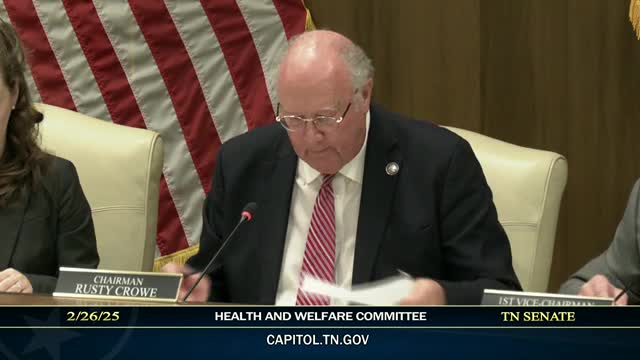
Committee sends 'Emma's Bill' to finance after emotional testimony on TennCare nursing rules
Summary
The Senate Health and Welfare Committee voted to send Senate Bill 650 — known as "Emma's Bill" — to the finance committee after parents of a young woman affected by TennCare rules testified and TennCare officials described fiscal and program constraints tied to a 12-hour ventilator threshold.
Senate Health and Welfare members voted to send Senate Bill 650, known in testimony as "Emma's Bill," to the Finance Committee after hearing emotional testimony from the patient's parents and a detailed explanation of current TennCare policy from agency officials.
The bill would require the TennCare Bureau to consider a patient's overall welfare — rather than treat the cost-of-alternative as a determinative prong — when reviewing coverage for private duty nursing and related supports. Sponsor Chairman Ferrell Crowe said the bill is intended to preserve coverage for people like Emma, a college freshman who suffered severe brain injury and later improved but no longer met the program's ventilator-time threshold that triggered eligibility for round-the-clock nursing.
Emma's father, Mark Harrod, and her mother, Jody Harrod, described Emma's medical course and the family care they provide. They told the committee that, after improvement reduced Emma's nightly ventilator use from 12 to eight hours, TennCare reduced the private duty nursing funding that paid for 24-hour nursing the family says Emma needs to prevent life‑threatening events such as aspiration.
Victor Reed, chief medical officer at TennCare, and Ashley Reed (division of TennCare) explained the agency's current practice: TennCare's adult private duty nursing benefit requires meeting several clinical conditions (including tracheostomy dependence and frequent suctioning) and defines ventilator dependence operationally as use for 12 hours or more. Reed said the 12‑hour clinical threshold is a state rule implemented by TennCare to align clinical criteria and control program costs. He described private duty nursing as costly and said the program must consider the cost of alternative settings (consumer-directed services, nursing facilities, etc.) when evaluating medical necessity. TennCare staff estimated more than 1,000 TennCare members receive some type of nursing service and said removing the cost-consideration prong would have a significant fiscal impact across the program.
Committee members pressed TennCare on whether the 12‑hour standard is federally mandated; Reed said the 12‑hour definition is part of TennCare's rules rather than an explicit federal standard, though federal requirements influence the overall benefit design. Several senators, including Sen. Hensley and Sen. Massey, expressed sympathy for families like Emma's and requested further work with TennCare to find an amendment that could address the family's circumstances while accounting for program fiscal limits.
Chairman Crowe said he would work with TennCare and stakeholders on possible amendments before the bill reaches Finance. The committee voted 9–0 to send SB 650 to the Finance Committee.
The committee also recessed briefly to allow Mark and Jody Harrod to testify at the microphones. Their testimony described Emma's hospitalization, hospice placement, slow improvement, ongoing 24‑hour care needs, and the family's unsuccessful appeal to a judge who cited the statutory/administrative 12‑hour standard.
The committee discussion and the agency's responses left open specific drafting choices; TennCare indicated it would analyze cost impacts and work with the sponsor on potential amendments prior to finance consideration.