Lifetime Citizen Portal Access — AI Briefings, Alerts & Unlimited Follows
Tennessee House Health Subcommittee advances multiple health bills; faith‑based childcare proposal fails after hearing
Loading...
Summary
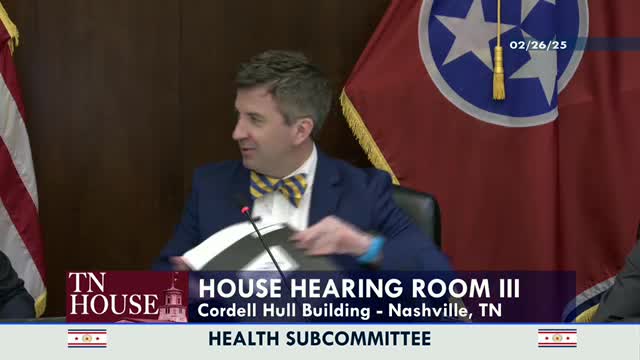
The Tennessee House Health Subcommittee on Feb. 26 approved a slate of health measures and a TASER study request, advancing bills on credentialing, death‑pronouncement authority and public‑health messaging while rejecting a proposal to create a faith‑based childcare grant program.
Tennessee House Health Subcommittee members on Feb. 26 advanced a group of health bills to the full Health Committee and considered a study resolution, approving several measures unanimously or by large margins and rejecting one notable childcare grant proposal after extended debate.
The meeting’s most contested item, House Bill 631, would have created a grant program within the Office of Faith‑Based and Community Initiatives that required the office to dedicate one third of its annual funds to grants for nonprofit and faith‑based childcare providers serving children ages 4 and younger. Representative John Clemons, the bill’s sponsor, said the program would prioritize ‘‘childcare deserts’’ and require participating programs to be licensed and to operate on an income‑based model that charges families no more than 7% of household income. The committee voted 2 ayes, 7 noes and the bill failed.
Why it matters: lawmakers who opposed HB 631 said the proposal duplicated recently expanded state grant efforts, raised transparency and fiscal‑note concerns about creating new administrative positions, and risked creating parallel bureaucracy instead of directing funds through existing programs.
What else passed: the subcommittee advanced measures that remove a World Health Organization reference from state code, update prior‑authorization language by deleting an obsolete statute, allow registered nurses in certain licensed facilities to pronounce death by removing the word "anticipated" from current law, add an additional national credentialing body for surgical first assistants to Tennessee statute, direct a TASER study on the state’s continuum of care for at‑risk populations, renew a sunset for 25 Medicare skilled‑nursing facility beds, modernize marriage and family therapy licensing terminology, and pass a House Joint Resolution urging congressional support for pilot HBOT treatment coverage for veterans. A bill titled the "Restore Trust in Public Health Messaging Act" also moved forward after public testimony.
Subcommittee highlights and debate
Childcare grant proposal fails after extended questioning: Representative Clemons told the committee, "Childcare is a serious problem across state of Tennessee, we have multiple childcare deserts," and described the bill’s requirement that 1/3 of the office’s annual appropriation be used to fund licensed nonprofit and faith‑based childcare providers that cap family fees at 7% of household income. Opponents pressed on transparency and duplication: Representative Alex Leatherwood and Chairman Williams questioned the fiscal note, pointing to an estimated $348,000 cost for four new positions and arguing that the state already expanded a grant program to include for‑profit providers. Clemons said he did not have the office’s full budget figures and that the bill aimed to direct existing money to childcare, not to create unnecessary bureaucracy. The vote failed, 2–7.
Public‑health messaging bill moves forward after witness testimony: Representative Susan Lynn sponsored HB 1157, the Restore Trust in Public Health Messaging Act, which would require state public‑health messaging about FDA‑regulated products (including vaccines, masks and emergency‑use products) to adhere to FDA product labeling and related approvals. Two witnesses—Bernadette Prager and Dr. Denise Sibley—spoke in support. Prager said she has advocated for "fully informed consent and scientific integrity in public health policy," and described public distrust arising during COVID. Dr. Sibley, a private‑practice internist, told the committee she had concerns about Department of Health guidance recommending co‑administration of multiple seasonal vaccines without cited safety data. Representative McKenzie and others questioned the scope and linkage between product labeling and non‑product interventions like masks. The subcommittee approved the measure, 6 ayes, 2 nos and 1 present not voting.
Death pronouncement statute amended to remove "anticipated": Representative Chris Hale’s HB 155 (as amended) removes the word "anticipated" from the statutory criteria that allow registered nurses employed by hospitals, nursing homes or assisted living facilities to pronounce death when a physician has an agreement with the facility. The sponsor said the change is intended to streamline processes—particularly in rural areas—and avoid unnecessary ambulance transports and delays for families. The bill passed, 9–0.
Credentialing for surgical assistants expanded: HB 186 adds the American Board of Surgical Assistants (ABSA) to Tennessee’s list of approved credentialing bodies for hiring surgical technicians/first assistants. Sponsor Representative Slater said ABSA has more than 30 years of certifying surgical assistants and that adding the board would increase workforce capacity while maintaining patient safety. Representative McKenzie expressed concern about "watering down" standards by adding credentialing options; the sponsor said the change reflects request from employers and affected practitioners. The bill passed, 9–0.
Continuum‑of‑care TASER study approved: HB 1192 requests a TASER study of Tennessee’s continuum of care and the state’s support for local NGOs serving at‑risk populations. Sponsor Representative Supiki asked TASER to review state agencies’ processes and local delivery so the legislature would have recommendations next year. Chairman Williams encouraged confirming TASER’s timeline with the director before finalizing a due date. The study request passed, 9–0.
Other measures advanced: HB 1074 (sponsor Garrett) deletes an earlier prior‑authorization statute made redundant by later law (committee amendment deleted the bill’s language and the measure advanced, 9–0). HB 1226 (Representative Lafferty) removes references to the World Health Organization from Tennessee code and passed by voice vote with a recorded result of 6 ayes, 2 nos. HB 584 renews an annual allotment of 25 Medicare skilled‑nursing facility beds through June 30, 2029 (9–0). HB 959 modernizes terminology for marriage and family therapy licensing (replace "temporary" with "associate," rename some exam language) and moved forward, 8 ayes, 0 nos and 1 present not voting. HJR 1, urging Congress to support veteran access to hyperbaric oxygen therapy for TBI/PTSD, carried by Representative Reedy, passed, 9–0.
Votes at a glance
- HB 1226 (remove WHO reference from code): passed; tally reported 6 ayes, 2 nos. (sponsor: Representative Lafferty) - HB 1074 (delete obsolete prior‑auth language; amendment deleted bill language): passed; 9 ayes, 0 nos. (sponsor: Representative Garrett) - HB 631 (faith‑based childcare grant program; one‑third funding requirement, 7% family cap): failed; 2 ayes, 7 nos. (sponsor: Representative Clemons) - HB 155 (allow registered nurses in specified licensed facilities to pronounce death by removing "anticipated"): passed; 9 ayes, 0 nos. (sponsor: Representative Hale) - HB 186 (add ABSA to approved credentialing bodies for surgical assistants): passed; 9 ayes, 0 nos. (sponsor: Representative Slater) - HB 1192 (TASER study of continuum of care for at‑risk populations): passed; 9 ayes, 0 nos. (sponsor: Representative Supiki) - HB 1157 (Restore Trust in Public Health Messaging Act — require adherence to FDA product labeling in state messaging): passed; 6 ayes, 2 nos, 1 present not voting. (sponsor: Representative Lynn) - HJR 1 (urging Congress to support HBOT pilot for veterans with TBI/PTSD): passed; 9 ayes, 0 nos. (sponsor: Representative Reedy) - HB 584 (renew 25 Medicare SNF beds through 6/30/2029): passed; 9 ayes, 0 nos. (sponsor: Representative Atchley) - HB 959 (modernize marriage and family therapy licensing terminology): passed; 8 ayes, 0 nos, 1 present not voting. (sponsor: Representative Hemmer)
What the committee asked staff to follow up on
- Request for the Office of Faith‑Based and Community Initiatives’ current budget and spending details (raised repeatedly during HB 631 debate). - Clarify TASER’s capacity and timeline for HB 1192 study (Representative Williams asked sponsor to coordinate with TASER director before the full committee). - Several members asked staff to provide or confirm fiscal‑note assumptions for HB 631, including the $348,000 administrative estimate and the assumed four positions cited in the fiscal analysis.
Speakers and witnesses quoted in this report
Representative Lafferty (sponsor, HB 1226); Representative John Clemons (sponsor, HB 631); Representative Matthew Garrett (sponsor, HB 1074); Chairman Williams (committee member); Representative Susan Lynn (sponsor, HB 1157); Bernadette Prager (public witness); Dr. Denise Sibley (public witness). Exact quotes are taken from the subcommittee transcript and attribution is limited to the speakers recorded during the Feb. 26 session.
Next steps: approved bills will be scheduled for full Health Committee consideration. Several sponsors said they expect technical amendments before full committee or on the floor; HB 631’s sponsor indicated he would keep working on childcare options despite the defeat in subcommittee.